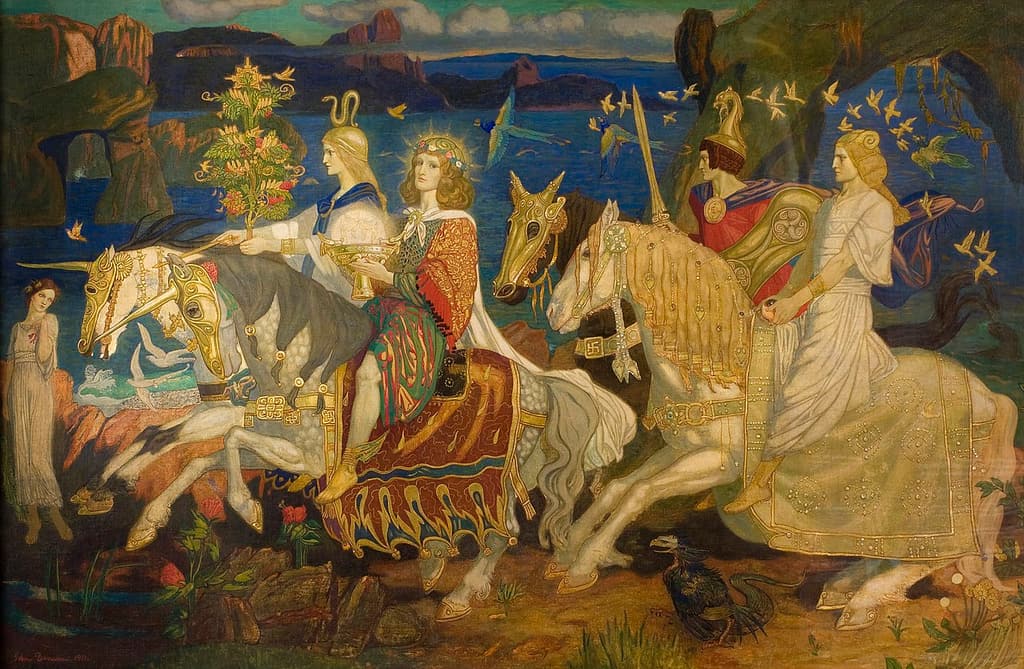
The single most important thing to know about the Tuatha Dé Danann is that our knowledge of them comes from a book written by Christian monks to prove that Irish history fitted into the Bible.
Lebor Gabála Érenn, the Book of the Taking of Ireland, was compiled in the eleventh century out of older material and reworked repeatedly afterwards. Its purpose is chronological: to give Ireland a past that starts with Noah, runs parallel to the Old Testament, and arrives at the Irish of the present day by a traceable descent. Into that framework it fits a sequence of settlements — Cessair before the Flood, then Partholón, Nemed, the Fir Bolg, the Tuatha Dé Danann and finally the Sons of Míl, the Gaels.
The gods are one item in a list of migrations. That is the frame everything else here sits inside, and reading the book as a pagan scripture — which a great deal of popular material does — gets the whole tradition wrong at the first step.
The name, and the argument about it
The usual translation is "the peoples of the goddess Danu". The older and simpler form of the name is Tuath Dé, "the tribe of the gods" or "people of God" — and that is the problem, because Irish churchmen used exactly that phrase for the Israelites. A term that could mean either the native gods or the chosen people of scripture is ambiguous in a way that a scribe writing sacred history would want to fix.
One well-supported explanation is that Danann was appended precisely to disambiguate: the Tuath Dé who are of Danu, as opposed to the Tuath Dé who are of God. If that is right, then Danu as a named goddess may be a consequence of the group's name rather than its origin, which is roughly the reverse of how every popular chart draws it.
Four cities, four treasures
Before coming to Ireland they are said to have spent time in four northern cities — Falias, Gorias, Findias and Murias — learning druidry, knowledge and prophecy, and from each they brought one object:
- The Lia Fáil from Falias, the stone that cried out under a rightful king. A standing stone on the Hill of Tara is identified as it, which is a medieval identification rather than a demonstrable one.
- The spear of Lugh from Gorias, against which no battle was ever won.
- The sword of Nuada from Findias, from which no one escaped once it was drawn.
- The cauldron of the Dagda from Murias, which no company ever left unsatisfied.
The four cities are not places. No attempt to locate them has succeeded, and the schema — four objects, four cities, four directions — has the look of a learned literary construction rather than a memory. The treasures are nevertheless one of the tradition's most durable exports, and everything later built on them, from occult correspondences to the tarot suits, is a nineteenth-century idea rather than a medieval one.
Arriving in cloud, and two battles
They come to Ireland in a mist or dark cloud that obscures the sun for three days, landing in the west. Some versions have them burn their ships so that retreat is impossible; that detail is a later addition and reads like a classical borrowing.
They fight the resident Fir Bolg at the first battle of Mag Tuired and win, at the cost of Nuada's arm and therefore of his kingship. Then comes the reign of Bres, the tribute demanded by the Fomorians, and the second battle, which is the central narrative of the whole cycle and the text in which most of these figures do the things they are remembered for.
It is worth stressing that the two enemy peoples are not monsters facing gods. The Fomorians intermarry with the Tuatha Dé constantly, Lugh has a Fomorian mother, and Bres is half of each. The Celtic family tree draws those crossings rather than treating them as anomalies.
Losing Ireland, and going under the hill
The Sons of Míl arrive from Spain, and the poet Amergin negotiates the landing. Three queens of the Tuatha Dé — Banba, Fódla and Ériu — each meet the incomers and ask that the island be named after her, and each is promised it will be. Ériu's name is the one that stuck, and modern Éire carries it.
The Tuatha Dé lose the decisive battle, and the settlement that follows is the tradition's most consequential moment. Ireland is divided into two halves: the Gaels take everything above ground, and the Tuatha Dé take everything below it. Their dwellings are allocated among the síde, the prehistoric burial mounds that stand in the Irish landscape by the thousand, and they withdraw into them.
From that point they are the aes síde, the people of the mounds — the fairies. That descent is not a folkloric guess made by later collectors; it is stated in the medieval literature, and it is why Irish fairy belief is populated by dispossessed gods rather than by small winged creatures. A Middle Irish text adds the practical arrangements: a mist that keeps them from mortal sight, a feast that keeps them from ageing, and pigs that can be eaten and are alive again the next day.
What the mounds actually are, and why the belief has teeth
The síde are real monuments — Neolithic passage tombs and Bronze Age barrows, thousands of years older than any Celtic language in Ireland, standing in fields that have been farmed continuously around them. The medieval identification of these as the houses of a displaced divine people is one of the most economical explanations any culture has produced for an inherited landscape it did not build.
The belief has had measurable modern effects. Ringforts and "fairy forts" survive across the Irish countryside in far greater numbers than the pressure on farmland would predict, because farmers left them alone. In 1999 a planned bypass at Latoon in County Clare was rerouted after the folklorist Eddie Lenihan argued publicly that a whitethorn on the route was a fairy tree, and the story went around the world. That is not evidence of continuity of belief so much as evidence that this material still has a claim on the physical map.
What they are not
- Not a real historical people. They are not Atlanteans, not refugees from a lost civilisation, not visitors from elsewhere, and not a memory of a pre-Celtic population. Those readings recur in pseudohistory and none has evidential support.
- Not a pagan pantheon as recorded by pagans. Every text naming them is Christian, monastic, and centuries after conversion.
- Not fallen angels, except in later folk explanation, where the fairies are sometimes accounted for as angels who took neither side in the war in heaven — a rationalisation that lets a Christian population go on taking the síde seriously.
What survives is a group of figures with genuine divine credentials — attested in place-names, in a few glosses that call them gods outright, and occasionally in cognate names on the Continent — preserved by people who could only keep them by declaring them human. The Celtic tradition hub sets out how that filter shapes everything downstream.
Did the Irish ever call them gods explicitly?
Occasionally, and the slips are revealing. Glossaries and legal commentary refer to figures like Goibniu, Dian Cécht and Brigit in terms that assume divinity, and one much-quoted line has a character swearing by the god his people swear by. The main narrative texts, though, are careful: the Tuatha Dé are skilled in druidry and knowledge, they are not worshipped on the page, and the word for god is largely kept out of the way.
Why do the same figures appear in both the Mythological and Ulster cycles?
Because the cycles are modern editorial categories rather than medieval ones. Scribes copied whatever tales they had into the same manuscripts, and a figure who belongs to the divine race in one text can turn up as a supernatural helper or an ancestor in another set several centuries later in the pseudo-chronology. The division into Mythological, Ulster, Fenian and Kings cycles is a nineteenth-century filing system that has since become almost impossible to write around.
How many of them are there?
There is no fixed roster. The battle-text names dozens as it goes through the roll of specialists, the invasion book gives genealogies that contradict each other, and later poems add figures no earlier source mentions. Anyone offering a definitive list of the Tuatha Dé Danann has chosen one manuscript and suppressed the others, which is worth knowing before comparing two such lists and wondering why they disagree.