Greece and the Aegean
Greek mythology
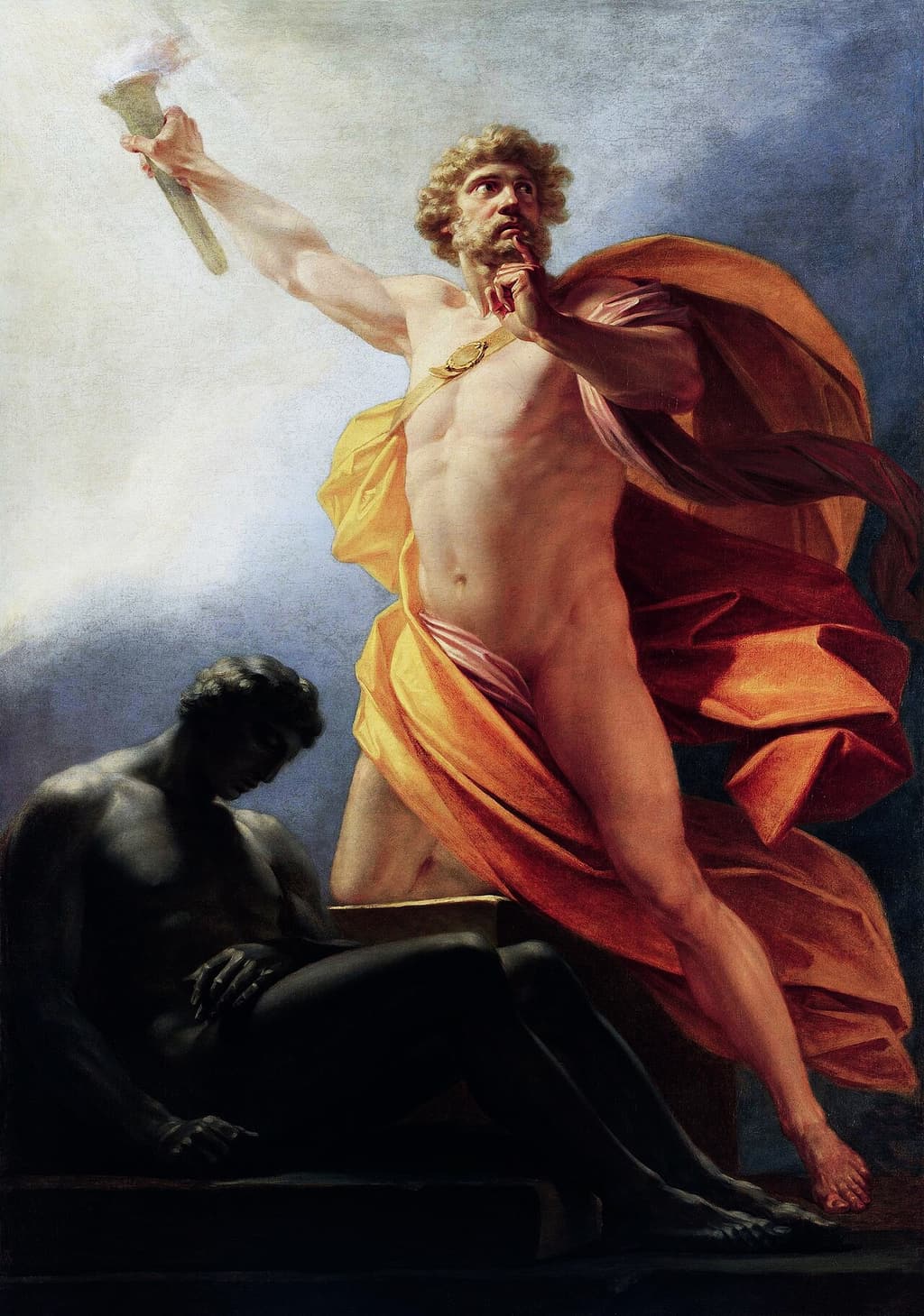
Greek mythology is not a book. There is no Greek bible, no canonical version of any story, and no priesthood that ever tried to establish one. What survives is a thousand years of poems, plays, hymns, painted pots, scholarly footnotes and travellers' notebooks, produced by people in hundreds of separate cities who agreed about the names of the gods and argued about nearly everything else. Understanding that is the difference between reading these stories well and reading them as though they were scripture that somebody garbled.
How it actually reached us
The material is far older than the writing. Linear B tablets from Mycenaean palaces, some three centuries before Homer, already record offerings to Poseidon, Zeus, Hera, Dionysus and Artemis — names that were being written down for accountancy purposes while the myths themselves were still entirely oral. Then a gap: the Bronze Age palaces collapse around 1200 BCE, writing disappears from Greece for four hundred years, and when it returns in an alphabet borrowed from the Phoenicians, the first substantial thing anyone does with it is write down poems that had been recited for generations.
Those poems are the Iliad and the Odyssey, conventionally around 750–700 BCE, and they are not mythology handbooks. They assume you already know who everybody is. The gods in them behave like a quarrelsome aristocratic family with too much time and no consequences, and the poet expects that to be funny in places and appalling in others.
Hesiod, writing at roughly the same time, is doing something different and rarer: the Theogony is a deliberate attempt to put the whole divine order into one genealogical sequence, from primordial Chaos through the generations of Titans to the Olympian settlement. It is the closest thing Greece produced to systematic theology, and it succeeded so well that later Greeks largely treated it as the standard account — which is itself a warning, because it is one poet's arrangement of material that existed in other arrangements elsewhere.
After that, the sources multiply and change character:
- The Homeric Hymns (7th–5th centuries BCE) — narrative poems introducing individual gods, each usually explaining how a particular cult came to exist. The one to Demeter is the founding document for the Eleusinian Mysteries.
- The Athenian tragedians (5th century BCE) — Aeschylus, Sophocles and Euripides taking inherited stories and rewriting them hard for a civic audience. Much of what people think of as "the myth" of Oedipus, Medea or Electra is a specific playwright's dramatic choice.
- Apollodorus' Bibliotheca (probably 1st–2nd century CE) — a systematic handbook that flatly lists variants: this happened, though some say otherwise. Dull to read and indispensable, because it preserves versions whose original sources are lost.
- Pausanias' Description of Greece (2nd century CE) — a travel writer walking the country and recording what was in each sanctuary and what the locals said about it. The single best source for what people actually did, as opposed to what poets wrote.
The consequence is that any Greek myth you meet comes with a date and an agenda attached, and the pages here name both.
The shape of the pantheon
Greeks did not organise their gods into the neat twelve-slot table that later handbooks like. What they had was a set of overlapping groupings.
The Olympians are the ruling generation, the family that took power after the Titans and lives on the mountain: the sky-king Zeus and his siblings and children. The canonical twelve varies by author and by city — Hestia and Dionysus swap places in different lists, and no ancient list is authoritative.
The Titans are the previous generation, defeated but not erased. Some remain active and honoured: Helios drives the sun, Prometheus is central to what humans are, Hecate keeps her privileges in Hesiod's account explicitly.
The primordials are the oldest layer and barely characters at all — Chaos, Gaia, Nyx, Tartarus. They are conditions of the world more than persons, and they generally have no myths, only genealogy.
The chthonic gods are the ones under the earth, and they are a different kind of religion rather than a different address. Sacrifice to them was made at night, into a pit, and burned entire rather than shared; Olympian sacrifice was a daytime feast where the community ate the meat. A single god could receive both — the same name, two rites, two moods.
Then there are the heroes, who are not a minor category. A hero was a dead mortal, usually with a divine parent, whose bones lay somewhere specific and whose tomb received offerings and gave protection. Heracles, Theseus, Perseus and the Trojan War generation were local political property as much as story characters, and cities fought over their remains.
Where the local versions matter
Because there was no central authority, the same god could be almost unrecognisable between cities. Artemis at Ephesus, hung with what may be breasts, eggs or bull testicles depending on which scholar you read, has little in common with the huntress of Attic vase painting. Athena at Athens was the city's owner; elsewhere she was a war goddess with none of the crafts. Sparta's Helen had a sanctuary and was worshipped as a goddess of a kind, which sits oddly beside the Iliad's adulterous queen.
This is why the phrase "the Greeks believed" is nearly always wrong on its own. Belief in the modern sense was not the point; participation was. Greek religion asked you to attend the festival, join the procession, contribute to the sacrifice and eat. It did not ask you to affirm that a story was true, which is precisely why Greeks could enjoy poems in which the gods behave disgracefully and still sacrifice to them the next morning without any sense of contradiction.
The mysteries, and the part that was never written down
Alongside the public festivals ran a second kind of religion, and it is the part the sources are least able to tell us about, because initiates were forbidden to describe it and — remarkably — for a thousand years essentially nobody did. The Eleusinian Mysteries outside Athens set the bar at two things only — enough Greek to follow the rite, and no blood-guilt — which let in women and the enslaved alongside citizens, and what they offered was a better condition after death. We know the procession route, the fasting, the drink taken, the great hall the initiates entered, and that something was shown. What was shown is genuinely lost.
The same secrecy surrounds the Samothracian mysteries and the various Dionysiac and Orphic groups, the last of which produced a distinctly un-Homeric theology: a soul that transmigrates, a body that is a prison, dietary rules, and gold leaves buried with the dead carrying instructions for which spring to drink from in the underworld. Those leaves have been excavated in southern Italy, Crete and Thessaly, and they are the strongest evidence that ordinary Greek religion contained ideas the poets never touched.
Pots, temples and the pictures that carried the stories
Most Greeks met these myths visually rather than textually. Painted pottery — tens of thousands of surviving vases — carried scenes that were recognisable at a glance, and the choices painters made are evidence in their own right: certain episodes are painted constantly and never described in a surviving text, which proves that stories were circulating outside the literary tradition. Temple sculpture did the same work at civic scale, with pediments and metopes arguing a city's descent and its claims through the myths it chose to show. Where a page here says a version is well attested in art but not in literature, that is what is meant.
What is systematically misunderstood
Four things trip up nearly every popular account.
- The Romans did not simply rename these gods. Jupiter, Mars, Minerva and Venus have their own Italic histories and their own state cult, and Roman writers deliberately equated them with the Greek gods rather than inheriting them. The Greek and Roman pantheons compared sets out where the equations hold and where they break.
- The statues were painted. The white marble aesthetic is an accident of pigment loss and a nineteenth-century taste built on that accident. Ancient temple sculpture was brightly coloured, and the cult statues inside were often dressed in real clothes.
- Myth and cult are separate systems. No festival re-enacted the seduction stories. What happened at sanctuaries was mostly procession, sacrifice, athletics, oath-taking and oracle-consultation, and it often has no narrative attached at all.
- Ovid is Roman, and late. An enormous share of the "Greek myths" in circulation — Medusa's transformation, Arachne, Narcissus, many of the metamorphoses that give the Metamorphoses its name — come from a Latin poet writing under Augustus with literary aims of his own. His versions are magnificent and they are not evidence for archaic Greek belief.
Where to start
If you want stories, start with a full myth retelling rather than a god's biography — the narrative is what the tradition is for. If you want the structure, read the family tree, which lays out the generations and marks the descents the sources fight about. If you have decided to read an ancient work, the honest advice is: begin with the Odyssey, which is a good adventure novel and forgives a reader who does not know the background; go to the Iliad second, when the names have settled; and keep Apollodorus beside you as a reference rather than reading him through.
Below are the figures of this tradition currently written up here, arranged by what kind of being they are.
gods
- Zeussky, thunder, kingship
- Heramarriage, women's lives, sovereignty
- Poseidonsea, earthquakes, horses
- Hadesthe dead, the underworld, hidden wealth
- Demetergrain, agriculture, the mysteries
- Athenawisdom, craft, strategic war
- Apolloprophecy, music, healing
- Artemisthe hunt, wild animals, childbirth
- Areswar, bloodlust, courage
- Aphroditedesire, beauty, sexuality
- Hephaestusfire, metalworking, craft
- Hermesboundaries, travel, trade
- Dionysuswine, ecstasy, theatre
- Hestiathe hearth, the home, sacrificial fire
- Persephonespring growth, the underworld, the mysteries
- Hecatecrossroads, witchcraft, ghosts
- Panshepherds, flocks, wild places
- Erosdesire, attraction, generative force
- Nikevictory, in battle and in games
- Iristhe rainbow, messages between gods
- Thanatosdeath itself, peaceful death
- Hypnossleep
- Nemesisretribution, the balance owed for good fortune
- Charonferrying the dead, the river crossing
- Heliosthe sun, sight, oaths sworn by what he sees
- Selenethe moon
- Eosthe dawn
- Amphitritethe sea, sea creatures
- Tritonthe sea, calming and raising waves
- Asclepiusmedicine, healing, dream cures
- the Musespoetry, music, history
- the Moiraifate, the allotted span, the thread of life
- the Erinyesvengeance for kin-murder, curses, broken oaths
- Circepharmaka and drugs, transformation, the island of Aeaea
primordials
- Nyxnight, the primordial dark
- Gaiathe earth, fertility, oracles
- Uranusthe sky, the heavens
- Cronustime (by later interpretation), the harvest, the golden age
- Rheamotherhood, the flow of generations
- Chaosthe first gap, the void before order
- Atlasholding up the sky, astronomy, endurance
- Prometheusfire, craft, foresight
places
mortals
artifacts
heros
- Heraclesstrength, endurance, the labours
- Perseusmonster-slaying, founding of Mycenae
- TheseusAthenian kingship, the labyrinth, synoikismos
- Achilleswar, rage, glory
- Odysseuscunning, endurance, homecoming
- Jasonthe Argo voyage, the fleece quest, broken oaths
- Orpheusmusic, the descent to the dead, the mysteries
- Bellerophontaming Pegasus, the Chimera, hubris
- Atalantahunting, running, refusal of marriage
- Oedipusprophecy, riddles, pollution
- Medeasorcery, herbs, revenge
- Ariadnethe thread, the labyrinth, abandonment
- Helenbeauty, the cause of the war, cult at Sparta
- Cassandraprophecy, disbelief, the fall of Troy
- Pandorathe first woman, the jar, hope
creatures
- Medusapetrifying gaze, apotropaic power
- Cerberusguarding the gate of the dead
- the Minotaurthe labyrinth, the tribute of youths
- the Lernaean Hydraregeneration, poison, the second labour
- the Chimerafire-breathing, impossible hybridity
- Pegasusflight, poetic inspiration, the Hippocrene spring
- the Sirensirresistible song, knowledge that kills
- Scyllathe strait, devouring sailors