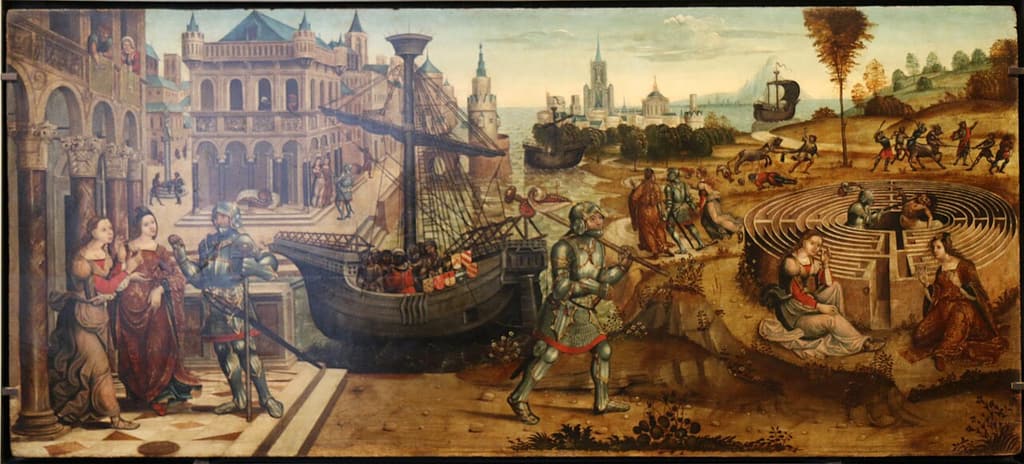
Athens needed a hero and did not have one. Argos had Perseus, Thebes had Heracles, and the city that would dominate fifth-century Greece had a minor local figure of no particular standing in the epic tradition — Homer barely mentions him. So Athens built one. Over roughly the sixth and fifth centuries BCE, Theseus acquired a career deliberately shaped like Heracles': a sequence of road-clearing labours on the way to the city, a bull, a monster, a descent to the underworld. The process is visible in the art. Theseus' road adventures appear on Athenian vases in quantity from about 510 BCE onward, immediately after the fall of the tyrants and the reforms of Cleisthenes, and hardly at all before.
Knowing this does not spoil him. It makes him the clearest surviving case of a city consciously assembling a national myth, and Plutarch, writing his Life some six centuries later, is openly uneasy about the material — he opens by comparing his task to a mapmaker writing "beyond this lie sandy deserts full of wild beasts" at the edge of the known.
The sword under the rock
Aegeus, childless king of Athens, consulted Delphi and got an answer he could not read: do not loosen the wineskin's mouth until you reach Athens. Passing through Troezen, he was made drunk by King Pittheus and slept with his daughter Aethra. Before leaving he put his sword and sandals under a great rock and said that if a son could move it, he should come to Athens. In the Troezenian version Aethra also waded to a nearby island that same night at Athena's prompting and lay with Poseidon — which gives Theseus a double paternity that no one bothered to resolve. Athens preferred the mortal father when it needed a legitimate king and the divine one when it needed a hero.
At sixteen he lifted the rock and chose to travel to Athens by land, along the dangerous Isthmus road, when the sea route was easy. That choice is the character: he goes looking for the difficult version.
The six on the road
Each of the roadside killers is dispatched by his own method, which is the organising joke of the sequence.
- Periphetes at Epidaurus, who clubbed travellers, is clubbed; Theseus keeps the club.
- Sinis the pine-bender, who tore men apart between two bent trees, is torn apart the same way.
- The Crommyonian sow, a monstrous pig named Phaea, is simply hunted down — Plutarch notes a rationalising version in which she was a murderous woman nicknamed for her habits.
- Sciron, who made travellers wash his feet on a cliff and kicked them into the sea to a turtle, is kicked off it. Megara, which regarded Sciron as a respectable citizen, disputed this whole episode; Plutarch reports the quarrel.
- Cercyon at Eleusis, who forced passers-by to wrestle, is beaten at wrestling — Theseus is credited with inventing the technical art of it, using skill against size.
- Procrustes, who fitted guests to his bed by stretching or amputation, is fitted to it.
Arriving at Athens, he is nearly poisoned by Medea, then living with Aegeus, who recognises the sword at the last second and knocks the cup away. The spot where the cup fell was still shown in the Delphinion precinct.
Crete: the tribute, the thread, the sail
Athens owed Minos of Crete a tribute of seven youths and seven maidens, in expiation for the death of his son Androgeos in Attica. Theseus volunteered to go with them. Ariadne, Minos' daughter, fell in love with him and gave him a ball of thread — and, in Apollodorus' version, the instruction came originally from Daedalus, who had built the labyrinth and knew the only way out of it.
Bacchylides' seventeenth dithyramb preserves an episode that the later prose summaries drop: on the voyage, Minos challenges Theseus' claim to divine descent by throwing a ring into the sea. Theseus dives, is escorted by dolphins to Poseidon's halls, is greeted by Amphitrite, and surfaces dry, wearing a crown she has given him. It is a proof of paternity rather than a retrieval.
He kills the Minotaur and escapes, taking Ariadne — and abandons her on Naxos. The sources split along predictable lines. Some say he simply left her; some that a storm carried him off; some, most influentially, that Dionysus claimed her, and that Theseus was ordered to leave by the god. The versions that exonerate him are, as a rule, Athenian. Hesiod and the Naxian traditions are less kind. Homer's Odyssey has Artemis kill her on Dia "on Dionysus' testimony", a line nobody has satisfactorily explained.
Then the sail. He had agreed to raise a white sail if he survived, and forgot; Aegeus, watching from the cliff at Sounion or from the Acropolis depending on the source, saw black and threw himself down. Plutarch says the Aegean is named for him.
The synoikismos: what Athens actually credited him with
His real Athenian significance is constitutional. He is credited with the synoikismos — the unification of the scattered towns of Attica into a single political community centred on Athens, with a common council house — and with founding the Panathenaia and the Isthmian Games. Plutarch and Thucydides both treat this as historical, and Thucydides in particular states it flatly as a fact about the past.
Later Athenian democracy went further and made him a proto-democrat who voluntarily surrendered power to the people, a claim visible in Euripides' Suppliants, where he argues the case for the rule of law against a Theban herald. That is a fifth-century constitution being retrojected onto a Bronze Age king, and it is one of the clearest examples of myth serving contemporary politics anywhere in Greek material.
His bones came home too. In 476/5 BCE Cimon, following a Delphic instruction, went to Skyros — where Theseus had been killed, pushed from a cliff by King Lycomedes — found a large skeleton with a bronze spear and sword, and brought it back to Athens in triumph. A shrine, the Theseion, was built for it and served as a sanctuary for runaway slaves and the poor.
The later career, which is a decline
The material after Crete is much darker and is often quietly omitted. He marries Phaedra, Ariadne's sister, whose passion for her stepson Hippolytus and false accusation destroy the boy — the plot of Euripides' Hippolytus and, through Seneca, of Racine's Phèdre. He abducts the child Helen from Sparta with his friend Pirithous, and the two then go down to the underworld to abduct Persephone as well; they are trapped in chairs of forgetfulness, and Heracles frees Theseus but cannot free Pirithous. In his absence the Dioscuri sack Attica to recover their sister. He returns to a city that no longer wants him, is exiled, and dies on Skyros.
The ship, and a problem philosophy could not put down
Plutarch records that the Athenians preserved the thirty-oared ship in which Theseus sailed, replacing the decayed planks with new timber, down to the time of Demetrius of Phalerum, and that it became a standing example for philosophers arguing about growth and identity — one side holding it was the same ship, the other that it was not. Hobbes later sharpened it by asking what happens if someone collects the discarded planks and reassembles them. The ship of Theseus is now standard in every introduction to the metaphysics of identity, is applied to everything from cell replacement to restored buildings to legal continuity of institutions, and is a good deal more famous than most of the myths that produced it.
Renault, Gide, and a career too long for a children’s version
He does less well in popular culture than his career would suggest, partly because his best material is already claimed by the labyrinth story and partly because his later life is unusable for a children's version. Mary Renault's novels The King Must Die and The Bull from the Sea are the outstanding modern treatment, rationalising the Minotaur into Cretan bull-leaping and taking the political career seriously. André Gide's Thésée was his last work. In games and films he tends to be reduced to the maze and the monster, with Ariadne as a love interest and the abandonment omitted.
The synoikismos, the crane dance, and the black sail
Is the synoikismos historical?
Something like it probably happened, and Attica was unified early and unusually completely compared with the rest of Greece, but the process was almost certainly gradual and cannot be attributed to an individual. Thucydides' confident attribution is a fifth-century Athenian reporting his city's own foundation story, not independent evidence. Archaeology shows Attica's settlements converging on Athens over a long period rather than at a moment.
What are the Oschophoria and the crane dance?
Plutarch describes a set of Athenian rites tied to the Cretan voyage: the Oschophoria, a procession with vine branches led by two youths dressed as girls, and the ritual of the Pyanepsia. He also reports that on Delos, on the return journey, Theseus and the rescued youths danced the geranos — a crane dance whose loops and reversals were understood to trace out the maze they had just escaped. A surviving festival dance whose form encodes a maze is unusually good evidence that the story was ritually re-enacted.
Why does he wrestle so much?
Because Athens claimed him as the inventor of scientific wrestling — the use of skill and leverage against brute mass — and because it distinguishes him from Heracles, whose method is force. Pausanias credits him with the invention explicitly. Athenian self-image as the clever city rather than the strong one runs all the way through the hero's design.
Did the black sail have to be a mistake?
Some ancient writers thought not. A tradition preserved in the scholia and hinted at by later authors suggested Theseus' forgetfulness was designed rather than accidental, or was caused by the god as part of the punishment for Ariadne. Plutarch reports the version in which Aegeus watched from the Acropolis and, since the Acropolis has no view of the sea approach, the detail is often taken as evidence that even the ancient account was already patched together from separate local stories.