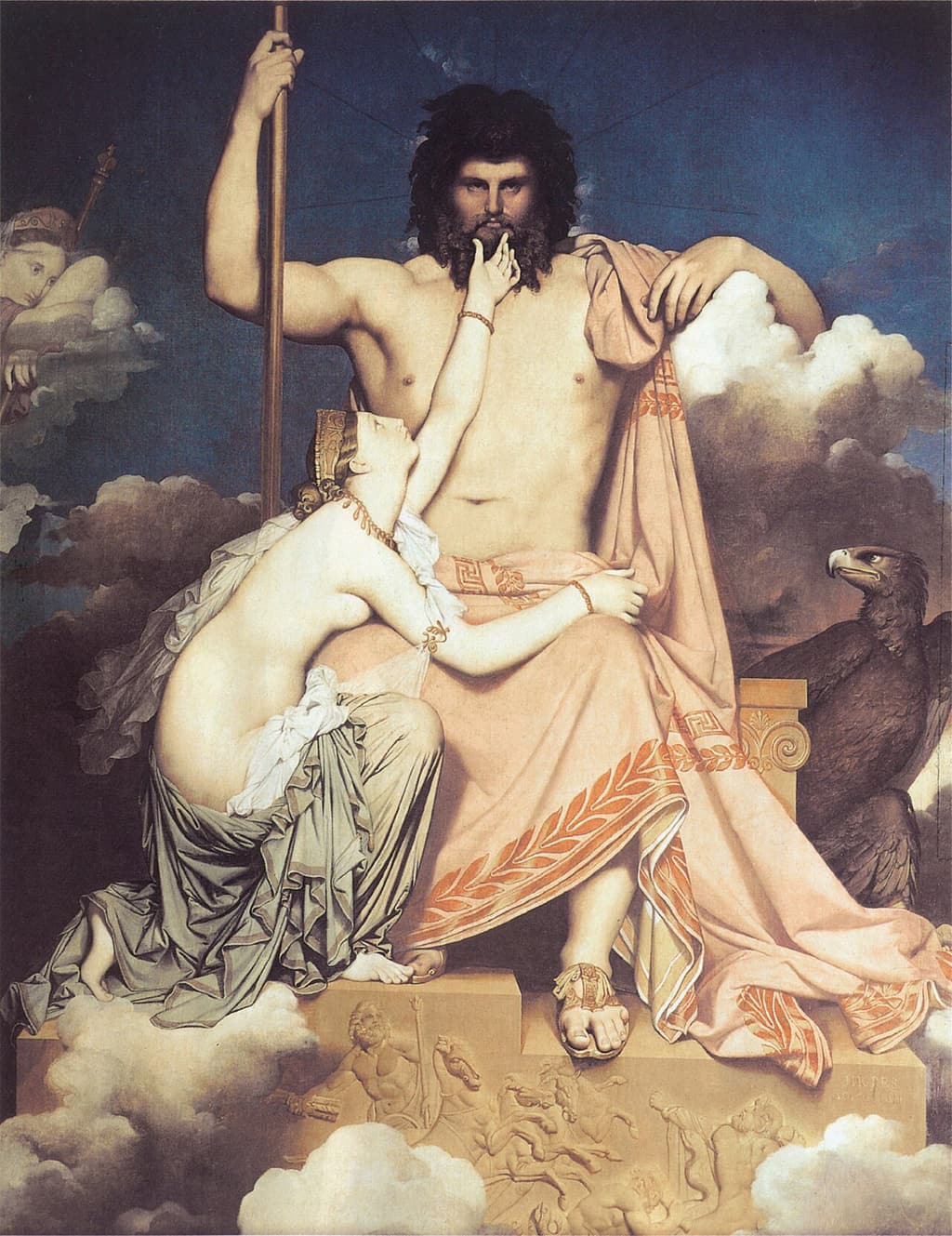
Zeus is the god the Greeks could not agree about. In the poems he is a philanderer who deceives his wife with a new disguise every hundred lines; at his sanctuaries he was the god you swore by when nothing else would hold a promise together, the one who punished men for turning a stranger away from the door. Both are genuinely him. A reader who takes only the seductions gets the Zeus of Ovid and of every modern retelling since; a reader who takes only the cult gets an abstraction no Greek would recognise. The interesting thing about the sky-god is that his worshippers held the two together without apparent difficulty for a thousand years.
His name is the oldest thing about him. Zeus, genitive Dios, descends directly from the Proto-Indo-European sky-father — the same root that surfaces in Latin Iuppiter (from a vocative Dyeu-pater, "sky father"), Sanskrit Dyaus Pita, and the Germanic Tiwaz who gave English its Tuesday. Of the major Greek gods he is one of the few whose name is transparently inherited rather than borrowed or obscure. He arrived in Greece already meaning "the bright sky", and the weather never left him: the lightning, the rain, the thunder that Homer calls his voice.
The swallowing father and the stone
The succession myth is told most fully in Hesiod's Theogony, and it is a story about a family that cannot stop eating itself. Ouranos, the sky, imprisons his children inside the earth until Cronus castrates him with a sickle his mother Gaia has made. Cronus, warned that a child of his will do the same to him, takes each newborn from Rhea and swallows it — five of them go down that way. Carrying the sixth, she appeals to her parents and is sent to Crete. She gives birth in a cave, hides the infant, and hands her husband a stone wrapped in swaddling bands, which he swallows without noticing the difference.
Where in Crete is a real dispute rather than a detail. Hesiod puts the birth-cave on Mount Aigaion near Lyktos; a strong later tradition puts it on Mount Ida; another names the Diktaean cave, where Bronze Age votive deposits have in fact been excavated. The Cretans went further and showed visitors the tomb of Zeus, which the rest of the Greek world treated as proof that Cretans were liars — the line "Cretans, always liars" is quoted by Callimachus in his Hymn to Zeus precisely on this point, since a god who dies is not a god. What the Cretans probably preserved was an older Minoan god of the year who does die and return, welded onto the incoming sky-father.
Grown, Zeus forces Cronus to bring up the swallowed children — Hesiod has him vomit up the stone first, and that stone was displayed at Delphi, an object visitors could still look at in Pausanias' day. Then comes the Titanomachy, ten years of it, decided when Zeus frees the hundred-handed Hekatoncheires from beneath the earth and they bury the Titans under a barrage of rock. The three brothers draw lots for the world afterwards: Zeus the sky, Poseidon the sea, Hades the dead. Earth and Olympus stay common ground. It is worth noticing that Zeus does not inherit the sky; he wins a lottery for it.
Typhon, and the last serious threat
The one opponent who nearly unmakes him is Typhon, the youngest child of Gaia, a hundred-serpent-headed thing whose voices run from bull-bellow to human speech. Hesiod's version is a straight artillery duel that Zeus wins with the thunderbolt. Apollodorus preserves a far stranger telling in the Bibliotheca: Typhon overpowers Zeus, cuts the sinews out of his hands and feet, and hides both god and sinews in the Corycian cave in Cilicia under a she-dragon's guard, until Hermes and Aigipan steal the sinews back and refit them. That version — a helpless, dismembered Zeus who has to be rescued — has almost no afterlife in art and none in popular retelling, which is exactly why it is worth knowing.
What the oath-god actually did
The cult Zeus is a different creature from the poetic one, and he is the reason the god mattered to ordinary people.
- Zeus Horkios, the oath-keeper. At Olympia his statue stood holding a thunderbolt in each hand, and competitors swore over the cut pieces of a boar that they had trained for ten months and would not cheat. Pausanias reports that the inscription at its base was aimed at perjurers.
- Zeus Xenios, the god of guest-friendship. Any stranger at the door came under his protection; the Odyssey uses this as its moral engine, and the Cyclops' refusal to respect it is what marks him as outside civilisation altogether.
- Zeus Herkeios, of the courtyard fence, whose altar stood in the open yard of the house. Having one was used in Athens as evidence that a man was genuinely Athenian.
- Zeus Meilichios, "the kindly one", worshipped in snake form, receiving offerings that were burned entire rather than eaten — a chthonic, placatory Zeus who has nothing obvious to do with the sky.
Olympia and Dodona were the two great sanctuaries and they could hardly have been less alike. Olympia was games, the four-yearly panhellenic festival, and from the 430s BCE Pheidias' chryselephantine seated Zeus, over twelve metres of ivory and gold, counted among the wonders of the world. Dodona in Epirus was older and stranger: an oracle where the god answered through the rustling of a sacred oak, read by priests called the Selloi who, the Iliad says, slept on the ground and never washed their feet. Hundreds of lead tablets carrying the actual questions have been excavated there — about marriages, thefts, whether to emigrate, whether a child is really the questioner's. On Mount Lykaion in Arcadia the rites were darker still, with a persistent ancient claim of human sacrifice and of a man who ate the flesh and became a wolf.
The genealogies do not agree, and the marriages are political
Zeus' children are the map of the Greek pantheon, and the map has variant editions. Hesiod's Theogony gives an orderly sequence of consorts culminating in Hera, with Athena born from his head after he swallows the pregnant Metis — a succession myth solved by absorbing the threat rather than fighting it. Homer's Iliad simply calls Aphrodite the daughter of Zeus and Dione, while Hesiod has her born from the sea-foam of the castrated Ouranos, generations earlier. Both were current at once. The pattern with the mortal affairs is easier to explain than to excuse: cities and aristocratic houses claimed descent from Zeus, so the god acquired ancestors' worth of liaisons — Perseus at Argos through Danaë, Heracles at Thebes through Alcmene, Minos in Crete through Europa, Helen at Sparta through Leda. Genealogy in Greece was a political document.
Hera's jealousy, which reads as comedy in Ovid, has a sharper origin: she was a major goddess with her own ancient cult at Argos and Samos, and the myths marrying her to the incoming sky-god preserve the friction of that merger. The quarrels in the Iliad are the theology of two cults sharing a household.
The thunderbolt is his in art almost without exception, along with the eagle, the oak and the aegis — that last a goat-skin storm-shield he lends to Athena and shakes to rout an army. The double axe appears with him in Caria and Crete, another Minoan inheritance.
Jupiter is not a translation of him
The Romans equated Zeus with Jupiter, and the equation is old and genuine — both are inherited sky-fathers, both hold the thunderbolt, both guarantee oaths. But Jupiter Optimus Maximus on the Capitol is a god of the Roman state with a state cult, augury and a flamen; he has almost no myth of his own that is not imported Greek material. Reading Ovid's Jupiter as evidence for Greek religion, which is how most modern retellings do it, produces a god assembled out of Latin love poetry.
Zeus after antiquity
Percy Jackson's absentee god-father, God of War's tyrant, the Marvel films' bombastic showman and Hades' distant Olympian all take the same half of him: power without responsibility. It is a coherent reading of the poems and a poor reading of the religion, and it is worth being explicit that none of these draw on the oath-god at all. The Renaissance did something similar in the opposite direction, turning the seductions into a licence for mythological nudes — Correggio's Danaë, Titian's Rape of Europa — which is how the philandering Zeus became the default image in European art. The astronomical Jupiter, its Galilean moons named for his lovers, is the one place the old genealogy is still catalogued daily.
Worship set against story, and the end of the sanctuaries
Did anyone in Greece actually worship the Zeus of the myths?
They worshipped the same god, but the myths were not scripture and cult did not follow them. There was no rite commemorating the seduction of Leda. Sacrifice at Olympia or Dodona addressed the god as king, oath-keeper and weather-bringer; the stories were poetry, entertainment and civic genealogy, and Plato objected to teaching them to children precisely because they were not what religion required.
Is the thunderbolt a weapon he made or one he was given?
Given. The Cyclopes forge it for him in Hesiod's account, in return for being released from imprisonment, and the debt matters: it is the reason Apollo later kills them, and the reason Zeus punishes Apollo for it. The bolt is a manufactured object with a supply chain, not an innate power.
Why do so many Greek heroes turn out to be his sons?
Because heroic genealogy was a claim on land and office. A ruling family that could trace itself to Zeus through a local heroine had a charter for its position, and rival cities produced rival descents. The number of affairs is a by-product of many independent local traditions being collected into one pantheon by poets who then had to fit them all into a single household.
What happened to his sanctuaries?
Olympia's games were ended by imperial decree in the late fourth century CE; the temple burned and earthquakes and the shifting Alpheios river buried the site, which is partly why so much survived to be excavated from 1875. Pheidias' statue was probably moved to Constantinople and lost in a fire there. Dodona's oracle was still answering questions into the fourth century CE, by which time the oak had been cut down at least once by a raiding Illyrian.