Scandinavia and Iceland
Norse mythology
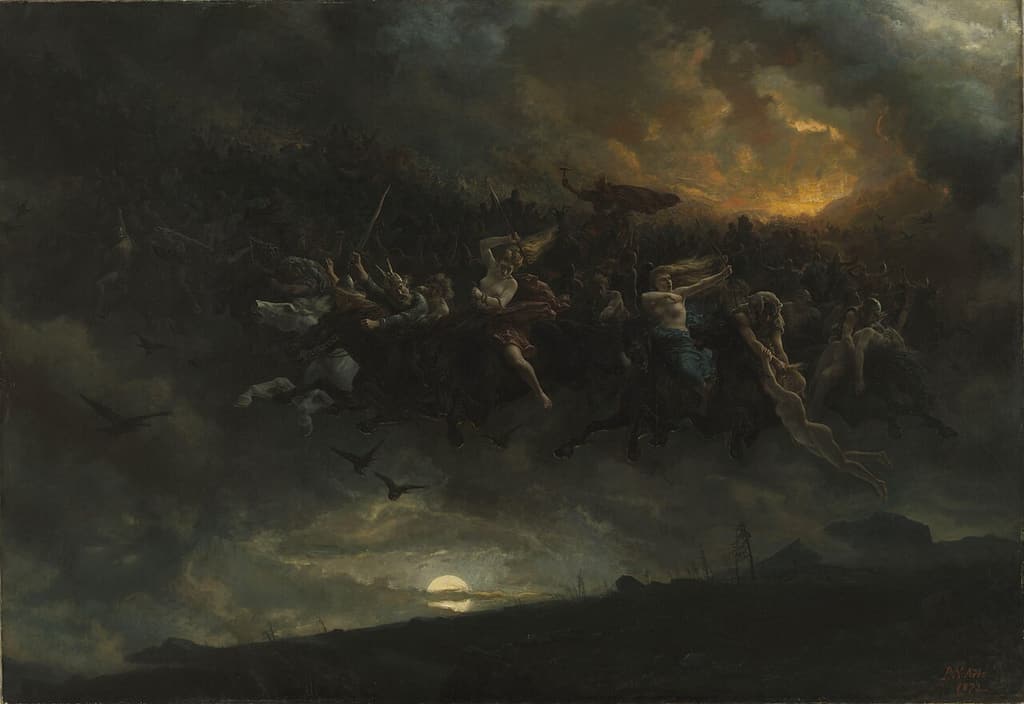
Almost everything anyone knows about the Norse gods was written down in Iceland, in the thirteenth century, by Christians. That single fact does more to shape the tradition than any other, and no honest account of it can start anywhere else.
Iceland converted around the year 1000. The two works that preserve the mythology — the Poetic Edda, a manuscript anthology of anonymous verse, and the Prose Edda, written by the chieftain and historian Snorri Sturluson in about 1220 — were produced two hundred years later by people whose grandparents' grandparents had been the last pagans. Snorri was not writing scripture. He was writing a textbook for poets, because skaldic verse ran on mythological allusion and young poets no longer knew the references. To explain why gold could be called "Sif's hair" or "the otter's ransom", he had to retell the stories. We owe most of Norse mythology to a manual of professional metaphor.
What each source actually gives you
- The Poetic Edda — preserved chiefly in the Icelandic Codex Regius manuscript of around 1270, though the poems in it are older and some are certainly pre-Christian. This is the primary material: Völuspá, in which a seeress narrates the world from creation to Ragnarok and beyond; Hávamál, a collection of advice and lore in Odin's voice; the wisdom-contest poems; and the heroic lays of the Volsungs. It is allusive, gapped and difficult, and it is the closest thing to a pagan voice that survives.
- Snorri's Prose Edda — orderly, readable, funny, and reconstructed. Its Gylfaginning section supplies the cosmology most people picture: the nine worlds, the ash Yggdrasil, the hall of the slain, the sequence of Ragnarok. Snorri sometimes had sources we do not, and sometimes appears to be tidying, harmonising or inventing connective tissue. Distinguishing the two is a permanent scholarly argument, and this site flags where a detail rests on Snorri alone.
- Skaldic verse — court poetry from the ninth century onward, often genuinely pagan in date and therefore extremely valuable, but composed under a kenning system so dense that it is nearly unreadable without a commentary.
- Saxo Grammaticus' Gesta Danorum — a Danish Latin history, roughly contemporary with Snorri, giving markedly different and often euhemerised versions in which the gods are ambitious human sorcerers. Where Saxo and Snorri diverge, both are recorded here.
- The sagas and the archaeology — the Icelandic family sagas mention pagan practice in passing, usually disapprovingly. The physical evidence is separate and independent: rune stones, the ship burials, thousands of small hammer amulets, the temple postholes at Uppåkra, place-names all over Scandinavia that preserve a god's name attached to a field or a grove.
The shape of the world
The Norse cosmos is spatial in a way the Greek one is not. Where Greek gods live on a mountain in the same world as everyone else, Norse cosmology stacks and rings realms around a world-tree: the ash Yggdrasil, with the gods' enclosure of Asgard, the human middle enclosure of Midgard, the giants' Jotunheim, the dark Niflheim and the fiery Muspelheim among the nine worlds Snorri names. Bridges, roots and rivers connect them, and something is always gnawing at the tree.
The gods themselves fall into two families who fought a war and then merged. The Æsir are the sky-and-sovereignty group around Odin and Thor. The Vanir — Njord, Freyr, Freyja — are associated with fertility, wealth, seafaring and prophecy, and joined the Æsir as hostages after the war ended in stalemate. Some scholars read this as the memory of two religious systems combining; others as a straightforward Indo-European functional division. It cannot be settled, and pages here say so.
The giants, the jötnar, are not simply monsters. They are older than the gods, the gods keep marrying them, and Odin, Thor and Loki all have giant ancestry. The distinction is political rather than biological: the jötnar are the powers outside the enclosure. Almost every Norse myth is about the boundary between inside and outside being crossed, tested or violated.
Ragnarok, and why it feels different
No other tradition on this site puts its own end at the centre. Völuspá narrates the death of the world as something already fixed: the long winter, the wolf loose, the sun swallowed, the sea rising over the land, Odin killed and avenged, and the survivors afterwards finding the old gold game-pieces in the grass. The gods know this is coming. Odin's entire programme — the hanged sacrifice for the runes, the eye given for the well, the hall filled with chosen dead — is preparation for a battle he has been told he will lose.
Whether the rebirth at the end of Völuspá is pagan or a Christian editor's addition has been argued for two centuries and remains unresolved. What is not in doubt is the tone: this is a mythology in which fate is fixed, everybody knows it, and the only question worth asking is how you conduct yourself in the meantime. The comparison of Ragnarok with other apocalypse traditions sets it against the Zoroastrian and Christian versions, where the good side wins.
What people actually did
The myths say very little about practice, and practice is where the archaeology takes over from the manuscripts.
The central rite was blót: an animal sacrificed, the blood sprinkled with a twig on the walls, the images and the participants, and the meat boiled and eaten at a feast where toasts were drunk to named gods. Adam of Bremen's account of the temple at Uppsala, with nine of every male creature hung in a grove, is a hostile German churchman writing about a place he had not seen, and is treated here with the caution that deserves — but sacrificial deposits in bogs and lakes across Scandinavia, including weapons, horses and people, are physical fact.
Seiðr was a form of ritual magic concerned with prophecy and manipulating fate, practised chiefly by women; the sagas treat a man doing it as shameful, and simultaneously credit Odin with being its master, which is one of the sharper contradictions in the material. Burial ranged from cremation under a mound to the great ship burials at Oseberg and Gokstad, furnished as if for a household continuing elsewhere. And the hammer amulets — hundreds of them, mass-produced in silver and bronze, worn round the neck — are the closest thing the Viking Age has to a statement of personal devotion, appearing in largest numbers exactly when Christian crosses start arriving.
Beyond Iceland: the Continental evidence
Norse mythology is the best-recorded branch of a wider Germanic religion, and the other branches survive only in fragments that are worth knowing because they show what Iceland preserved and what it did not. Tacitus, writing in 98 CE, describes German tribes worshipping gods he equates with Mercury, Hercules and Mars, and a goddess Nerthus carried in a covered wagon whose attendants were drowned afterwards — a name that is the linguistic feminine of the later Njord. The Old English Nine Herbs Charm invokes Woden; the Old High German Merseburg charms invoke Wodan and Frija in a healing formula, and their gods' names are the same gods a thousand kilometres and three centuries from Snorri.
What popular culture has changed
More than any other tradition here, Norse mythology now reaches most people through adaptation, and the adaptations have specific fingerprints worth recognising.
- Marvel's Asgard is a Kirby-designed science-fantasy realm with a father-sons melodrama at its centre, and the family structure it made famous is the comics' own: the medieval texts arrange those three figures quite differently, as the individual pages set out.
- Wagner's Ring shaped the visual language — horned helmets, valkyrie flight, doomed grandeur — and horned helmets in particular are pure nineteenth-century costume design.
- Games from God of War to Assassin's Creed Valhalla generally follow Snorri's cosmology closely, because it is the only tidy version available, which quietly makes a thirteenth-century Christian's systematisation the standard picture of Viking Age belief.
- Modern misuse. Norse symbols have been appropriated by far-right movements since the 1930s, which is worth stating plainly on a mythology site: it is a political theft with no basis in the sources, and Icelandic and Scandinavian heathen organisations have repeatedly said so.
The names in the calendar
The one place the old gods survive in daily English use is the week. Tuesday is Tiw's day, the Old English form of the god Snorri calls Týr; Wednesday is Woden's, that is Odin's; Thursday is Thor's; and Friday belongs to Frigg or Freyja, whom the Old English tradition does not clearly distinguish. These are not borrowings from Norse but the English cousins of the same gods, translating the Roman planetary week god by god — Mercury to Woden, Jupiter to Thor, Venus to Frigg — which incidentally records which equations made sense to Germanic speakers in late antiquity.
Where to start
Read Völuspá first, in any decent translation, and read it aloud — it is short, it contains the entire arc of the mythology, and its strangeness is the point. Then Snorri's Gylfaginning for the map. Then, if the appetite holds, the Saga of the Volsungs, which is where the heroic material and Tolkien's borrowings both live.
For the structure rather than the stories, the Norse family tree lays out the Æsir and Vanir lines and marks the parentages the sources genuinely disagree about — of which Loki's is the most notorious. What follows is the roster as it currently stands.
gods
- Odinwisdom, poetry, war
- Thorthunder, protection, strength
- Lokicunning, shapeshifting, strife
- Friggmarriage, foreknowledge, motherhood
- Freyjalove, fertility, war
- Freyrfertility, peace, good harvest
- Njordthe sea, wind, wealth
- Tyrlaw, oaths, single combat
- Baldrlight, beauty, innocence
- Heimdallwatchfulness, the boundary of Asgard, the origin of classes
- Bragipoetry, eloquence, the skaldic art
- Idunnyouth, the apples of the gods
- Sifthe harvest, golden hair, marriage
- Vidarvengeance, survival past Ragnarok
- Valivengeance for Baldr
- Hodrblindness, the unwitting killing of Baldr
- Ullrarchery, skiing, the hunt
- Forsetijustice, reconciliation, legal judgement
- Skadiwinter, skiing, hunting
- Gefjonploughing, the making of Zealand, virginity
- Helthe realm of the dead, those who die of sickness or age
- Nannagrief, devotion
- Sigynloyalty, endurance
- Mimirwisdom, the well beneath the world tree
- Kvasirknowledge, the mead of poetry
- Hoenirindecision, the giving of spirit to humankind
- Aegirthe sea, brewing, the feast of the gods
- Randrowning, the sea's dead, the net
primordials
creatures
- Surtrfire, the end of the world, Muspelheim
- Thrymgiant kingship, the theft of Mjolnir
- Utgarda-Lokiillusion, the humbling of Thor
- Angrbodagiant motherhood, the monstrous brood
- Gerdrlight, the field, reluctant marriage
- Fenrirthe devouring wolf, Ragnarok, bound fate
- Jormungandrthe encircling sea, Ragnarok, Thor's nemesis
- Sleipnirtravel between worlds, speed
- Nidhogggnawing the world tree's root, corpses of oath-breakers
- Ratatoskrmessage-carrying, slander
- Huginn and Muninnknowledge, surveillance, Odin's sight
- Garmrguarding the road to Hel, Ragnarok
- the Valkyrieschoosing the battle-dead, serving in Valhalla, fate in war
- the Nornsfate, the well at the tree's root, law
- the draugrthe walking dead, grave-guarding, undead strength
heros
places
- Asgardthe stronghold of the gods, the halls
- Valhallathe honoured dead, daily battle, the einherjar
- Yggdrasilthe axis of the worlds, the wells, cosmic structure
- Bifrostthe bridge between worlds
- Niflheimmist, cold, the primordial north
- Helheimthe realm of the ordinary dead
- Midgardthe human world, the enclosure
- Ginnungagapthe primordial void, the meeting of fire and ice