On a flat slab of rock beside a road in Södermanland, Sweden, carved around 1030, a runic memorial commissioned by a woman named Sigríðr for a bridge she had built runs along the body of a serpent. Inside and around it, the carver put a man thrusting a sword up into the serpent's belly from below; a man roasting something on a spit and sucking his thumb; birds in a tree; a headless smith among his tools; and a horse loaded with a burden.
The Ramsund carving is the oldest datable depiction of the Sigurd story anywhere, it predates every manuscript that tells it, and it is on a Christian monument. Whoever commissioned it expected passers-by to recognise a dragon-slayer, a treacherous foster-father, and a hero who learned the language of birds.
The story the carving assumes
The full narrative survives in the Völsunga saga, a thirteenth-century Icelandic prose compilation, and in a run of Eddic poems: Reginsmál, Fáfnismál, Sigrdrífumál and a group of laments and death-poems.
Sigurðr is the posthumous son of Sigmundr, of the Völsung line, fostered by the smith Reginn. Reginn tells him about the gold: how Loki killed an otter that was really Reginn's brother Ótr; how the family demanded the otter-skin filled and covered with gold as compensation; how Loki extorted that gold, including a ring, from the dwarf Andvari, who cursed it as he handed it over; and how Reginn's other brother Fáfnir killed their father for it, took the shape of a serpent, and now lies on the hoard.
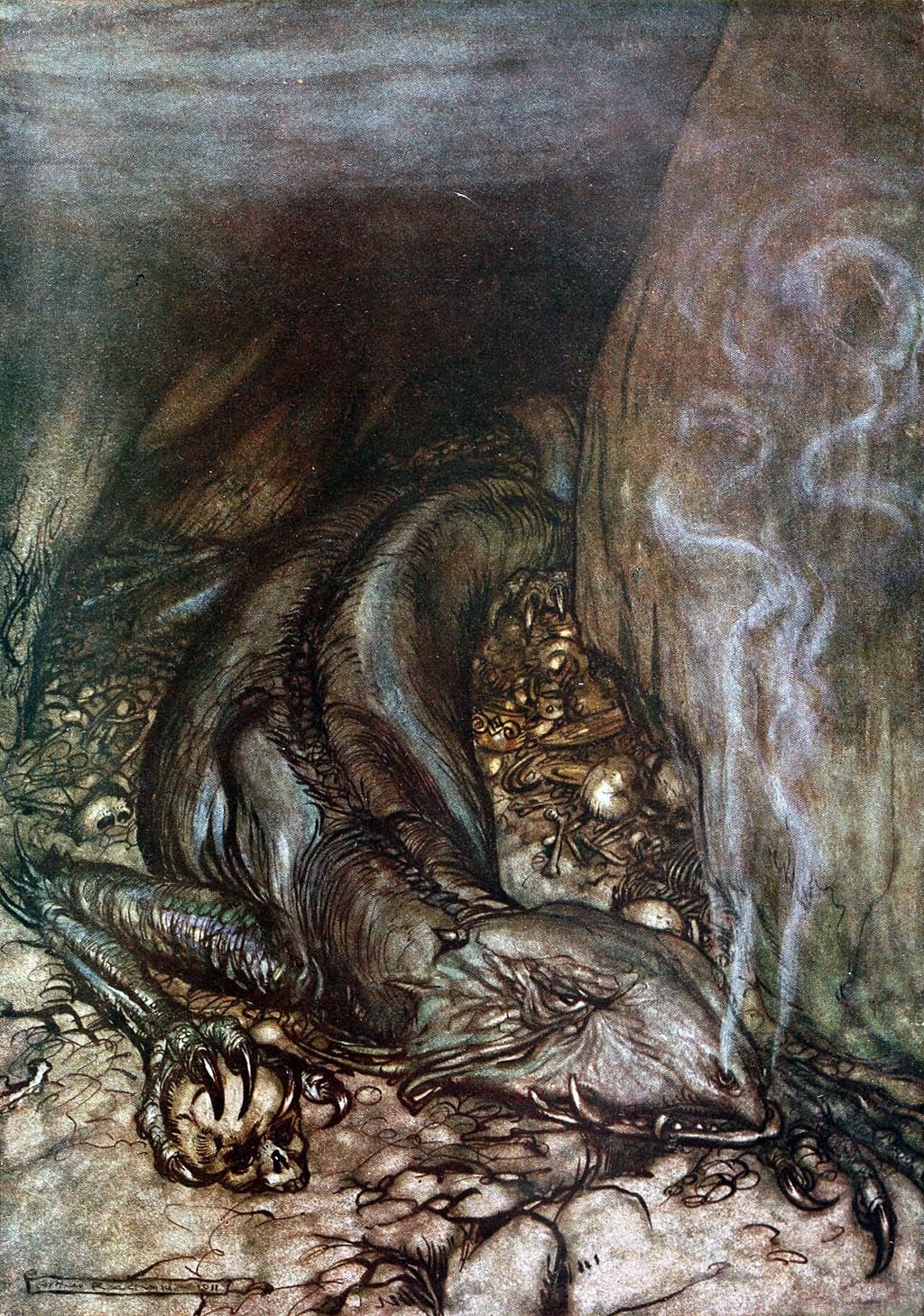
Reginn reforges the broken sword Gram — Sigurðr smashes two earlier attempts on the anvil — and Sigurðr digs a trench in the path Fáfnir uses to reach water and stabs upward as the serpent passes over. Fáfnir, dying, spends a long time warning him about the gold and about Reginn. Sigurðr roasts the heart as instructed, burns his thumb testing it, puts the thumb in his mouth, and the blood on his tongue makes the birds in the branches intelligible: they are discussing Reginn's plan to kill him. He beheads Reginn, loads the treasure onto the horse Grani — descended from Sleipnir — and rides away.
Every element of that is on the Ramsund rock, in order.
What happens next, and it is not heroic
He rides up a mountain, finds a wall of shields or fire, and wakes an armoured woman who has been put to sleep for defying Odin over which king should win a battle. She teaches him runes and gives him counsel — the Sigrdrífumál material is a manual of runic and ethical instruction, not a romance — and they exchange oaths.
Then he arrives at the court of the Gjúkungs, is given a drink of forgetting by Queen Grímhildr, marries her daughter Guðrún, and helps her son Gunnarr win Brynhildr by riding through the flames in Gunnarr's shape. When Brynhildr discovers the deception — in a quarrel with Guðrún about precedence while washing their hair in a river — she demands his death and gets it. Gunnarr and Högni are bound by oath not to harm him, so they goad a younger brother, Gutthormr, who is not, into stabbing him in bed. Sigurðr throws Gram after him and cuts him in half as he flees.
Brynhildr laughs when she hears Guðrún scream, and then kills herself to burn beside him.
The Norse hero and the German one
The Nibelungenlied, written in Middle High German around 1200, tells a version that has diverged substantially. Its Siegfried kills a dragon almost in passing and bathes in its blood to become invulnerable except for one spot where a leaf fell; there is no bird-speech, no Reginn, no runic instruction. Its Brünhild is a queen of Iceland with superhuman strength who must be defeated in athletic contests, and her grievance is a status quarrel rather than a broken oath — she is not a valkyrie and never loved Siegfried. Hagen kills him at a spring, and the second half of the poem belongs to Kriemhild's revenge, whereas the Norse tradition ends with Guðrún's brothers dying at Atli's hands and Guðrún's own vengeance.
Neither is the original. They are two descendants of a shared body of Migration-Period legend, some of which has a historical spine: Gunnarr corresponds to Gundaharius, a Burgundian king destroyed by Huns around 437, and Atli to Attila.
The carvings and the churches
Beyond Ramsund, the Sigurd material is carved on the eleventh-century Gök stone nearby, on stones on the Isle of Man, and — most remarkably — on the portal of the Hylestad stave church in Setesdal, Norway, from around 1200: the sword-forging, the dragon-killing, the thumb, the birds, Reginn's death and Gunnarr in the snake-pit, all carved on a church door. Whether the Christian setting is meant as allegory, decoration or genealogy is argued about, and no explanation covers every instance.
After the Middle Ages
Wagner's Ring des Nibelungen fuses the Norse and German versions, taking the Eddic gods and the Nibelungenlied names, and is the route by which most people now know any of it. Tolkien lectured on the Völsunga saga, wrote his own verse Legend of Sigurd and Gudrún, and lifted the cursed ring, the reforged sword and the greedy dragon into a shape the whole fantasy genre inherited.
For the dragon itself and the fight, see Sigurd and Fáfnir; for the woman whose oath drives the second half, Brynhildr; and for the tradition as a whole, the Norse overview. Sigurd, Sigurður and Sjur remain in live use as given names across Scandinavia — see name histories.
Is the Great Lacuna a real problem for reading this story?
Yes, and it is worth knowing about. The Codex Regius manuscript of the Poetic Edda is missing a gathering of eight leaves at exactly the point where the meeting of Sigurd and Brynhild would have been narrated. That gap is why we depend on Völsunga saga, whose author had a complete manuscript and paraphrases what he read. It also means the single most consequential episode in the legend survives only in prose retelling, and every attempt to reconstruct what the lost poems said is guesswork built on the saga's summary.
Did Sigurd exist?
Almost certainly not as a person, though the world around him is historical. The Burgundian kings, the Hunnic court and the destruction of a real dynasty in the fifth century are documented; Sigurd himself has no historical trace and looks like a dragon-slayer of folktale attached to a genuine dynastic catastrophe. That combination — an invented hero inside a remembered political disaster — is characteristic of Germanic heroic legend generally, and it is why the sagas can be simultaneously fantastical and full of accurate fifth-century names.