Odin is not a comfortable god. He is the patron of poets and of gallows, the giver of victory who decides your defeat, and the only major figure in Northern myth who deliberately mutilates himself twice in pursuit of knowledge he will use to delay an end he already knows is coming. Scandinavians did not worship him the way they worshipped Thor — the archaeology says he was a god of kings, jarls and poets rather than of farmers — and the literature that survives was written by exactly the class that did.
The hanging
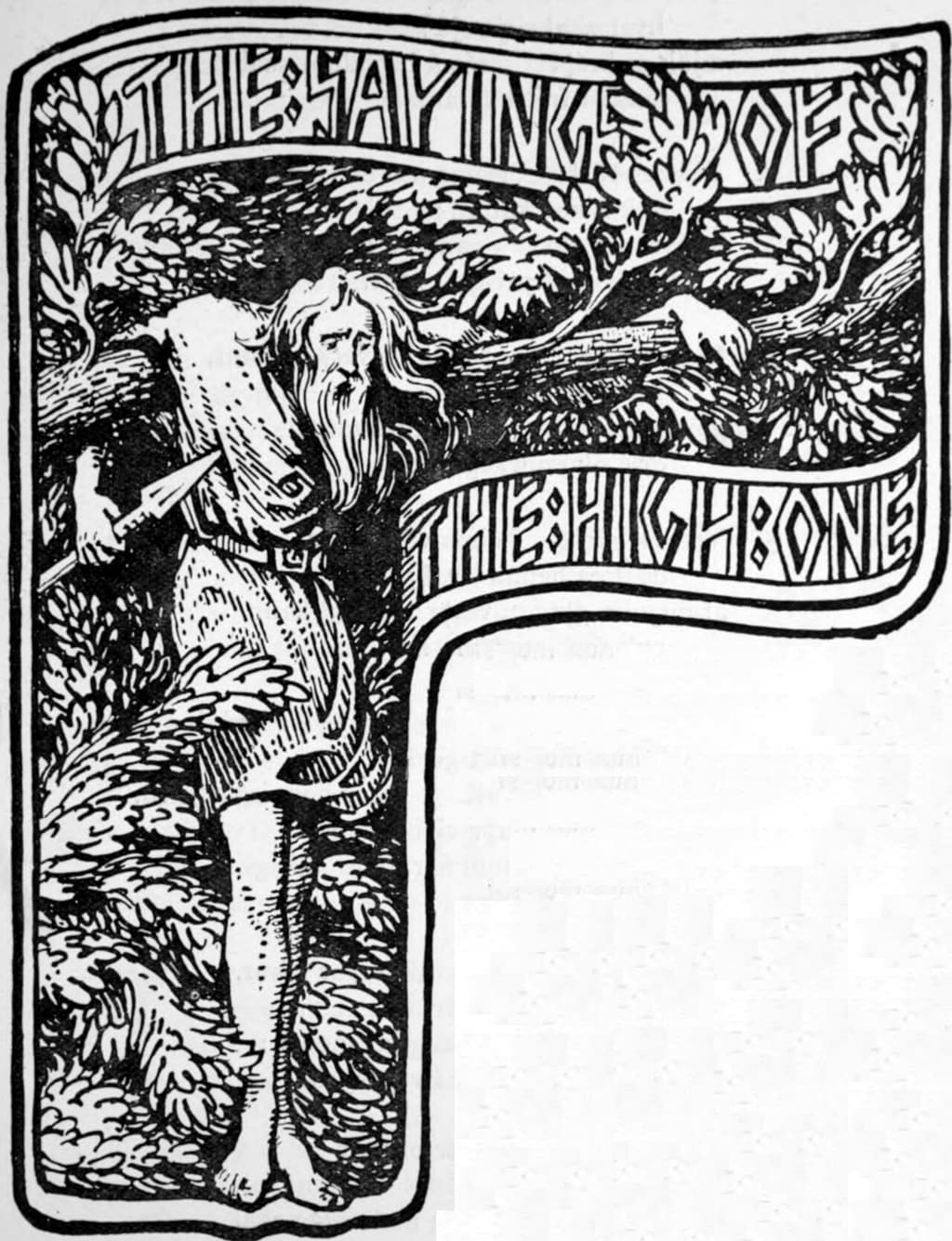
The strangest passage in Norse literature is spoken in his own voice, in the poem Hávamál. He says he hung on a windy tree for nine nights, wounded with a spear, given to Óðinn, himself to himself, on the tree whose roots no one knows. Nobody gave him bread or drink. He looked down, took up the runes screaming, and fell back.
Every element of that is deliberate and strange. He is both the sacrificer and the sacrifice; he is hung and stabbed, which is precisely how human offerings to him are described elsewhere; the tree is unnamed but is almost certainly the world-ash; and what he gains is not power but writing — the runes and the spells that go with them. The comparison with the Crucifixion has been made since the nineteenth century, and it is genuinely unresolved: the poem is preserved in a Christian manuscript, the motif of self-sacrifice is unusual, and yet the details are entirely un-Christian and the ritual practice of hanging and stabbing victims is independently attested. Pages here do not settle it, because the field has not.
His second mutilation was a trade. He gave an eye — placed, Snorri says, in the well of Mímir under one of the tree's roots — for a drink from it and the wisdom it holds. Later he consults the severed, preserved head of Mímir for counsel. Odin's characteristic transaction is a permanent loss for an increment of knowledge, and he never stops making it.
What he is actually good at
The domains are not the standard war-god's. He wins battles by giving victory rather than by fighting, and he is notorious for withdrawing it from a favourite at the last moment, which the sagas treat as a known hazard of his patronage rather than a betrayal.
- Poetry. He stole the mead of poetry from the giant Suttungr by seducing the giant's daughter Gunnlöð over three nights, drinking all three vats, and escaping as an eagle to spit the mead into vessels in Asgard. Skaldic verse is his gift, and this is why a poet's kenning for verse can be "Odin's theft".
- Seiðr. The magic of prophecy and manipulation, which Snorri says he learned from Freyja. It was regarded as a woman's practice, and a man doing it attracted the accusation of ergi, unmanliness — an insult Loki throws at him directly in Lokasenna. That the chief of the gods practises the shameful magic is one of the sharpest tensions in the corpus, and modern retellings almost always remove it.
- The dead. Half the slain go to him and half to Freyja, which is easy to forget because Valhalla dominates the popular picture. The chosen dead are not a reward; they are an army he is stockpiling for a battle he has been told he loses.
- Knowledge by interrogation. Vafþrúðnismál and Grímnismál are wisdom-contests in disguise, in which Odin turns up unrecognised and asks questions until his opponent is destroyed by his own answers.
The names, and what they are for
Snorri's Grímnismál commentary lists dozens of names for him, and the list is a functional inventory rather than a poetic flourish: Grímnir, the masked one; Alföðr, all-father; Ygg, the terrible; Bölverkr, evil-worker; Gangleri, wanderer. He arrives in stories in disguise, as a one-eyed old man in a broad hat and blue cloak, and the disguise is the point. A god whose defining activity is extracting information from people who do not know who they are talking to needs a hundred faces.
The family the sources cannot agree on
Odin is the son of Borr and the giantess Bestla, and with his brothers Vili and Vé he kills the primordial giant Ymir and builds the world out of the body — skull for sky, blood for sea. That much is consistent. After that, the genealogies get argumentative. Thor is his son by the earth, Jörð, in the Eddic material, and Baldr and Höðr are his sons by Frigg. Váli is begotten specifically to avenge Baldr and does so at one day old. Other sons appear in one list and not another, and Snorri's tendency to tidy is visible.
Ravens named Huginn and Muninn — Thought and Memory — fly the world daily and report; Snorri has Odin remark that he fears more for Muninn's return than Huginn's, which is a startlingly modern anxiety for a god to voice. The wolves Geri and Freki eat the meat he does not, since he lives on wine alone. The spear Gungnir never misses, and throwing a spear over an enemy army to dedicate it to him is attested as an actual battlefield practice.
Snorri's problem, in miniature
Anyone reading about Odin runs into a specific difficulty. In the Prose Edda's prologue and in Heimskringla, Snorri presents him not as a god but as a human king who migrated from Asia — "Æsir" glossed as men of Asia — and who deceived people into worshipping him. This is euhemerism, the standard medieval Christian device for handling pagan gods without endorsing them, and it lets a thirteenth-century Icelandic Christian write four hundred pages about heathen mythology without heresy.
The problem is that the same author is our best source for the myths themselves. Snorri quotes older poems, and where we can check him against those poems he is often faithful. Where we cannot check him, we are trusting a man with an explicit theological reason to reframe what he is reporting. This site marks the places where a detail rests on Snorri alone, and the essay on the Snorri problem works through the method.
Saxo Grammaticus, writing in Denmark around the same time, does something similar but nastier: his Odin is a fraudulent sorcerer, humiliated and exiled at one point, and his versions diverge sharply from the Icelandic ones.
The end he already knows
Odin's entire programme makes sense only in light of Völuspá. He has consulted a dead seeress, he has traded an eye for foresight, and what he has learned is that the wolf Fenrir will kill him at Ragnarok, and that his son Víðarr will avenge him by tearing the wolf apart. He assembles the hall of chosen warriors anyway. This is the ethical core of the whole tradition: the value of an action does not depend on it working.
Odin now
He is the most adapted Norse god, and almost every adaptation drops the same things. Marvel's Odin is a stern king and a father, with the sorcery, the deception and the sexual disgrace absent. Gaiman's American Gods gets closer than most, keeping the confidence-trickster and the appetite for sacrifice. Vikings and the God of War games both use the paranoid-manipulator reading, which is defensible from Grímnismál.
Two modern claims are worth flatly correcting. Wednesday is genuinely his day — Old English Wōden's day, translating the Latin day of Mercury, which tells you which Roman god late antique Germanic speakers thought he resembled. And the appropriation of Odinic symbolism by far-right movements has no basis whatever in the sources: the god of the medieval material is a foreign-travelling, magic-practising, gender-transgressing patron of poets, which is close to the opposite of what he is currently being recruited for.
Questions this page gets asked
Was Odin ever the chief god in actual worship, or only in the poems?
The evidence pulls two ways. Adam of Bremen's description of the temple at Uppsala puts Thor in the central seat, and hammer amulets vastly outnumber any Odinic object in the archaeological record. Place-names containing his name cluster in Denmark and central Sweden and are far rarer in Norway and Iceland. The reasonable conclusion is that he was pre-eminent among a specific class — rulers, warband leaders, poets — and that the literature survives because those were the people who commissioned it.
Why does he have so many wives and lovers who are giantesses?
Because the boundary between gods and giants is political rather than biological, and marriage across it is how the two groups are entangled. Odin himself is half-giant through Bestla. The pattern is asymmetric and worth noticing: gods take giant women, while giants who attempt to take goddesses are killed for it.
Is Odin the origin of Father Christmas?
The claim is popular and is at best unproven. A midwinter Odin leading a wild hunt exists in later Germanic folklore, and Santa's beard and gift-giving have been attached to it since the nineteenth century. But the modern figure descends demonstrably from Saint Nicholas by way of Dutch and American reworking, and the Odinic elements enter the story late, as folklorists were looking for pagan survivals everywhere.