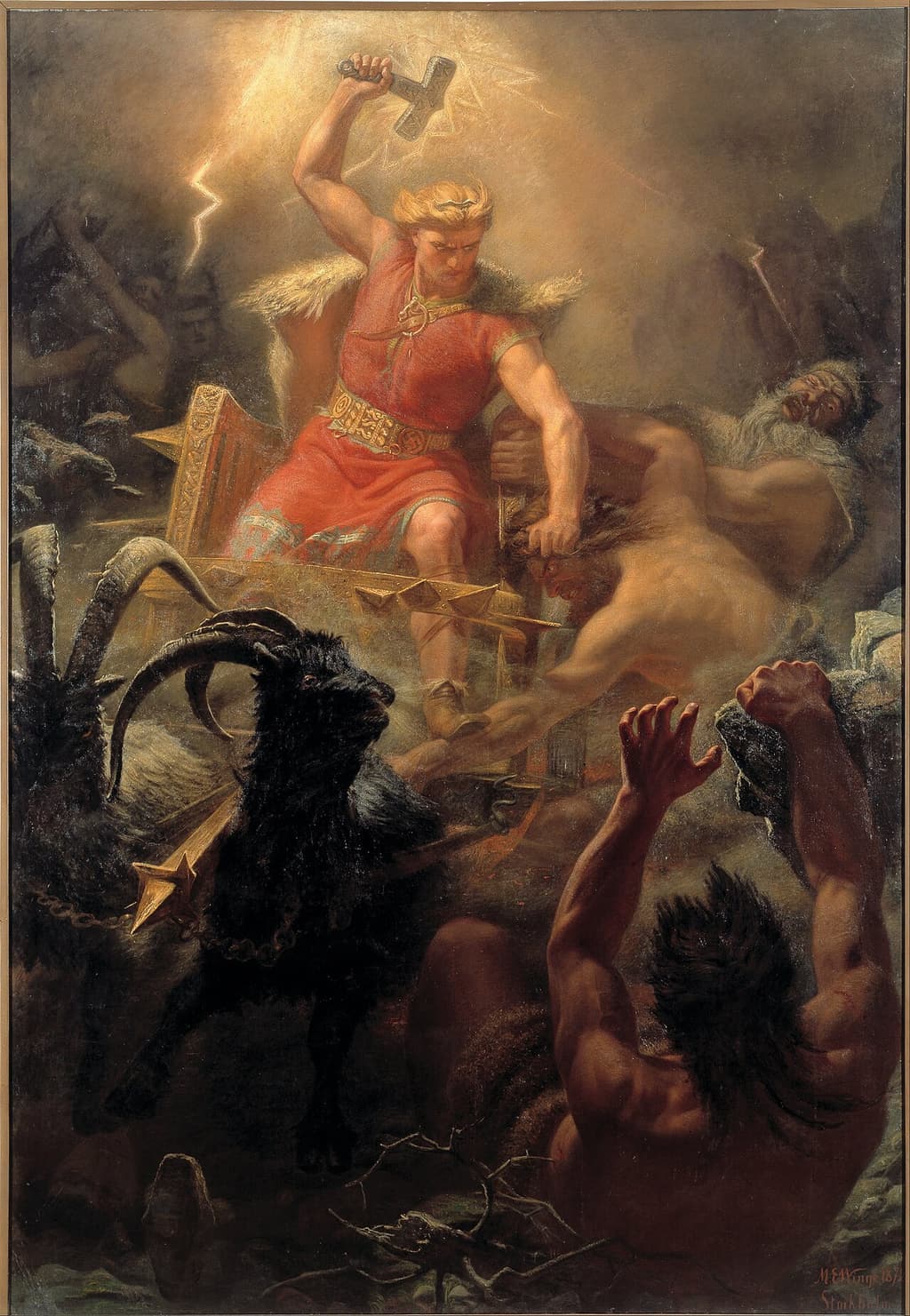
If you want to know which god ordinary Scandinavians actually cared about, count the objects. Thousands of small hammer amulets in silver, bronze, amber and iron have come out of Viking Age graves and hoards, worn round the neck, and no other Norse deity has anything approaching that presence in the archaeological record. Thor's name is embedded in personal names across the region — Thorstein, Thorbjorn, Thorgerd, Thorvald — at a rate no other god's approaches. Place-names dedicate fields and groves to him from Norway to England. He is the god of the household, the voyage, the boundary and the ordinary crisis.
That popularity sits oddly beside the literature, where he is very often the butt of the joke.
The red-bearded one, and what he does
Thor's function is protection, and it is protection by violence against a specific enemy: the giants, the powers outside the fence. He is not a god of war between people. He does not receive the battle-dead; he has no interest in strategy; the Hárbarðsljóð poem has a disguised Odin taunting him with the fact that Odin gets the nobles while Thor gets the thralls, and the insult lands precisely because it is true. Thor belongs to the people who work.
His equipment is unusually well specified. Mjölnir is a short-handled hammer, made by dwarfs, and short because Loki in fly-form interfered with the bellows during the forging; it returns when thrown. The iron gloves are needed to hold it, and the belt Megingjörð doubles his strength. His chariot is drawn by two goats, which he can slaughter, eat and resurrect from the bones the next morning — a detail that reads like folklore and that has a precise consequence in one story, when a farm boy splits a bone for the marrow and the resurrected goat is lame.
The hammer as a symbol had a second life during the conversion period: moulds have been found that cast crosses and hammers side by side, and hammer pendants become commoner, not rarer, as Christianity arrives. It reads as a statement.
The fishing trip
The story that best shows what he is comes from Hymiskviða and Snorri's retelling, and it is also, unusually, depicted on stone carvings from England and Sweden, which means it was current and recognisable.
Thor goes to the giant Hymir's hall, eats two of the giant's oxen at a sitting, and is taken fishing. He rows out further than Hymir wants to go, baits his hook with an ox head, and hauls up Jörmungandr, the serpent that encircles the world. He braces so hard his feet go through the bottom of the boat and he stands on the sea floor. He raises the hammer. And Hymir — terrified — cuts the line, and the serpent sinks back. Snorri says Thor threw the hammer after it and struck off Hymir's head with a slap.
The scene is the whole theology in one image: the god of the middle enclosure hauling the outer chaos into view, and not quite being allowed to finish. They meet again at Ragnarok, where Thor kills the serpent and walks nine steps before its venom kills him.
The comedy
Norse literature is entirely comfortable making its most popular god ridiculous, which is worth taking seriously rather than treating as irreverence.
In Þrymskviða, the hammer is stolen and the giant Þrymr will return it only in exchange for Freyja as a bride. Freyja's refusal is so violent the halls shake. Heimdall proposes that Thor go instead, dressed as the bride, with Loki as bridesmaid — and Thor's objection is not that it is dangerous but that the Æsir will call him unmanly. He goes. At the feast he eats an entire ox, eight salmon and three barrels of mead, and Loki explains that the bride has been too excited to eat for eight nights. When the hammer is laid in the bride's lap to hallow the marriage, the poem ends in slaughter.
In Snorri's account of the journey to Útgarða-Loki, Thor loses three contests by illusion: he cannot drain a horn whose far end is the sea, cannot lift a cat that is the world-serpent, and is wrestled to one knee by an old woman who is old age. He is furious when it is explained. The comedy depends entirely on the audience knowing how strong he actually is.
The one place he outranks Odin
Adam of Bremen, describing the temple at Uppsala around 1075 from second-hand report, places three statues inside and puts Thor in the middle, with Odin and Freyr to either side, and says Thor governs the air, thunder, winds, rain and crops. The literary sources put Odin first without hesitation. Both cannot be a description of the same hierarchy, and the likeliest resolution is that there was no single hierarchy: court poetry reflects what kings and skalds cared about, and Adam is reporting — however unreliably — on a cult site serving a farming population.
Family, and what Marvel changed
He is the son of Odin and the earth-giantess Jörð. His wife is Sif, whose famous golden hair was made by dwarfs after Loki cut off the original as a prank. His sons Magni and Móði survive Ragnarok and inherit the hammer; his daughter Þrúðr appears mainly in kennings. Magni's mother is the giantess Járnsaxa.
That Loki is his brother is a comics invention. In the sources Loki is Odin's blood-brother, not Thor's kin at all, and he travels with Thor constantly as a companion of convenience whose plans cause the trouble the hammer then solves. The blond hair is also Marvel; Norse sources are emphatic that the beard is red, and "red-beard" is used as a byname. Nor is Mjölnir worthiness-locked in any medieval text — the enchantment is that it returns to the hand.
The thunder in the language
Thursday is his day, Old English Þunres dæg, translating the Latin day of Jupiter — which records that late antique Germanic speakers looked at the Roman sky-and-thunder god and saw their own thunderer, not their own sky-father. The thunder gods compared page examines how far that equation actually holds, and it holds less well than the calendar implies: Jupiter is a god of the state and of oaths, and Thor is a god of the fence around the field.
The related Continental forms — Donar in Old High German, Þunor in Old English — carry the same meaning as the common noun for thunder, which is not true of most divine names and suggests something about how old and how basic the figure is.
Reading him now
Start with Þrymskviða, which takes fifteen minutes and is very funny. Then Hymiskviða for the fishing. Then Snorri's Útgarða-Loki sequence in Gylfaginning, which is the best-told piece of prose narrative in the whole corpus and is the source of nearly every "Thor gets tricked" reference you will meet elsewhere.
Was Thor worshipped for protection, or for weather?
Both, and the two are less separable than they look. The hammer hallows: it is used in the sources to bless a marriage and to consecrate a funeral pyre, and rune stones ask him to hallow the inscription. A god who keeps out the giants and a god who brings the rain that makes the crop are, from a farmer's point of view, doing the same job — keeping the destructive outside on its own side of the boundary.
Why does he have a chariot when the thunder is a hammer?
The chariot is the older layer. Wheeled thunder-vehicles turn up widely in related traditions, and the rumbling of wheels as an explanation for thunder is not specific to Scandinavia. The hammer, or axe, is a Northern development, and depictions of it firm up considerably in the tenth century — which is exactly when the amulets proliferate.