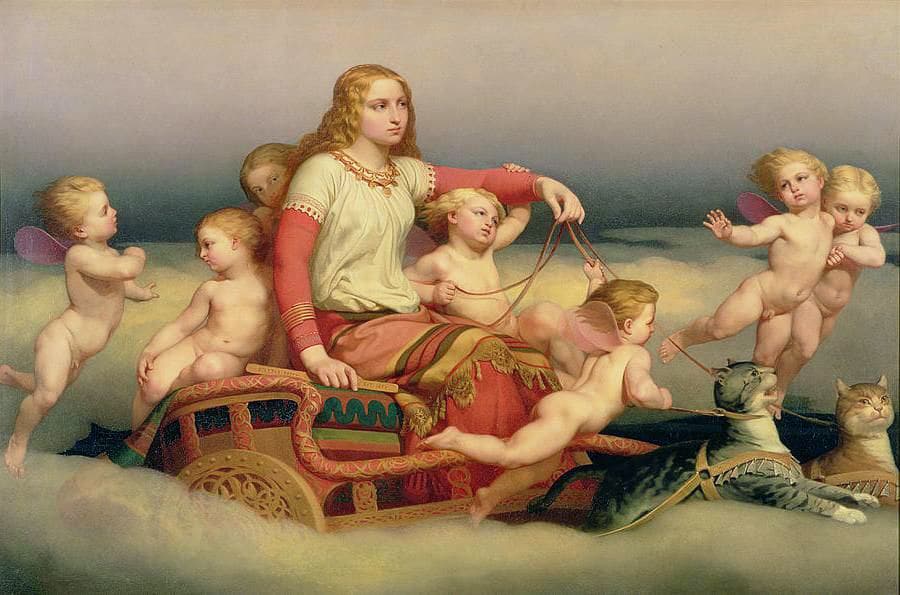
Half of everyone who dies in battle goes to Freyja. Not to Odin — to Freyja, first, before he takes what is left. The line is in Grímnismál, stanza 14: Fólkvangr is the ninth dwelling, Freyja allots the seats there, and each day she chooses half the slain while Odin has the other half. Snorri repeats it in Gylfaginning without comment, as though it were unremarkable.
It is not unremarkable. Almost everything popular culture says about the Norse afterlife assumes one destination for the honoured dead and one god issuing the invitations, and the earliest surviving mythological poem on the subject says the opposite in a single clause and then moves on. That is characteristic of how Freyja survives: enormous claims, stated flatly, never explained.
Vanir, hostage, immigrant
She is not originally one of the Æsir. Freyja, her twin-adjacent brother Freyr and their father Njörðr come to Ásgarðr from the Vanir as part of the settlement ending the Æsir–Vanir war — a hostage exchange that turns permanent. Ynglinga saga adds that among the Vanir a brother could marry his sister, and that Freyr and Freyja were born of such a union, a custom the Æsir forbade. Whether that is genuine cult memory or Snorri reasoning backwards from the pair's closeness is not decidable from the evidence.
What she brings with her is seiðr. Ynglinga saga chapter four says plainly that Freyja was the priestess who first taught this magic to the Æsir — which means the signature practice of Odin, the one that makes him strange and gets him accused of unmanliness in Lokasenna, is a Vanir import taught to him by a woman. The most powerful figure in the pantheon learned his best trick from the immigrant.
The names, and what they are hiding
She carries more bynames than any other Norse goddess: Vanadís (lady of the Vanir), Gefn, Hörn, Mardöll, Sýr, Skjálf, Þrungva. Snorri's explanation is that she took these while wandering among unknown peoples searching for her missing husband. That is a rationalisation of something odder — a cluster of divine names that were probably local goddesses absorbed into one figure, or one figure worshipped under regional titles. Place-name evidence supports a real, wide cult: Frøihov, Frøvi, Frösvi and similar formations scatter across Norway and Sweden, alongside far denser concentrations for Freyr.
Óðr, and the gold
Her husband is Óðr, and the sources give him almost nothing to do except leave. He travels far, he does not return, and Freyja weeps tears of red gold for him, searching under assumed names among strange peoples. Their daughters are Hnoss and Gersemi, both of whose names simply mean treasure; skalds use "Freyja's tears" as a kenning for gold, which is either the origin of the story or the residue of it.
The name Óðr is the neuter noun for mind, frenzy, poetic inspiration — and it is the same root as Óðinn. A goddess whose vanished husband is called Frenzy, married to a war-goddess who takes half the slain, standing beside a chief god called Frenzy's-master, is the single strongest piece of evidence in the Frigg-and-Freyja question: are these two goddesses, or one goddess split apart during transmission? The Norse texts are unambiguous that they are two. The comparative and etymological evidence keeps refusing to settle.
Brísingamen and the price
The necklace Brísingamen is her defining possession and the sources are unusually blunt about how she got it. Sörla þáttr, a late fourteenth-century text preserved in Flateyjarbók, says she found four dwarfs making it, wanted it, and bought it by sleeping one night with each. That version is late and written by a Christian who frames her as a mortal concubine of Odin, so its hostility is not neutral evidence — but Húsdrápa, composed around 985, already refers to Loki and Heimdall fighting in seal form over the Brísinga men, which means the necklace and a theft story attached to it were current three centuries earlier. The object is old; the shaming account may not be. See the necklace itself for the Old English cognate in Beowulf, and symbol traditions for how it has been read since.
Cats, a boar, and a falcon skin
Her chariot is drawn by cats — Snorri says two, and does not name them; every name you will find online for them is modern. She also rides a boar called Hildisvíni, "battle-swine," which in Hyndluljóð turns out to be her human protégé Óttar transformed, taken to a giantess to have his ancestry recited so he can win a legal inheritance case. That poem is the closest thing Norse myth has to a goddess acting as an advocate in a property dispute.
The falcon cloak she owns is borrowed constantly by Loki — to fetch Iðunn back, and to scout Þrymr's hall after the hammer goes missing. When the giant demands Freyja herself as the price of returning it, her refusal is violent enough that the halls of the gods shake and Brísingamen snaps off her neck. She is not a decorative figure in these stories. She is the one whose refusal forces everyone else to improvise.
What Lokasenna says, and what it means
At Ægir's feast Loki accuses her of having slept with every one of the Æsir and elves present, including her own brother. The accusations are formally structured — flyting is a genre with rules — and Loki says something obscene about every deity in the hall, so the individual charge is weak evidence for cult reality. What it does show is that a Christian-era Icelandic audience found "Freyja as sexually unrestrained" a legible joke, and that framing has stuck to her ever since, usually stripped of its context as a ritual insult contest.
Friday, the name, the afterlife
Old Norse frjádagr and Old English Frīgedæg both render dies Veneris, the day of Venus — and the goddess named there is Frigg, not Freyja, in every Germanic language where the two are distinguishable. English speakers who assume Friday belongs to Freyja are importing the Norse pair onto a West Germanic calendar.
Freya is now a mainstream given name in Britain, Ireland and Scandinavia, ranked in the UK top twenty through much of the 2010s — a genuine revival of a divine name with no continuous transmission behind it (see name histories). Marvel's films gave her almost nothing; God of War Ragnarök gave her a great deal, including a mother-son relationship with Baldur and a witch's cottage, neither of which exists in any medieval source. The half-of-the-slain line, which is the most startling thing anyone ever wrote about her, is the part the adaptations consistently leave out. Her place in the Norse family tree and the tradition as a whole both depend on it.
Did anyone actually worship Freyja, or is she a literary construct?
Place-names, personal names and one significant legal detail say yes. Icelandic and Norwegian sources record freyja surviving as a common noun meaning "lady" long after conversion, the way frú does in modern Scandinavian languages — a divine name decaying into a courtesy title is a mark of real currency, not of scribal invention. Small female figurines with drinking horns and knotted hair from Viking-age Denmark and Sweden are frequently identified with her, though nothing on them says so.
Why does a fertility goddess get the war dead?
The category "fertility goddess" is the problem, not the evidence. It is a nineteenth-century sorting box, and Freyja fits it badly: she owns a battle-boar, receives the slain, is called upon in a legal-inheritance poem, and practises the magic that lets you see and alter outcomes. Seiðr in the sagas is used to fix the result of fights and voyages. A goddess who controls how things turn out is not doing two unrelated jobs when she governs both crops and casualties.