the Nile valley
Egyptian mythology
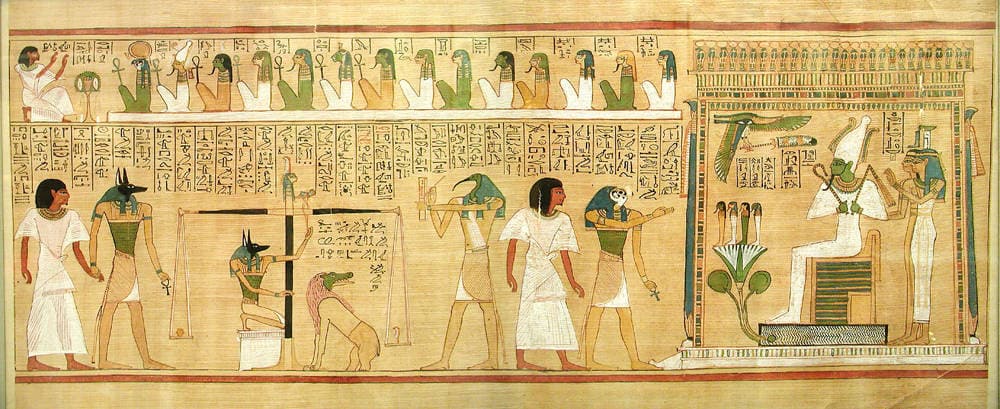
The first thing to abandon when approaching Egyptian religion is the idea of a pantheon with a fixed cast. Egyptian religion ran for well over three thousand years — longer separates the pyramid builders from Cleopatra than separates Cleopatra from us — and across that span gods merged, split, changed sex, swapped functions, rose with a dynasty and sank with it. A sentence beginning "the Egyptians believed" is almost always missing a date and a place.
Where the texts come from, and what kind of texts they are
There is no Egyptian Homer. There is no single narrative telling the great myths in order, and the reason is that the surviving religious literature was not written to tell stories to people. It was written to do things for the dead.
- The Pyramid Texts (from around 2350 BCE, Old Kingdom) are carved inside royal pyramids at Saqqara: spells to get a dead king into the sky and among the imperishable stars. They are the oldest substantial religious writing from anywhere, and they refer to myths allusively, as things everybody knows.
- The Coffin Texts (Middle Kingdom) do the same work on the coffins of non-royal Egyptians — the afterlife democratising downward.
- The Book of the Dead, properly the Book of Coming Forth by Day (New Kingdom onward), is a customisable papyrus spell-book buried with the deceased, containing the weighing of the heart, the negative confession before the forty-two judges, and instructions for every hazard between death and the field of reeds.
- Temple inscriptions, particularly the very complete late temples at Edfu, Dendera and Philae, carry long mythological texts — but they date from the Ptolemaic and Roman periods, two thousand years after the Pyramid Texts, and they are systematising rather than reporting.
- Literary papyri such as the New Kingdom Contendings of Horus and Seth are the closest thing to narrative myth, and that one is broadly comic: a divine lawsuit dragging on for eighty years while the tribunal bickers.
- Plutarch's On Isis and Osiris (around 100 CE) is the only continuous account of the Osiris myth that exists — and its author was a Delphic priest working in his own language, for his own countrymen, reading Egyptian religion out through Middle Platonism. Every retelling of Osiris in every modern book descends from it, which is a genuinely uncomfortable fact and one that Egyptian pages here state rather than hide.
Three creations, three cities, no contradiction
Different theological centres taught different creations, and Egyptians appear to have felt no need to choose between them.
At Heliopolis, the self-created Atum arises on the primordial mound from the waters of Nun and produces Shu and Tefnut, who produce Geb and Nut, who produce Osiris, Isis, Seth and Nephthys — the Ennead, and the family the Osiris story runs on. At Memphis, Ptah creates by conceiving in the heart and speaking with the tongue, an intellectual creation that predates by two millennia the philosophical ideas it is often said to anticipate. At Hermopolis, eight primordial frog- and snake-headed deities, the Ogdoad, embody the qualities of the pre-creation waters themselves. Thebes later inserted Amun above all of it.
These are not competing sects. They are local claims to priority, and Egyptian theology handled them by combination rather than by argument — which is why gods routinely appear fused into compounds like Amun-Ra, Ptah-Sokar-Osiris or Ra-Horakhty. Fusion is the standard operation of Egyptian religion, not a scribal error.
What the gods were for
The organising principle is ma'at — order, truth, rightness, the correct functioning of the cosmos — set against isfet, chaos. The king's entire justification was maintaining ma'at, and temple ritual was maintenance work, performed daily behind closed doors: the god's image woken, washed, dressed, fed, and put to bed by priests acting in the king's name. Ordinary people did not attend. They met the gods when the image came out of the sanctuary in procession at festivals, and they addressed personal prayers to household gods, ancestors and the local sacred animals instead.
Two ideas make the Egyptian material unlike anything else on this site. The first is that the sun's daily journey is a nightly battle, not a metaphor: the sun god sails through the twelve hours of the underworld each night and is attacked by the serpent Apophis, and if he loses, the sun does not come up. Egyptians performed rituals to help. The second is that a person is composed of several separable parts — the ka, the ba, the akh, the name, the shadow, the body — each of which must be preserved for the person to continue. Mummification, tomb goods, offering cults and the insistence on writing the name are all engineering to that end.
The periods you need in your head
Because every Egyptian statement needs a date attached, these are the divisions used throughout this site. They are conventional and their boundaries are debated, but a claim placed in the wrong one is usually a wrong claim.
- Old Kingdom (c. 2686–2181 BCE) — pyramid building, the solar theology of Heliopolis dominant, the Pyramid Texts written for kings alone.
- Middle Kingdom (c. 2055–1650 BCE) — the Coffin Texts extend the afterlife to officials; Osiris rises to prominence and Abydos becomes a pilgrimage destination.
- New Kingdom (c. 1550–1069 BCE) — empire, Amun of Thebes supreme and enormously wealthy, the Book of the Dead standardised, the Valley of the Kings, and the Amarna episode.
- Late Period (c. 664–332 BCE) — animal cults at industrial scale, Persian conquest, intense archaising.
- Ptolemaic and Roman (332 BCE–4th century CE) — Greek and then Roman rulers building Egyptian temples in Egyptian style; Edfu, Dendera and Philae, and the sources most modern retellings unknowingly rely on.
Names, spellings and what nobody knows
Egyptian was written without vowels, so every divine name you read here is a modern convention rather than a pronunciation. Ra, Re and Pre are the same god; Amun, Amon and Ammon likewise; Isis and Osiris are Greek forms of names the Egyptians wrote closer to Aset and Wesir, and Thoth is Greek for Djehuty. This site uses the form most readers will recognise in the running text and gives the Egyptian and Greek variants in the at-a-glance panel, because a search for the wrong spelling is the commonest reason someone fails to find a page.
The animals, and why they are not what they look like
Egyptian gods appear as animals, as humans, and as humans with animal heads, and the third form is a piece of visual grammar rather than a belief that Anubis had a jackal's head. The animal signals the god's nature: the jackal that haunts the desert cemetery for the god of embalming; the falcon whose flight and eye suit a sky-and-kingship god; the lioness whose ferocity suits a goddess of plague and of the king's rage. The same god can appear in all three modes on one wall.
Late in the period, sacred animals were bred, mummified and dedicated at industrial scale — millions of ibises at Saqqara, cats at Bubastis — as votive offerings. This is a Late Period development that Greek and Roman visitors found bizarre and reported prominently, which has skewed the popular picture of the whole three thousand years.
The Amarna interruption
Around 1350 BCE, the pharaoh Akhenaten did something no other Egyptian ruler did: he suppressed the other gods, closed temples, erased Amun's name from monuments, moved the capital to a new desert site, and directed worship to the Aten, the visible disc of the sun, accessible through the king alone. It lasted roughly two decades. After his death the old cults were restored, his city abandoned and his name struck from the king lists. Whether it constitutes the first monotheism, and what if any relationship it bears to Israelite religion, has been argued since the nineteenth century and is not settled — the honest position is that the connection is unproven and popular certainty about it is unwarranted.
From Egypt to the rest of the world
Egyptian religion did not simply stop. Isis acquired a Hellenised cult that spread across the entire Roman Empire, with temples in Rome, Pompeii and London and initiates who had never seen the Nile — the version Apuleius describes in The Golden Ass. The temple at Philae was still operating into the sixth century CE, the last functioning Egyptian sanctuary. And the last person able to read hieroglyphs died at some point in late antiquity, closing the writing system for fourteen centuries until the Rosetta Stone reopened it in the 1820s. Everything on these pages is a product of that decipherment; before it, Europe's Egypt was entirely invented.
Where to start
Start with the Osiris material, because the murder, the search, the reassembly and the posthumous son organise most of the rest of the religion. Then read a Book of the Dead papyrus with its vignettes — the Ani papyrus is the famous one — to see how the afterlife was actually navigated. Then the Contendings of Horus and Seth, which is short, strange and much funnier than its reputation.
Avoid, at least at first, anything promising Egyptian mysteries, lost wisdom or pyramid secrets. That genre descends from Renaissance misreadings of Greek Hermetic texts and from nineteenth-century occultism, and it has nothing to do with what the Egyptians wrote about themselves.
The Egyptian family tree lays out the Heliopolitan Ennead and marks where other traditions cut across it, which they constantly do. The figures written up so far follow below.
gods
- Rathe sun, kingship, creation
- Osiristhe dead, resurrection, fertility
- Isismagic, healing, motherhood
- Horuskingship, the sky, vengeance for his father
- Setstorms, the desert, disorder
- Nephthysmourning, protection of the dead, the night
- Anubisembalming, the necropolis, weighing the heart
- Thothwriting, wisdom, the moon
- Hathorlove, music, joy
- Sekhmetwar, plague, healing
- Bastetprotection of the home, cats, fertility
- Ptahcraftsmen, creation by speech, architecture
- Amunhiddenness, air, kingship
- Atumthe first god, completion, the setting sun
- Gebthe earth, earthquakes, fertility of the soil
- Nutthe sky, the stars, the coffin's protection
- Shuair, light, the space between sky and earth
- Tefnutmoisture, dew, the fierce eye
- Ma'attruth, cosmic order, justice
- Sobekthe Nile, crocodiles, military power
- Khnumthe Nile flood, the potter's wheel, creation of bodies
- Khonsuthe moon, travel, healing
- Mutmotherhood, queenship, the vulture
- Montuwar, the fierce bull, Theban kingship
- Neithweaving, war, hunting
- Serqetscorpions, venom, protection of the dead
- WadjetLower Egypt, protection of the king, the uraeus
- NekhbetUpper Egypt, the vulture, royal protection
- Beschildbirth, the household, warding off evil
- Taweretchildbirth, pregnancy, protection of mothers
- Kheprithe rising sun, becoming, transformation
- Atenthe visible sun disc, light, Akhenaten's sole god
- Minfertility, the eastern desert routes, the harvest
- Hapithe Nile inundation, abundance
- Seshatwriting, measurement, records
- Hekamagic as a force, the power that makes ritual work
- Sokarthe Memphite necropolis, craftsmanship in death, the underworld
- Nefertemthe lotus, perfume, the first sunrise
- Imhoteparchitecture, medicine, wisdom
- Wepwawetwar, the opening of roads, funerary procession
- Renenutetthe harvest, nursing, the true name given at birth