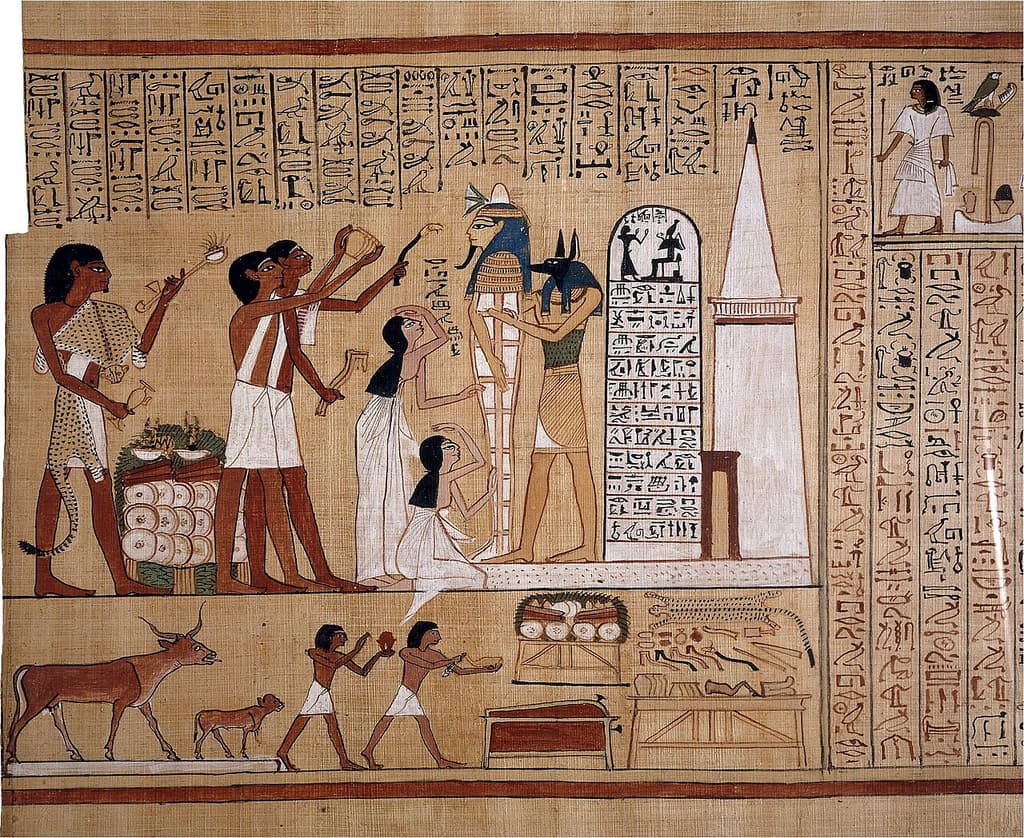
There is a peculiar hole at the centre of Egyptian religion. Osiris was murdered by his brother, and Egyptian texts refer to that murder for three thousand years — in mortuary spells, temple hymns, festival calendars, magical papyri, royal inscriptions — without ever once narrating it. They allude, they mourn, they celebrate the aftermath, and they will not describe the act. The continuous story everybody knows, with the coffin and the dismemberment, comes from a Greek writing in the second century CE.
What the Egyptians would not say
The reticence looks deliberate. Egyptian writing operates on a principle that naming a thing gives it reality and power, which is why enemies' names are struck out, why hostile figures in tomb art are sometimes drawn mutilated so they cannot act, and why the serpent of chaos is ritually destroyed in effigy rather than described in triumph. Setting down the murder of the god of resurrection in full might have been understood as re-performing it.
So the sources circle. The Pyramid Texts address the dead king as Osiris and speak of him being raised, gathered, his scattered parts collected. The Great Hymn to Osiris on the Stela of Amenmose praises his kingship, his wife's search and her revival of him. The Coffin Texts and the Book of the Dead assume the whole framework. Temple inscriptions at Abydos and Dendera describe the rites without describing the crime.
Plutarch, in On Isis and Osiris, supplies what they withhold: Set tricks Osiris into a fitted chest at a banquet, seals it and throws it in the Nile; it drifts to Byblos and is grown into a tree; Isis recovers it; Set finds the body again and cuts it into fourteen pieces, scattered; Isis recovers all but the phallus, eaten by fish, and makes a replacement.
That account is invaluable and it must be read for what it is — a Greek priest of Apollo, writing in Greek, for a Greek readership, twenty-five centuries after the cult began, interpreting Egyptian religion through Platonic philosophy and openly saying so. The fourteen pieces and the missing phallus appear in no Egyptian text. This site gives the Plutarch narrative, clearly labelled, and separates it from the Egyptian material — which is a distinction almost no popular retelling makes.
The king who died and stayed dead
What Osiris does not do is return to life in the sense a modern reader expects. He is revived long enough for Isis to conceive Horus, and then he is king of the dead — permanently, in the Duat, in the west. He does not resume his earthly throne; his son takes it after a long legal battle with Set.
That distinction destroys a great deal of nineteenth-century comparative scholarship. Frazer's Golden Bough assembled Osiris, Adonis, Attis and Tammuz into a class of "dying and rising gods" whose deaths and returns explained the agricultural year and, by extension, a good deal else. Egyptologists have spent a century qualifying it into near-nothing: Osiris' revival is transfer to a different kingship, not a return, and the individual cases in Frazer's class turn out to differ from each other in almost every particular. The category still circulates widely in popular writing, and it should be treated as a Victorian scholarly artefact rather than a description of Egyptian belief.
Green skin, wrapped legs, crook and flail
His iconography is unusually stable and unusually specific. He is shown as a mummiform figure — legs bound in wrappings, so he cannot walk — with skin painted green or black. Green is vegetation and renewal; black is Nile silt, the same regenerative colour used for Anubis. He wears the atef, a tall white crown with a plume on either side, and holds the crook and flail crossed on his chest: the shepherd's hook and the agricultural flail, the two instruments of a ruler who both guides and threshes.
The djed pillar is his: a column with four crossbars, read as his backbone, and raised upright in a ceremony that enacted his restoration. It is one of the commonest amulets in Egypt and appears carved into architecture, on coffin floors under the spine of the deceased, and in the "raising the djed" rite performed by the king.
Then there are the corn mummies — actual objects, found in tombs and museum collections: Osiris-shaped beds or trays filled with earth and sown with barley, watered, and left to sprout in the darkness of a tomb. Green shoots emerge from the outline of the god. Nothing states the theology more plainly, and it was physical, repeatable and cheap.
Abydos, and the festival nobody was allowed to watch
Abydos was his great cult centre, and it acquired the claim to hold his head. Egyptians of every period wanted to be buried there or, failing that, to have a memorial stela erected there so they could participate — the site is thick with private stelae from people buried elsewhere entirely, which is essentially a subscription to the afterlife.
The annual mysteries of Osiris at Abydos are known chiefly from the twelfth-dynasty stela of Ikhernofret, an official sent by the king to organise them, who describes his own role: the procession of the god's barque, a staged conflict against his enemies, the "great going forth", the mourning, and the return of the god in triumph to his temple. Ikhernofret says he did these things; he does not say what happened inside, and the mystery holds.
The other great festival, Khoiak, was tied to the agricultural cycle and involved the making of the corn-Osiris figures and the raising of the djed.
Where the whole judgement idea comes from
The most consequential thing about Osiris is not the story of his death but its constitutional result: because he died, was mourned, was vindicated against Set in a divine tribunal, and became king of the dead, every Egyptian who dies can follow the same route. The dead person becomes "the Osiris [name]" in funerary texts — not like Osiris, but identified with him.
Hence the Hall of Two Truths, the weighing of the heart against the feather of Ma'at, the negative confession before forty-two assessors, and the vindication that follows. What began in the Old Kingdom as a royal privilege spreads down the social scale through the Middle Kingdom, until by the New Kingdom anybody who could afford a papyrus could equip themselves for the trial. It is the only afterlife on this site in which conduct is assessed and the outcome can genuinely differ — a contrast with the Mesopotamian house of dust that is set out on the afterlife comparison.
Afterwards
His cult continued into the Roman period and merged with Isis' export success; Serapis, engineered under the early Ptolemies as a Greek-facing composite of Osiris and the Apis bull with Greek attributes, was a deliberate act of state religious design, and it worked well enough to give Alexandria one of the ancient world's great temples.
Modern treatments are thinner than for most Egyptian gods, largely because he is not visually dramatic and does not fight. Where he appears in fiction and games he is generally the benevolent murdered king, which is at least the right shape, though the resurrection is nearly always misread as a return to life.
Three questions worth separating
Was Osiris originally a fertility god or a king?
Both threads are old and neither is clearly prior. His mummiform kingship, his crook and flail and his royal titles pull one way; the corn mummies, the green skin and the Khoiak agricultural timing pull the other. The most defensible reading is that Egyptian thought did not separate the two: the king's function was to keep the land productive, so a dead king who guarantees the harvest is one idea, not two joined together.
Why is Set his brother rather than an outsider?
Because the conflict is about succession, and succession disputes happen inside families. The Contendings of Horus and Seth is a lawsuit over inheritance, argued before a tribunal for eighty years with recesses and appeals, and its shape reflects Egyptian legal practice. An external enemy would make it a war story; a brother makes it a case.
Is the phallus detail Egyptian at all?
No surviving Egyptian text contains it. Egyptian sources do describe Isis conceiving Horus from the revived body, and depict her as a kite hovering over it — an image that implies the conception without narrating it. The eaten phallus and the replacement are Plutarch's, and they may reflect a genuine local tradition he was told, or a Greek elaboration. It cannot currently be decided.