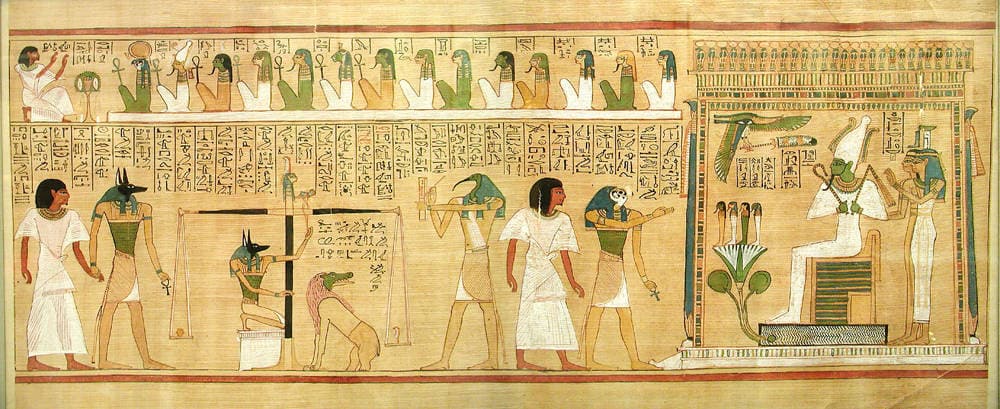
Anubis is black, and the colour is the first thing to get right, because almost every modern treatment gets it wrong. Egyptian black — kem — is the colour of the silt the Nile lays down when the flood recedes, the fertile soil that made the country habitable and gave it its own name for itself, Kemet, the Black Land. It is the colour of things that come back. Real jackals are a sandy grey-brown; Anubis is painted black because he belongs to regeneration, not because he belongs to death.
A god of technique
He is the god of embalming, and he is depicted doing the work: bent over the body on the lion-headed bier, adjusting the wrappings, with the canopic jars beneath. Egyptian mummification was a seventy-day technical procedure with a precise sequence of dehydration, evisceration, resination and bandaging, and the priest performing the crucial stages wore a jackal-headed mask, acting as the god.
That mask is not a supposition. A painted cartonnage jackal head, made to be worn — the wearer looked out through the neck — survives in the Roemer- und Pelizaeus-Museum in Hildesheim, and it is one of the most direct pieces of evidence anywhere for how an Egyptian ritual actually looked from inside. Tomb paintings show the masked figure standing at exactly the moment the texts assign to him.
The scales, and what he does not do
The famous scene from spell 125 of the Book of the Dead — best known from the Papyrus of Ani in the British Museum — is frequently described as Anubis judging the dead. He does not judge. Look at the roles:
- Anubis leads the deceased in by the hand, adjusts the plumb line of the balance and checks it is true. He is the technician of the scale.
- The heart of the deceased sits in one pan; the feather of Ma'at, order and truth, in the other.
- Thoth stands with palette and reed, recording the result.
- Ammit — crocodile head, lion forequarters, hippopotamus hindquarters — waits beside the balance to devour the heart that fails.
- Osiris presides on the throne at the end of the hall, and it is his court.
Anubis' job is to guarantee that the measurement is accurate. In a religion whose central value is ma'at, correct order and correct measure, the god who certifies that the instrument reads true holds an office of real dignity. Calling him a death god flattens all of that into a costume.
He is also the Imy-ut, "he who is in the place of embalming", and Khenty-imentiu, "foremost of the westerners" — the west being where the sun sets and where the cemeteries were, on the desert edge opposite the towns. That title was originally a separate jackal god of Abydos whom Anubis absorbed, and later it passes to Osiris. Egyptian titles migrate between gods as their fortunes change, and following that migration is one way to date a text.
Older than Osiris
Anubis is one of the oldest gods attested in Egypt, prominent in the Old Kingdom Pyramid Texts, where he is the principal mortuary deity and Osiris is not yet dominant. As the Osiris cult rose through the Middle Kingdom, Anubis was not displaced but subordinated: he became the one who prepared Osiris' body, the loyal specialist rather than the king of the dead.
His parentage shifts to match. The earliest material makes him a son of Ra — one text calls him the son of the sun god born of a cow goddess. Later tradition, and Plutarch reporting it, makes him the child of Nephthys by Osiris, conceived when she disguised herself as her sister Isis, and raised by Isis afterwards. That later genealogy neatly binds an ancient independent god into the Osirian family, which is exactly what it was for. This site records both, because both were current in their periods, and a page that gives only one is describing a snapshot as though it were the whole three thousand years.
Where he was worshipped
Cynopolis — the Greek name, "dog city", modern el-Qeis — was his principal cult centre in Middle Egypt. But his real presence is in the cemeteries, and above all at Saqqara, where the Anubieion sanctuary sat at the edge of the necropolis and where excavation has produced dog and jackal catacombs containing an estimated eight million animal mummies. These were votive: a pilgrim paid for an animal to be mummified and dedicated on their behalf, a practice that ran at industrial scale in the Late and Ptolemaic periods.
Whether the animals in those catacombs were bred for the purpose, and how many were killed young, has been the subject of recent scanning studies, and the findings are uncomfortable — a large proportion are very young animals, and some bundles contain only fragments or nothing at all. It is a reminder that ancient religion had an economy attached.
Jackals at the edge of the graves
The choice of animal has a straightforwardly grim logic. Egyptian cemeteries were on the desert margin, in sand, and jackals dug there. A god who takes the form of the scavenger that threatens the dead is a god who has been recruited: the danger is converted into the guardian. The recumbent black jackal on a shrine, in the pose familiar from Tutankhamun's tomb, is watching the door.
Modern zoology has an addendum. The animal Egyptians depicted, long assumed to be the golden jackal, was reclassified after genetic work published in 2015 as the African golden wolf, a distinct species. The English name is stuck by convention, but the animal on the shrine is not quite the animal the word suggests.
The Greek and Roman afterlife
Greeks equated him with Hermes, on the ground that both conduct the dead, producing the composite Hermanubis — a figure who appears in Roman-period art in Greek dress with a jackal head, and who belongs to the Isis cult as it spread through the empire. Whether the equation is a good one is worth examining, and the comparison of Anubis with Hermes as conductor of souls does exactly that; the short answer is that Hermes escorts and Anubis prepares, which are different jobs.
Roman satirists mocked the animal-headed gods, and the barking Anubis is a stock joke in Latin poetry. It says more about Roman attitudes to Egypt than about the god.
The modern villain
Films and games have made him a death god and usually an antagonist — the Mummy films, Stargate, Assassin's Creed Origins, Smite and a long tail of others. The template is stable: black jackal-headed figure, underworld, hostility. There is essentially nothing in the Egyptian material to support it. He is a functionary of extraordinary status whose work is careful, protective and technically demanding, and the closest modern analogue to what he actually does is a mortician combined with a court's forensic officer.
The one adaptation strain that gets closer is the strand of contemporary fiction that treats him as a psychopomp with a duty of care, which is at least in the right register.
Questions people arrive with
Is Anubis the same as the "dog of the dead" in other mythologies?
No, and the comparison is usually made too quickly. Cerberus guards a gate to keep the dead in; Anubis prepares bodies and certifies a weighing. The recurrence of dogs at the boundary of the dead across unrelated traditions is real and interesting, and it is examined properly on the underworld guardians hub rather than assumed here.
Why does he sometimes appear fully human?
In the New Kingdom and later, particularly in scenes emphasising his priestly role, he can be shown as a man with a jackal's head, as a full jackal on a shrine, or occasionally with a human head in a mixed register. The three modes are visual grammar rather than different gods: the animal states the nature, the human states the office.
Did ordinary Egyptians pray to him, or only the wealthy?
Both, but differently. Full mummification was expensive and the elaborate Book of the Dead papyri were commissioned objects. The votive animal mummies at Saqqara, by contrast, were a mass-market devotional purchase, and the sheer number of them is the best evidence that his cult reached far beyond people who could afford a decorated tomb.