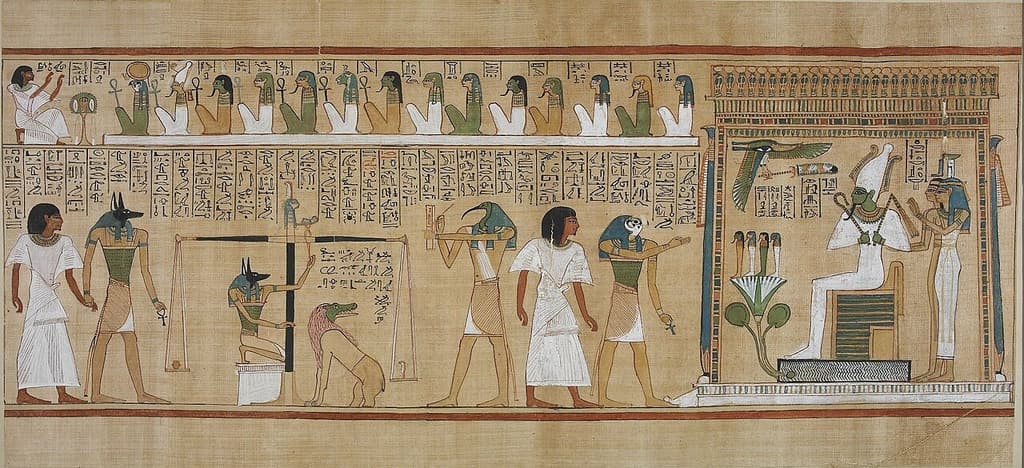
Every night, according to the Egyptians, the sun goes into the earth and has to fight its way out. That is not a metaphor for sunset. It is a described, mapped, hour-by-hour journey through a hostile country, illustrated on the walls of royal tombs in the Valley of the Kings with the precision of a route plan, and its outcome was not taken for granted. Ra's daily voyage is the most sustained piece of cosmological imagination in Egyptian religion, and nearly everything else about him follows from it.
Two boats and twelve hours
By day he crosses the sky in the mandjet barque; at sunset he transfers to the mesektet barque and enters the Duat, the underworld, through a gate in the west. The books written on tomb walls — the Amduat, the Book of Gates, the Book of Caverns — divide the night into twelve hours, each a region with its own inhabitants, its own gates, its own guardians who must be named correctly.
The crew is fixed and instructive: Ma'at stands in the prow, order itself steering the sun; Thoth records; Set, of all gods, stands at the front with a spear, because when the enemy is chaos you want the strongest violent god you have on your side. In the seventh hour the serpent Apophis attacks, coiling to drink the river dry and stop the boat. He is defeated every night and is never destroyed, because chaos is not the sort of thing that can be finished — only repelled again.
Priests helped. The Book of Overthrowing Apophis, a surviving temple text, prescribes rites in which a wax figure of the serpent is named, spat on, bound, cut and burned. Egyptian religion is full of this: the cosmos requires maintenance, and the temple was the workshop.
In the deepest hour, the sun's ba unites with the body of Osiris, and from that union it is renewed. Then it emerges at dawn as Khepri, the scarab, pushed up over the horizon exactly as a dung beetle rolls its ball — an image drawn from watching insects and applied to the largest object in the sky.
Three names for one sun
Ra at noon, Khepri at dawn, Atum in the evening: the Egyptians treated these as phases of one god and simultaneously as gods with independent cults and genealogies. Atum, the self-created one at Heliopolis, who brought forth Shu and Tefnut by his own act and began the Ennead, is both a separate creator and the aged evening form of the sun. The compound Ra-Atum appears in the Pyramid Texts; the compound Ra-Horakhty, "Ra-Horus of the two horizons", fuses him with the falcon sky god.
This is not confusion and it is not a scribal error. Fusion is the standard operation of Egyptian theology, and the original never disappears when a compound forms. The strongest case is Amun of Thebes, an obscure god of hidden air who rose with the Theban dynasties until he was fused into Amun-Ra, king of the gods, holding the wealthiest priesthood in the country — while Ra continued to be worshipped as Ra, and Amun as Amun, at the same time.
The old king
The most human story about him is his decline. In the Book of the Heavenly Cow, inscribed in New Kingdom royal tombs, Ra has grown old ruling on earth: his bones are silver, his flesh gold, his hair lapis lazuli, and humanity plots against him because he is weak.
He sends his Eye — the divine feminine power that goes out from him — as the lioness Sekhmet to punish them. She does, and then cannot be stopped: she goes on killing until the destruction of humanity is imminent. Ra has seven thousand jars of beer dyed red with ochre poured over the fields. She drinks it, believing it to be blood, becomes drunk, and sleeps. Humanity survives by a trick played on the god's own instrument of vengeance.
Ra then withdraws from earth, rising on the back of the sky-cow Nut, and rules from the sky thereafter, leaving Thoth to govern the night. It is an old god's abdication, and it is the closest Egyptian religion comes to explaining why the gods no longer walk about among people.
The other great story of his weakness is Isis extracting his secret name by poisoning him with a serpent made from his own saliva — told fully on her page, because the story is about her power rather than his.
The kings who belonged to him
From the Fourth Dynasty onward the pharaoh takes the title Son of Ra, and it is written into the royal titulary for the rest of Egyptian history. This is a political fact as much as a religious one: it ties the legitimacy of the crown to the daily reliability of the sun. Heliopolis, Egyptian Iunu, was the great centre — a temple complex almost entirely lost under modern Cairo, of which one standing obelisk of Senusret I remains — and its priesthood's theology dominates the Pyramid Texts.
The obelisk itself is a solar object, its pyramidion sheathed in electrum to catch first light, and the several dozen Egyptian obelisks now standing in Rome, Paris, London, New York and Istanbul are among the most conspicuous survivals of his cult anywhere.
Then there is the Amarna interruption, which was not about Ra as such but is impossible to separate from him. Akhenaten's Aten is the visible sun disc with rays ending in hands, worshipped to the exclusion of others — a solar theology taken to a point no other Egyptian ruler attempted, and abandoned within a generation.
The Eye, which is not an eye
The Eye of Ra is a distinct entity: a feminine, violent, protective power that goes out from the sun god and acts independently, and which is identified variously with Sekhmet, Hathor, Bastet, Wadjet, Mut and Tefnut depending on the text and the mood. When it is angry it destroys; when it is pacified it becomes the loving goddess. The uraeus — the rearing cobra on the pharaoh's brow — is this power, positioned to spit at the king's enemies.
The Eye of Ra should not be confused with the Eye of Horus, the wedjat, which is a different symbol with a different story about injury and healing. Popular sources merge them constantly. The distinction matters, and anyone interested in how these symbols are used and misused outside Egyptology will find the two conflated almost everywhere.
What modern versions do with him
The dominant modern treatment casts him as a tyrannical alien or a villain-king — Stargate being the most influential single instance, with a long train of games following. It reverses his function exactly: Ra is the guarantor of order against chaos, and a story in which he is the oppressor requires the whole Egyptian cosmology to be inverted first.
The other common modern move is to make him simply "the sun god" of a tidy pantheon, one deity per department. Egyptian religion never worked that way — Aten, Khepri, Atum, Horakhty, Amun-Ra and Ra are all solar, coexisting, and sometimes the same.
Questions this page answers
Is it Ra or Re?
Both, and neither is a pronunciation. Egyptian wrote no vowels, so every vocalisation of a divine name is a modern convention. "Re" is the form preferred in most Egyptological writing; "Ra" is overwhelmingly commoner in general use and is what people search for. The two never refer to different gods.
Why does the sun god need a boat?
Because in Egypt the way you travelled was by river. The Nile was the road, and every serious journey — including a god's, including a dead king's — was made by boat. Full-size buried boats beside pyramids, including the reassembled cedar vessel from beside the Great Pyramid, make the point physically: the sky was imagined as a waterway because the country was one.
Did anyone actually think the sun might not rise?
The rites against Apophis were performed daily and the texts state the stakes explicitly, so the anxiety was at least formally real. What that meant psychologically for an individual Egyptian is not recoverable. The safest statement is the one the sources support: the sunrise was understood as an achievement, secured each night by effort, and the temple's job was to contribute to it.