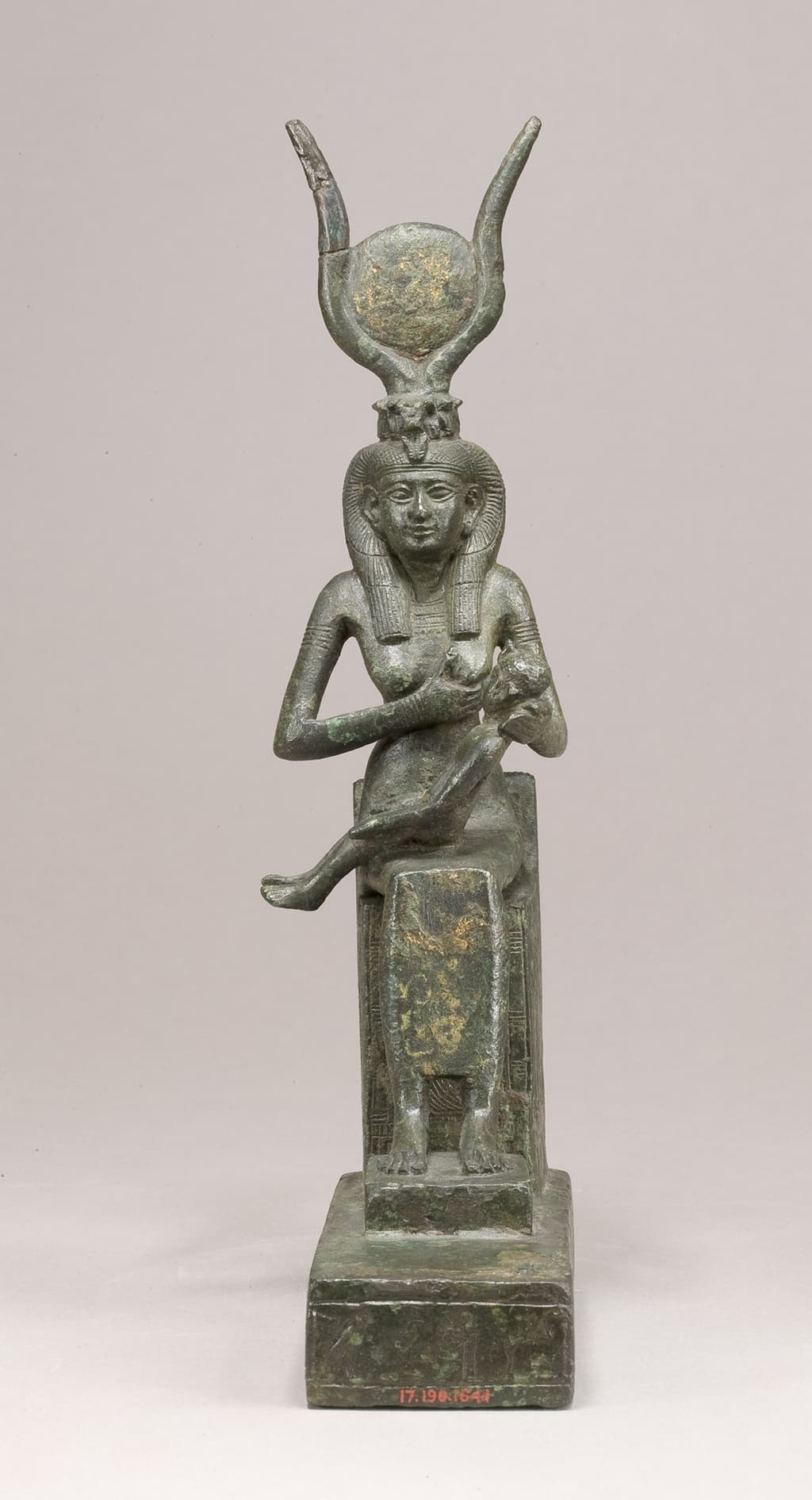
Isis is the only deity on this site whose worship spread from its homeland across an entire empire, acquired initiates who had never seen the country that produced her, and outlasted the civilisation that invented her by several centuries. A temple to her stood in Rome, another at Pompeii, and dedications turn up as far north as London and the Rhine frontier. To understand how an Egyptian goddess became a Mediterranean one, you have to start with what she was in Egypt, which is something rather narrower and considerably stranger.
The throne on her head
Her Egyptian name, Aset, is written with the hieroglyph of a throne, and she wears that sign on her head in almost every image. What the connection means is argued: that she personifies the seat of kingship, that she is the mother whose lap the king occupies, or that the writing is a pun that hardened into an attribute. What is not in doubt is that her earliest attested role is bound up with the king's legitimacy — she appears already in the Pyramid Texts of the Old Kingdom, some 2,300 years before Cleopatra, mourning and protecting the dead king.
Her other constant form is a kite, the shrieking bird of prey that circles carrion. She and her sister Nephthys take that form to mourn, and the sound of the funeral lament was understood as the kite's cry. It is a considerably fiercer image than the serene mother of later art.
The search, and the reassembly
She is inseparable from the death of Osiris, and it is essential to say what the Egyptian sources do and do not contain. They allude to the murder constantly — in spells, hymns, temple inscriptions, mortuary texts — and they never narrate it. The connected story with the coffin, the fourteen scattered pieces and the missing phallus comes from Plutarch's On Isis and Osiris, written in Greek around 100 CE by a priest of Apollo at Delphi.
What Egyptian material does supply is the function: Isis searches, finds, reassembles and revives her husband long enough to conceive, and Amenmose's stela, carrying the great hymn to her husband, states explicitly that her wings made the breath which stirred him. It is a magical act, not a medical one, and it establishes the pattern for every Egyptian funerary rite afterwards. The mourning of the two sisters over the body is enacted by priestesses at funerals, and the dead person becomes an Osiris to be revived by an Isis.
The name of Ra
The best story about her is not about grief at all. In a New Kingdom papyrus, Isis is described as a woman clever in her heart, wiser than millions of men, who decides she wants the power of Ra himself. Ra is old: he dribbles, and his saliva falls to the ground. Isis gathers the earth mixed with the spittle, moulds a serpent, and leaves it at a crossroads where the sun god passes on his daily circuit.
The serpent bites him. Ra burns with a poison he did not create and cannot name, and calls the gods for help. Isis arrives and offers to cure him — on one condition: she must know his true, secret name, the one he has hidden inside his body since his birth. Ra recites his epithets, all the grand public names, and she tells him flatly that his name is not among them. Eventually, in extremity, he lets the name pass from his body to hers, on the promise that she will reveal it only to her son Horus.
This is the founding text of Egyptian magic. Egyptian heka works by knowing and speaking names, and this is the story of how the most powerful practitioner in the pantheon acquired the most powerful name there is. It also establishes that her power is not derived from her husband or her son: she takes it from the sun god, by a trick, on her own account.
The mother in the marshes
The other great Isis narrative is her hiding in the Delta marshes at Chemmis, raising the infant Horus in secret from Set, and dealing with the accidents of an unprotected childhood. The Metternich Stela, a magical monument covered in spells, preserves the episode in which the child is stung by a scorpion while she is away, and she halts the sun's boat in the sky until Thoth supplies the cure.
These texts are practical objects. Spells recounting how Isis healed Horus were spoken over sick children, on the principle that a precedent creates power: what she did for her son, the magician's words can do for this child. Water poured over such a stela and drunk carried the cure. That is what Egyptian religion looked like at ground level.
Out of Egypt
From the Ptolemaic period onward, Isis changes character. Greek writers identified her with Demeter, Aphrodite and Tyche, and Greek-language hymns — the aretalogies, found at Kyme and elsewhere — have her declare in the first person what she invented and controls: writing, law, marriage, sailing, the courses of the stars. She becomes myrionymos, "of ten thousand names", a goddess who claims to be the reality behind every other goddess.
Her mystery cult spread with traders and soldiers. Initiates underwent a night ordeal and emerged reborn; Apuleius' Metamorphoses, in its eleventh book, gives a first-person account of an initiation, and it is the fullest description of any ancient mystery religion by someone who went through one. Roman authorities repeatedly tried to suppress her temples in the first century BCE and repeatedly failed. Her temple at Philae, on an island in the Nile, was the last functioning Egyptian sanctuary, closed under Justinian in the sixth century CE.
The Madonna question, honestly
The image of Isis seated with the infant Horus on her lap, offering the breast, resembles the Christian Virgin and Child, and the resemblance has been remarked on since at least the Renaissance. Egypt was also the birthplace of Christian monasticism and the home of a very large early Christian population, so contact is not speculative.
That said, the arguments cut in several directions. Iconographic influence — the visual type — is easier to defend than doctrinal influence, and the Marian title Theotokos was fought out in Alexandria in the fifth century in terms drawn from Christology, not from Egyptian religion. The honest position is that visual borrowing is plausible and widely accepted in some form, and that the stronger claims of direct derivation are not demonstrable. Anyone asserting either certainty is going beyond the evidence.
Her name today
Two modern facts about her are worth stating plainly. She remains one of the most widely used Egyptian deities in fiction and games, generally as a magician or healer, which is at least closer to the sources than most such treatments. And from 2014 her name was appropriated as an acronym by a terrorist organisation, which has affected search results, museum labelling and the naming of children and businesses in the English-speaking world — a piece of collateral damage to a four-thousand-year-old goddess that has no bearing whatever on who she was.
Questions readers bring here
Was Isis originally a minor goddess?
In the earliest material she is one of several protective mourners rather than a dominant figure, and her prominence grows steadily through the New Kingdom and explodes in the Late and Ptolemaic periods. That trajectory — from a specialised funerary role to a universal goddess — is unusual in Egyptian religion, where most deities stay tied to a city, and it is the reason her cult travelled while others did not.
Why is she shown with wings?
The wings belong to the kite form and are functional in the imagery: she spreads them over the body of Osiris and over coffins and sarcophagi to shelter and revive. On the corners of the golden shrine of Tutankhamun, she and three other goddesses stand with arms outstretched in exactly that protective posture. The wings are an act, not an ornament.
Where can her temples actually be seen?
Philae is the great one, moved stone by stone to the island of Agilkia in the 1970s to escape the reservoir behind the Aswan dam, and still standing. Behbeit el-Hagar in the Delta is a spectacular ruin. Outside Egypt, the sanctuary of Isis at Pompeii survives with its wall paintings, and it was among the first buildings excavated there in the eighteenth century — which is how her cult entered the European imagination well before hieroglyphs could be read.