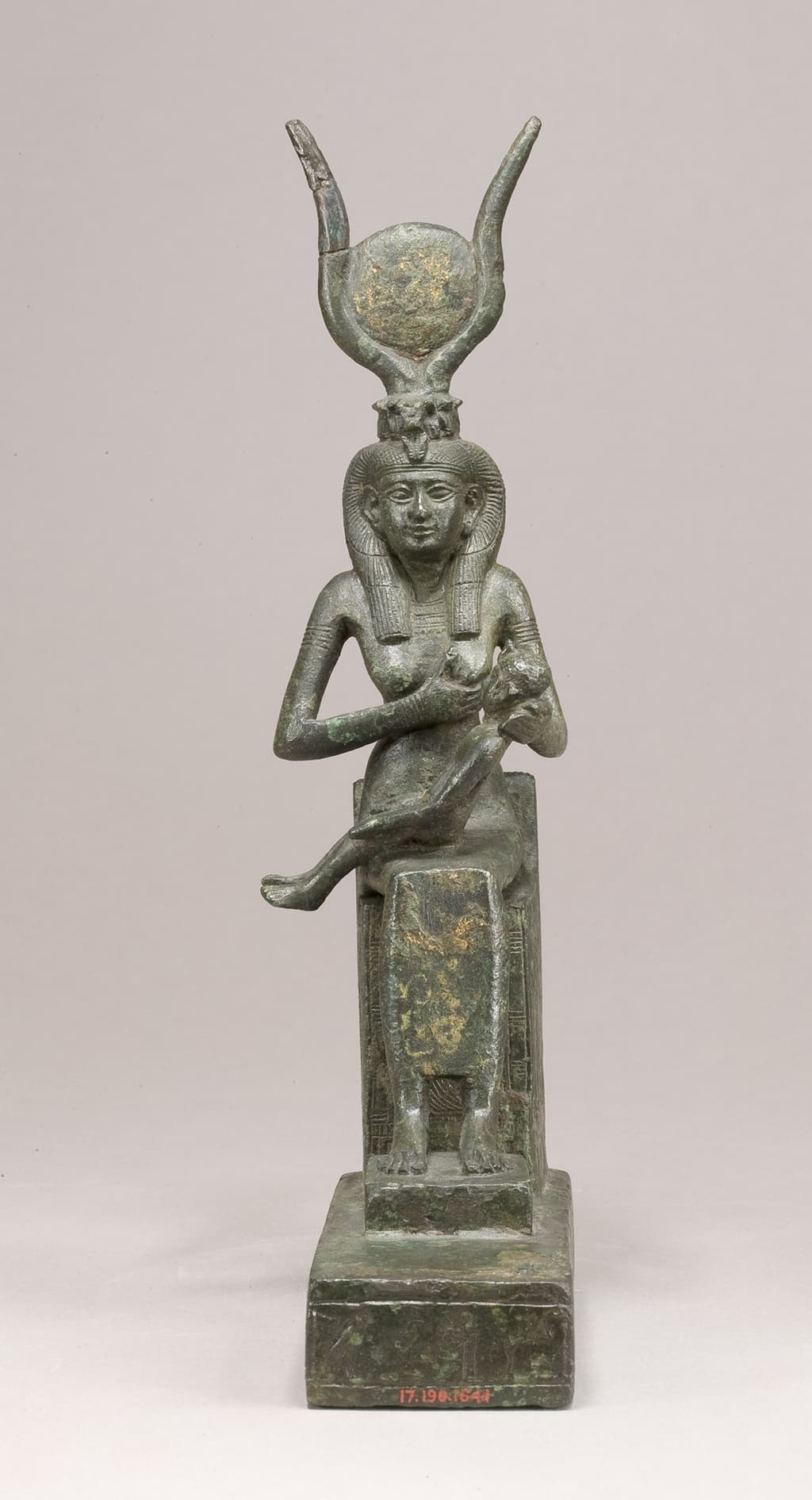
There is no single Horus. That is the first thing to settle, because almost every popular account quietly assumes there is, and then produces a biography that no Egyptian would have recognised. The falcon god Hor — "the distant one", the one high above — is attested from the very beginning of Egyptian history, on First Dynasty objects, as a sky god whose two eyes are the sun and the moon and whose body is the vault of heaven. Separately, the Osiris story produces a child born to a widow, hidden in the marshes, who grows up to claim his murdered father's throne. Egyptian priests knew these were not obviously the same figure, and they tried several ways of holding them together.
Elder and Younger, and the epithets that keep them apart
Where the sources want to be precise they use epithets rather than the bare name.
- Haroeris, Horus the Elder, is the ancient sky falcon. At Kom Ombo he shares a double temple with Sobek, each god given his own axis, sanctuary and priesthood in one building.
- Harsiese, Horus son of Isis, is the heir of the Osirian narrative.
- Harpocrates, Horus the Child, is the infant with a finger at his lip and the sidelock of youth — the form that the Greeks and Romans exported, and the one whose gesture they misread as an instruction to keep silent.
- Ra-Horakhty, Horus of the Two Horizons fused with the sun god, is a solar composite rather than a phase of anyone's life.
- Horus of Behdet, the winged disc over temple doorways across Egypt, is a form so widely used it became architectural.
Some texts make Haroeris a brother of Osiris and Set — a fifth child of Geb and Nut — which puts him in the generation above the avenger. The Egyptian family tree draws both lines because both were written down.
The living king
The single most consequential fact about him is constitutional rather than mythological. The reigning pharaoh is Horus. The oldest element of the royal titulary is the Horus name, written inside a serekh — a palace façade with a falcon standing on top — and it appears on the Narmer Palette at the threshold of recorded Egyptian history. The dead king becomes Osiris; his successor is Horus; the succession is therefore not a change of regime but the same divine event happening again. Three thousand years of Egyptian political theology run on that sentence.
This is why the Osiris myth is not merely a good story. It is a legal precedent about inheritance, decided in the gods' favour of the son, and every king who ever cited it was citing his own title deed.
The Contendings, which is funnier than you expect
Papyrus Chester Beatty I, a New Kingdom manuscript, preserves The Contendings of Horus and Seth — eighty years of litigation before the Ennead, and it is broad comedy. The tribunal cannot reach a verdict. Ra is petulant and sulks in his tent after being insulted about the size of his shrine. The gods write to Neith for an opinion, and she tells them to give the office to Horus and compensate Set with two Semitic goddesses; they take the advice and then fail to act on it. Isis disguises herself, tricks Set into condemning himself out of his own mouth, and Horus is so enraged at his mother's interference that he cuts off her head. A boat race is held in stone ships, and Horus wins by building his out of pine and plastering it to look like stone.
The episode modern readers find hardest is the sexual contest, in which Set attempts to dominate Horus and Isis intervenes with semen, lettuce and a great deal of practicality, ending with Set's own seed calling out from inside Horus's body and humiliating him before the court. It is crude, it is deliberately funny, and it is the same religion that produced the funerary literature. Egyptian sacred texts were not required to be solemn.
The eye
In the fighting Set tears out Horus's eye. It is restored — by Thoth in most accounts, by Hathor with gazelle milk in another — and the healed eye becomes the wedjat, the sound or whole eye, the commonest amulet in Egypt. Horus then offers it to his dead father, and the offering of the eye becomes the model for every offering made to any god or any dead person thereafter: the priest presenting bread at an altar is repeating what Horus did. The full account of the symbol, including the fraction claim that is now largely rejected, is on the Eye of Horus page, and the confusion with the quite separate Eye of Ra is the single most common error in popular symbol writing.
Set loses something too — his testicles, in most tellings — and the mutilations are paired. Neither combatant walks away whole.
Nekhen, Edfu, and a temple that still has a roof
His oldest cult centre is Nekhen, which the Greeks called Hierakonpolis, the city of the hawk — a Predynastic settlement in Upper Egypt where the Narmer Palette and a gold falcon head were excavated, and one of the places where the Egyptian state can be watched forming.
His best-preserved is Edfu, the Ptolemaic temple of Horus of Behdet, which survived because sand buried it. Its walls carry the Triumph of Horus, a text with stage directions: the god harpoons Set in the form of a hippopotamus, in ten episodes, performed annually. Whether the temple staged it as drama with actors or narrated it in procession is argued, but the script's division into scenes is on the wall. Edfu also hosted the Festival of the Beautiful Reunion, when Hathor travelled upriver from Dendera by barge to spend two weeks with him — a marriage kept up by boat, annually, for centuries.
Wearing the whole country
Horus wears the pschent, the double crown: the white crown of Upper Egypt inside the red crown of Lower Egypt. The pairing is not decorative. Egypt understood itself as two lands held together by the king, and the god of kingship wears the joint. Set, in the older scheme, held the red land of the desert while Horus held the black land of the floodplain, and the two of them are shown together binding the papyrus and lotus around the sema-tawy — the union sign — on the sides of royal thrones. The gods who fight in the courtroom are used, in the throne room, as the emblem of a country that works.
What later ages did with him
Harpocrates travelled. Roman-era bronzes of the child god turn up across the Mediterranean, and his finger-to-lip gesture — Egyptian shorthand for a child — was read by Greeks and Romans as a call for silence, which is how Harpocrates ended up as the classical god of secrecy, a meaning his own religion never gave him. The cippi of Horus, small stelae showing the child standing on crocodiles and gripping snakes and scorpions, were poured with water that was then drunk as a cure for venom; the Metternich Stela in New York is the finest of them.
Nineteenth-century occultism and its modern descendants have used him for a great deal he cannot support, including the persistent claim of a Horus–Jesus parallel built from details — a December birth, twelve disciples, a crucifixion — that are absent from every Egyptian source and traceable to a small number of Victorian writers. That claim gets a plain refusal here, because the Egyptian material is interesting enough without it.
Questions about the many Horuses
Why is he sometimes a falcon and sometimes a man with a falcon's head?
The two forms carry different information. The full falcon is the god in his own nature, and it is the form used on standards, on the serekh and on the horizon. The falcon-headed man is the god acting in a human scene — crowning a king, leading the dead to Osiris — where he needs hands. A third form, a plain human child, belongs to the nursing scenes and the household amulets.
Is the Eye of Horus the same as the "all-seeing eye" on the dollar bill?
No, and the resemblance is coincidental. The eye in a triangle is an eighteenth-century European emblem of divine providence with roots in Christian iconography and Renaissance geometry. The wedjat is a falcon's eye with the markings of a lanner falcon's cheek stripe drawn beneath it, and it does not appear in a triangle in any Egyptian context.
Did anyone worship Set alongside Horus, or were they enemies everywhere?
Both at once, and the balance shifts by period. Ombos in Upper Egypt was a working Set cult while Edfu, a short distance away, was carving him being harpooned. Two Nineteenth Dynasty pharaohs were named Seti — "man of Set" — and a Ramesside royal document is dated to a festival of Set. The Set page follows that reversal in detail.