Thoth is the god of the thing you are doing right now. Writing, reading, counting, keeping a record, checking a record against a fact — the whole apparatus by which a civilisation remembers itself belongs to him, and Egypt was the civilisation that invented most of it. His Egyptian name is Djehuty, and the god the Greeks met and renamed after their own Hermes was already, by then, two and a half thousand years old.
Ibis and baboon
He has two animals and they are not interchangeable.
The sacred ibis — Threskiornis aethiopicus, a white bird with a black head and a long downcurved bill — is his commonest form. The bill is often noted as resembling a reed pen, and the bird's methodical probing of mud for food has an obvious visual affinity with a scribe working across a page. The ibis is now extinct in Egypt as a wild bird, which is a strange afterthought to a cult that mummified millions of them.
The baboon, specifically the hamadryas, is his other form, usually shown seated with a lunar disc on its head. Hamadryas baboons vocalise at sunrise, and Egyptians read this as the animals greeting the sun; a troop of stone baboons with raised paws stands at the base of obelisks and on the west side of temples for that reason. Why the same god takes a bird of the marshes and a primate of the Red Sea hills is not explained anywhere in the sources, and the two probably represent local gods absorbed into one.
The moon, and why the calendar needed him
Thoth is a lunar god, and in Egypt that makes him the god of measured time. The moon divides the year into countable units, so reckoning, the calendar and the regulation of festivals fall to him. He is called "the reckoner of years", and the first month of the Egyptian civil year carried his name.
The best-known consequence is the story behind the five days that stand outside the calendar. Nut was forbidden to give birth on any day of the year; Thoth gambled with the moon for light, won a fraction of each day, assembled five extra days from the winnings and gave them to her, and on those five Osiris, Horus the Elder, Set, Isis and Nephthys were born. The narrative form of this comes to us through Plutarch, a Greek priest writing around 100 CE and roughly two millennia after the calendar in question was established, and the epagomenal days themselves are genuinely Egyptian and very old. That combination — an authentic institution wrapped in a late foreign story — is characteristic of nearly everything Egyptian that reaches us as narrative.
In the judgement hall
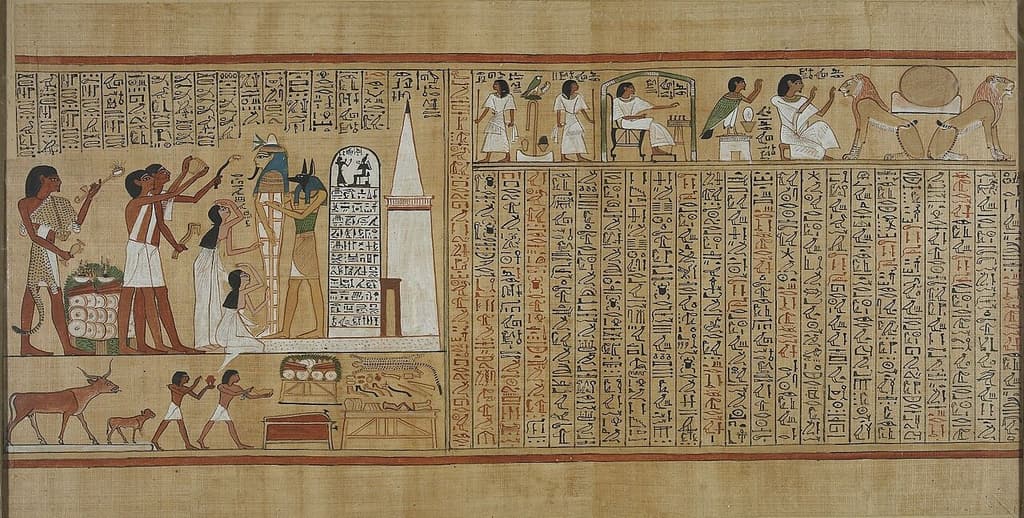
At the weighing of the heart, Thoth is the one holding the palette. Anubis adjusts the balance, the feather of Ma'at sits in one pan against the heart in the other, Ammit waits, and Thoth writes down the result and announces it to Osiris. He is the court reporter, and in a judicial system the reporter is not a minor figure: the record is the verdict.
He is also, throughout the funerary literature, the one who supplies the words. Spells work because they are correctly spoken, and the Book of the Dead — properly the Book of Going Forth by Day — repeatedly attributes its own text to him. Certain spells claim to have been found under the feet of a statue, written in his own hand, which is an ancient version of the manuscript-discovery device.
Hermopolis, and a different creation
His city is Khmun, "Eight-Town", which the Greeks called Hermopolis Magna after identifying him with Hermes; it lies in Middle Egypt near modern el-Ashmunein. The eight in the name are the Ogdoad: four frog-headed gods and four snake-headed goddesses in pairs — Nun and Naunet for the primordial waters, Heh and Hauhet for infinity, Kek and Kauket for darkness, and a fourth pair usually given as Amun and Amaunet for hiddenness. They are the conditions before creation rather than actors in it, and from their interaction the first mound rose at Hermopolis and the sun emerged from an egg, or from a lotus, depending on the text.
This matters because it is a rival account. Atum at Heliopolis made himself on the mound and generated the Ennead from his own body; Ptah at Memphis thought the world and pronounced it; Amun at Thebes was said to have preceded the lot of them. Egypt ran these systems in parallel for millennia without resolving them, and Hermopolis's contribution is the most abstract of the four. Thoth's relation to the Ogdoad is variously as their creator, their spokesman or the god who emerged from the egg, and the Egyptian family tree marks him as a god with no fixed parents anywhere: certain texts have him generate himself, while the Contendings produces him from Set's skull after Set had swallowed the seed of Horus.
The animal cemeteries
Beneath the desert at Tuna el-Gebel, Hermopolis's necropolis, are galleries containing mummified ibises and baboons in enormous numbers, deposited over centuries as votive offerings by pilgrims. Estimates for the ibis burials there and at Saqqara run into the millions. Recent genetic work on ibis mummies has been used to test whether the birds were farmed in dedicated hatcheries or trapped from wild populations, and the results point away from long-term domestication and towards seasonal capture from the wild — which does not make the scale any less startling.
The Greeks, and a two-thousand-year detour
Greeks in Egypt identified Thoth with Hermes on the basis of a rough functional overlap: both are associated with communication, both escort or assist the dead, both are quick-witted. The identification produced Hermes Trismegistus, "thrice-greatest Hermes", and under that name a body of Greek philosophical and alchemical texts was composed in Roman Egypt — the Corpus Hermeticum, the Asclepius, the alchemical and astrological Hermetica. These are genuine ancient documents and genuinely a product of Egypt, but they are Greek philosophy in an Egyptian costume, drawing on Platonism and Stoicism, and they are not a record of pharaonic religion. Renaissance Europe, following Ficino's 1471 translation, believed them to be immensely ancient wisdom predating Moses; Isaac Casaubon's philological dating in 1614 placed them in the early centuries CE and effectively ended that belief among scholars, though not among occultists.
Plato had already used him. In the Phaedrus, Socrates tells a story of the Egyptian god Theuth presenting writing to King Thamus as a remedy for memory, and the king replying that it is no such thing — that it will produce forgetfulness in the souls of those who learn it, since they will trust external marks instead of remembering from within, and that their students will have the appearance of wisdom without the reality. It is the oldest surviving argument that a new information technology degrades the mind, written by a man using that technology to make the point, and it is attributed to an Egyptian.
What people want to know about the scribe god
Is there really a "Book of Thoth"?
Several different things go by the name. Egyptian texts mention a book of Thoth as a concept — the god's own writing, the source of spells. A specific demotic composition, surviving in fragmentary copies from Roman-period Egypt, is now published under that title by Egyptologists: it is a long dialogue between a disciple and a divine master about scribal knowledge and the house of life. And there is a Ptolemaic-era tale, the story of Setna Khaemwaset, in which a prince steals a lethal magic book of Thoth from a tomb and is ruined by it. The occult "Book of Thoth" of the twentieth century, a tarot commentary, has no connection to any of these.
Did Egyptians think writing was invented, or given?
Given — and the distinction is one they cared about. The script is called medu netjer, "the god's words", which is where "hieroglyph" ultimately comes from via the Greek for "sacred carving". Scribes trained for years in a formal school system and were exempt from manual labour and much taxation; the surviving instruction texts push relentlessly on how much better a scribe's life is than a farmer's, a soldier's or a fisherman's. Attributing the script to a god was also a way of protecting a profession.
Why is he sometimes shown with a moon on his head and sometimes not?
The lunar disc-and-crescent crown marks the specific lunar aspect and turns up most in temple and astronomical contexts. In judgement scenes he is far more often plain ibis-headed with palette and pen, because what is wanted there is the scribe rather than the moon. Egyptian iconography is close to a labelling system: the headgear tells you which of a god's competences the scene is about.