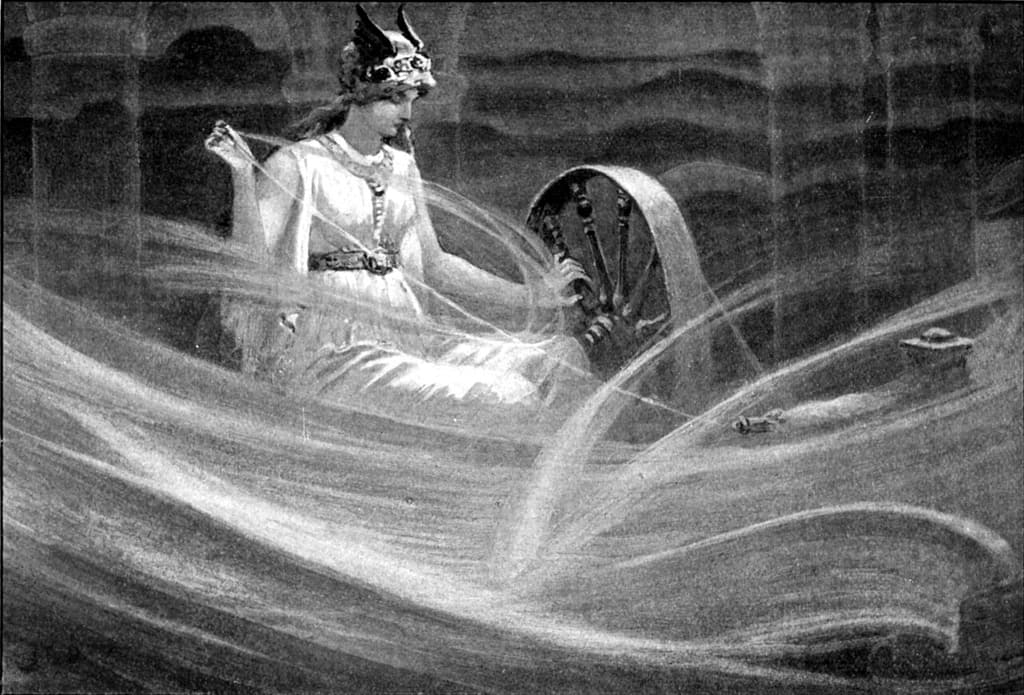
Lokasenna stanza 29 contains the most economical description of a deity in Norse literature. Loki has just insulted Frigg to her face, and Freyja tells him to stop: Frigg knows all fates, though she herself does not speak them.
Everything difficult about Frigg follows from that. She is a goddess of foreknowledge who withholds it, married to a god who spends the entire mythology hunting for exactly the information she already has, and the one time she acts decisively on what she knows, she causes the catastrophe she was trying to prevent.
Fensalir and the household
Her hall is Fensalir, "fen-halls" or "marsh-halls," and the name is worth pausing on: not a gold-roofed fortress but wetland. Her attribute in the later tradition is the distaff — the spinning-staff — and the constellation Anglophones call Orion's Belt was known in parts of Scandinavia as Friggerock, Frigg's distaff. Her domains as the sources actually present them are marriage, childbirth, and the running of a household with servants in it: Fulla carries her ash-wood casket and knows her secrets, Hlín is sent to protect those Frigg wants shielded, Gná rides errands on the horse Hófvarpnir. This is a queen's establishment, described in the vocabulary of a real Icelandic or Norwegian great-house.
The oaths, and the one that was skipped
The story that defines her is Baldr's death. Her son dreams of his own end; the gods are frightened; and Frigg goes out and takes an oath from fire and water, iron and every metal, stones, earth, trees, sicknesses, beasts, birds, venom and serpents, that none of them will harm him. Snorri's list is long and deliberate, and it works. The gods make a game of throwing things at Baldr for the pleasure of watching them refuse to hurt him.
Loki, in the form of a woman, asks Frigg whether anything was left out. She answers honestly: there is a young shoot west of Valhalla called mistletoe, too young to swear from. She tells him because she has no reason not to, and because the fact is trivially small.
The theological point is sharper than the plot point. Frigg knows all fates. She is nonetheless able to be surprised by one, and her attempt to bind the world by oath is precisely what routes fate through the single gap she created by judging one plant negligible. Norse myth does not offer a mechanism for reconciling those two facts, and it does not seem to think one is needed.
Her grief, and what it earned
After the pyre it is Frigg who asks who will ride to Hel and offer a ransom for Baldr. Hermóðr goes; Hel sets her condition; the giantess Þökk declines to weep. When Hermóðr returns he brings back the linen robe Nanna sent for Frigg specifically — a small courtesy between two widowed women in a story otherwise entirely about men riding places.
Völuspá records her mourning twice, once for Baldr and once, in a single devastating half-line at Ragnarök, for Odin: it calls Odin's death Frigg's second sorrow.
The Merseburg Charm and the age of the evidence
Frigg is one of a very small number of Norse deities attested outside Scandinavia in a genuinely pre-literary form. The Second Merseburg Charm, an Old High German incantation copied into a tenth-century manuscript but linguistically older, describes gods riding to the wood when Baldr's — or Phol's — horse sprains its foot. Sinthgunt and Sunna chant over it, then Friia and Volla, then Wodan, who is the one who succeeds. Friia is Frigg; Volla is her attendant Fulla; Wodan is Odin. The charm shows the goddess, her handmaid and her husband as a cluster in continental Germany, in a text with no Icelandic contact and no Snorri anywhere near it.
That is the strongest external control we have on the Norse material, and it holds.
Where she outmanoeuvres Odin
The prose preface to Grímnismál has Odin and Frigg watching two fostered boys from the high seat Hliðskjálf and disagreeing about which turned out better. Odin praises Geirröðr; Frigg says he is stingy with guests. They wager. Frigg then sends her maid to warn Geirröðr that a sorcerer is coming — with the result that Odin, disguised, is seized and tortured between two fires for eight nights, and Geirröðr dies falling on his own sword. Frigg wins the bet by rigging it, and Odin never mentions it again.
Saxo Grammaticus, writing in Latin in Denmark around 1200, is much harsher: his Frigga sleeps with a servant in order to get help stripping the gold from a statue of her own husband, and Odin goes into exile over the humiliation. Saxo is euhemerising — treating the gods as historical monarchs he can moralise about — and his account of the pantheon disagrees with the Icelandic one at almost every point, so it is best read as a parallel Danish tradition rather than a variant of Snorri's.
One goddess or two
The question of whether Frigg and Freyja were originally the same figure is not a fringe theory. The case for a split: their husbands' names, Óðinn and Óðr, come from the same root; both own falcon cloaks; both are associated with weeping and with a wandering absent partner; and no continental Germanic tradition preserves a Freyja-equivalent at all, only a Frija.
The case against: the Norse sources treat them as distinct in every text, give them different families, different halls, different functions and different afterlife roles, and Lokasenna has them speaking to each other in consecutive stanzas. Both women are separately insulted by Loki, with different accusations tailored to different reputations.
The honest position is that Frija and Freyja may share a distant common origin while being two entirely separate goddesses by the time anyone in Iceland wrote about them — which is the position this site's family tree takes, with the disagreement marked rather than resolved.
Friday
Old English Frīgedæg, Old Norse frjádagr, Old High German frîatac, modern German Freitag and Dutch vrijdag all translate Latin dies Veneris using Frigg's name, not Freyja's. The Germanic-speaking peoples who made that equation in late antiquity looked at Venus and picked the goddess of marriage.
Frigg has fared badly in modern adaptation: Marvel gave her a warrior's death she never had in any text, and most fiction reduces her to a grieving mother. The scheming, gambling, information-withholding queen of Grímnismál has essentially no popular afterlife at all. She is a much stranger figure than the tradition overview has room to show.
Is Frigg the same as the "Frea" who names the Lombards?
Paul the Deacon's History of the Lombards and the older Origo gentis Langobardorum tell of Frea advising the Winnili women to tie their hair across their faces as beards, so that Godan, looking east at dawn, would ask who the long-beards were and be obliged to grant them victory to the first people he saw. Frea is a Frigg-cognate and Godan is Odin. It is the same married pair, in a seventh-century Italian source, doing exactly what they do in Grímnismál: she manipulates what he sees.
Why does she own a falcon cloak if that is Freyja's attribute?
Both do, in different texts. Loki borrows Frigg's hawk-shape in Skáldskaparmál when he flies to Geirröðr's court and is caught, and borrows Freyja's falcon-shape when fetching Iðunn. Rather than proving the goddesses identical, this is a reminder that shape-changing gear in these stories is equipment: it belongs to whoever the narrative needs to have it, and Loki is always the one borrowing.