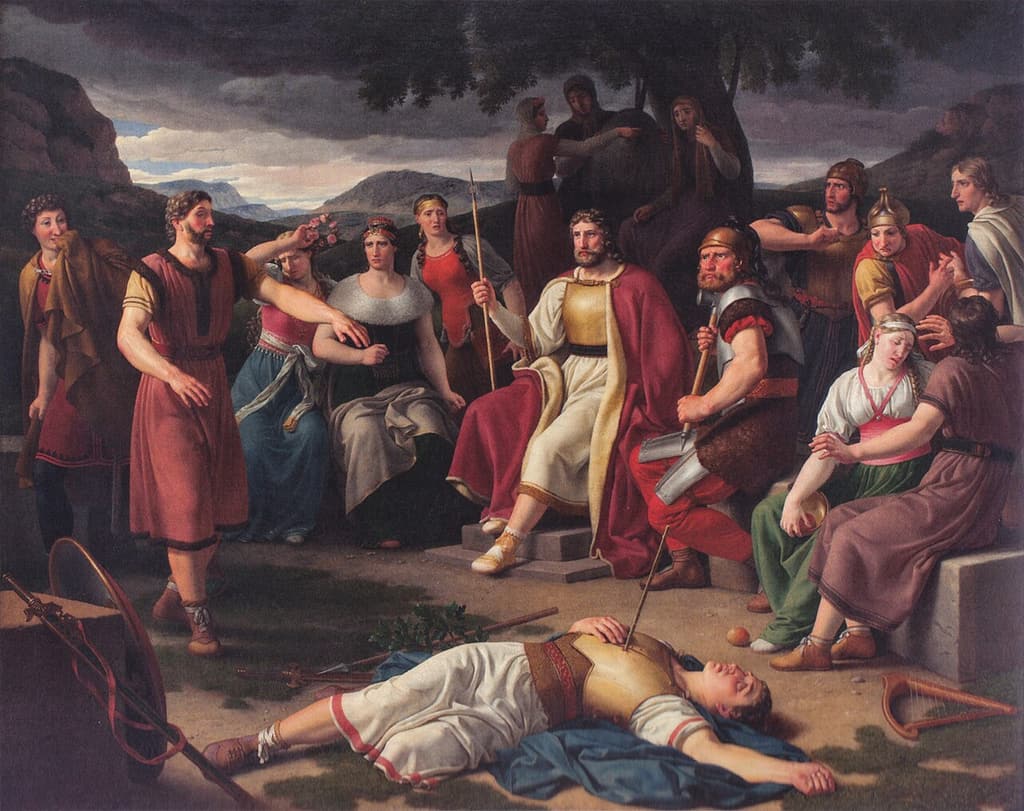
There are two Baldrs and they have almost nothing in common except a name and a rival.
In the Icelandic tradition he is the most beloved of the gods, so radiant that light comes off him, killed by accident with a plant nobody thought to ask, and mourned by everything alive. In the Danish tradition recorded by Saxo Grammaticus he is a demigod warlord fighting Høther for the hand of a princess, defeated in open battle after his opponent obtains a special sword, and buried in a mound that later grave-robbers try to open. One of these is a story about innocence. The other is a story about a woman and a war.
Both were written down within about thirty years of each other, by Christians, from oral material neither of them fully controlled. Anyone who tells you what "the" myth of Baldr means is choosing a version.
What Snorri tells
Gylfaginning gives the full narrative and it is the best-constructed piece of storytelling in the Prose Edda. Baldr, son of Odin and Frigg, begins dreaming of his own death. The Æsir take this seriously; Frigg extracts an oath from every substance and creature in the world not to harm him; and the gods discover that he has become invulnerable, which they turn into a party game, shooting and striking at him for entertainment.
Loki learns about the mistletoe. He puts it into the hand of Baldr's blind brother Höðr, guides the aim, and the shoot goes through Baldr and kills him. Snorri says nobody could avenge him because they stood on hallowed ground — a legal detail, and a very Icelandic one.
The funeral is on his ship Hringhorni, which the gods cannot launch until the giantess Hyrrokkin arrives riding a wolf bridled with vipers and shoves it out with one push, the rollers catching fire. His wife Nanna dies of grief on the spot and burns with him. Odin lays the ring Draupnir on the pyre. Thor consecrates it with the hammer and, in the middle of the most solemn scene in Norse mythology, kicks a passing dwarf named Litr into the flames for no stated reason.
Then Hermóðr rides Sleipnir nine nights down to Hel, who agrees to release Baldr on one condition: everything in the world, alive and dead, must weep for him. Everything does — except a giantess called Þökk, sitting in a cave, who says she will weep dry tears and let Hel keep what she has. Snorri adds that most people think Þökk was Loki.
The independent evidence that this is old
Snorri could have invented the shape of that story. He did not, and the checks are unusually good.
- Völuspá — probably tenth century — already knows Baldr's death, Höðr as the killer, the mistletoe, Frigg's weeping, and an avenger born to kill Höðr, all in compressed allusive stanzas that assume the audience knows the rest.
- Baldrs draumar has Odin ride to the east gate of Hel and wake a dead seeress to interrogate her about his son's dreams. She tells him the mead is already brewed and the benches strewn for Baldr's arrival — a hall prepared for a guest who has not yet died.
- Húsdrápa, composed by Úlfr Uggason around 985 to describe carvings in a hall in western Iceland, includes Baldr's funeral procession. That means the scene was worth carving on a wall in a pagan house, a full quarter-millennium before Snorri.
So the death, the killer, the mourning and the funeral are securely pre-Christian. What is less secure is the tone: the emphasis on Baldr's blamelessness and the redemptive return may have been shaped by writers who had a Good Friday in their heads.
Saxo's Balderus, who is nobody's innocent
Gesta Danorum, Book Three. Balderus is a demigod; Høtherus is a mortal prince, a swimmer, a musician, and an excellent shot. They both want Nanna, daughter of King Gevarus. Balderus is invulnerable to ordinary steel, so Høtherus travels to obtain a specific sword from a satyr named Mimingus. They fight several campaigns with mixed results — Balderus wins some — and Høtherus finally wounds him fatally. Balderus lingers three days and dies. Nanna marries Høtherus. Bous, son of Odin and Rinda, later kills Høtherus in revenge and dies of his own wounds the next day.
No mistletoe. No blindness. No trickster. No universal weeping, no ransom, no return. The only shared skeleton is: Baldr dies at Höðr's hands, and a son of Odin conceived for the purpose avenges him. Saxo is writing Danish dynastic history and openly rationalising gods into kings, but he is not working from Snorri and his version cannot simply be dismissed as corruption. It may preserve a rival Danish tradition in which the two were straightforward rivals.
The dying-god argument, and why it stalled
James Frazer built a substantial part of The Golden Bough on Baldr as a vegetation deity whose death enacts the year's turning, and the reading dominated popular treatments for most of the twentieth century. It has largely been abandoned in scholarship, for concrete reasons: there is no seasonal cycle in the story, Baldr does not return with the spring but only after the world ends, and the mistletoe's role is textually shaky — Old Norse mistilteinn may in some versions be a sword-name rather than a plant, and mistletoe does not grow in Iceland, which raises the question of whether the poet had ever seen one.
The Christian-influence argument is harder to dismiss but also unprovable. A beautiful blameless son who dies, descends, cannot be brought back by petition, and returns to rule a renewed and green earth after the destruction of the old order is a shape that a thirteenth-century Icelandic Christian would find deeply familiar. Whether Snorri found it or made it is exactly the kind of question the Norse corpus refuses to answer.
The return
Völuspá ends with the earth rising again out of the sea, the surviving gods gathering on Iðavöllr, finding the old golden game-pieces in the grass, and Baldr and Höðr coming back together, reconciled, to live in the halls of the slain war-god. Killer and victim return as a pair.
Baldr's own hall in Grímnismál is Breiðablik, and the poem says it is the place in which the fewest harmful things are found. His son is Forseti, the reconciler of legal disputes, which is a quietly consistent bit of genealogy: the family that produced the innocent death produces the judge.
What the modern versions do with him
God of War Ragnarök makes Baldur a raging invulnerable psychopath cursed by his mother's protection spell — an inversion so complete it is closer to Saxo's fighting Balderus than to Snorri's, probably by accident. Neil Gaiman's retellings follow Snorri closely. Marvel has mostly left him alone.
The name survives in Scandinavia as Balder and Baldur, and Icelandic uses Baldur as a live given name today. See how his death sits inside the wider collapse of the gods, and where he stands in the Norse family tree alongside three brothers, two of whom exist only to avenge or replace him.
Why couldn't the gods just kill Loki immediately?
The hallowed ground Snorri mentions is the þing-peace, the legal immunity of an assembly site, and it is not a decorative detail. Icelandic law made violence at an assembly a far graver offence than the killing it might avenge, and the gods behave like Icelandic litigants throughout: they take oaths, they demand compensation, they wait for the correct forum. Loki's eventual capture happens elsewhere and much later, after he has insulted everyone at a feast.
Is Baldr's invulnerability the same idea as Achilles' heel?
Superficially, and the comparison is old, but the mechanisms differ in a way that matters. Achilles is made invulnerable by an act on his body, and the flaw is a physical location. Baldr is made invulnerable by contract — every substance in the world has sworn — and the flaw is a legal omission rather than a bodily one. Norse myth locates the weak point in the paperwork.
Does anything survive of a Baldr cult?
Very little, and the absence is striking for a god this central to the literature. There are a handful of contested place-names in Norway, notably Baldrshagi and Baldrsberg, and Friðþjófs saga describes a sanctuary called Baldrshagi. No amulets, no reliable temple account, no personal names formed on his. Compare that with the hammer pendants and Thor-names littering the record, and the reasonable conclusion is that Baldr was a figure of story rather than of active worship — which is a real possibility that most retellings never raise.