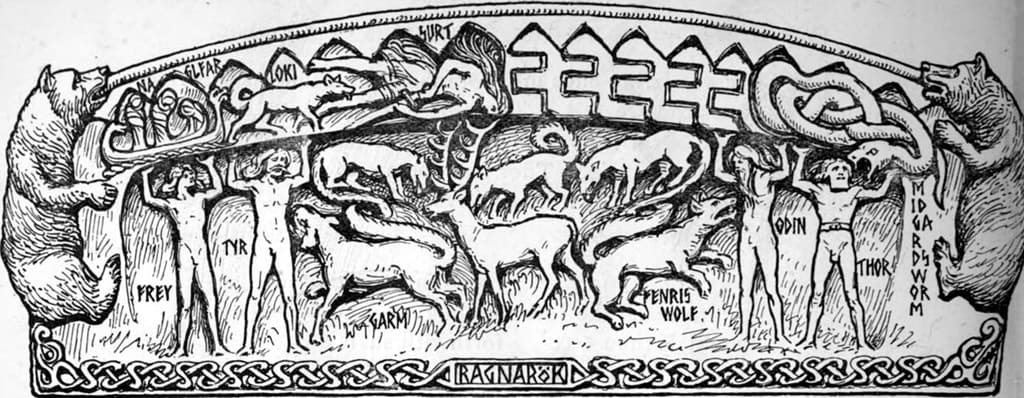
A dead woman is speaking. That is the frame of Völuspá, the poem that supplies almost everything anyone knows about the end of the Norse world: Odin has raised a seeress and is questioning her, and she recites the whole history of creation and destruction in about sixty stanzas, breaking off periodically to ask whether he wants to hear any more. He does.
She is not describing something that might happen. Norse myth has no conditional here. The gods already know.
Before the weapons: the winter and the failure of kinship
It begins socially, not militarily.
Three winters come one after another with no summer between them, and then three more. That is the fimbulvetr, the mighty winter, and it takes the food. What follows is the part of the prophecy that is genuinely frightening, because there is nothing supernatural in it: brothers will fight and kill each other, sisters' children will break kinship, no man will spare another. An axe-age, a sword-age, shields split; a wind-age, a wolf-age, before the world goes down.
For an audience living in scattered farmsteads in the North Atlantic, held together by feud law and obligations to kin, the apocalypse arrives first as the collapse of the one system keeping people alive.
The alarm
Three cockerels crow at once: a soot-red one in Hel's halls, one in the gallows-wood, and gold-combed Gullinkambi waking the warriors in Valhalla. The hound bays in front of the cave-mouth, and the poem's refrain says the fetter will break and the wolf run free.
Yggdrasil shudders from root to crown. The dwarfs groan in front of their stone doors. Heimdall lifts the Gjallarhorn and blows it so that every world hears, and Odin goes to talk with Mímir's head one last time — the last piece of counsel he will ever get, and the poem does not report what it was.
The muster on both sides
Fenrir breaks the fetter. Jörmungandr comes up out of the deep in a fury and the sea heaves over the land.
Naglfar floats. It is a ship built from the untrimmed nails of the dead, and Snorri adds the observation — half folklore, half warning — that this is why any man who dies with his nails uncut adds material to it. Völuspá gives the helm to a giant called Hrym; Snorri gives it to Loki, loose at last from under the serpent. The disagreement is real and old.
From the south come the sons of Muspell, riding fire, with Surtr at their head carrying a sword brighter than the sun. Bifröst breaks under the weight of them as they cross it. Everything converges on a plain that Vafþrúðnismál names Vígríðr and measures at a hundred leagues each way, which is a poet insisting on scale.
Who kills whom
The last battle is not a melee. It is a series of single combats, each one settling a debt contracted centuries earlier.
- Odin against Fenrir. He goes first and he loses. The wolf swallows him. This is the god of victory, who has spent the whole mythology recruiting dead warriors specifically for this fight, killed in the opening exchange — and he knew he would be.
- Víðarr against Fenrir. Odin's silent son steps forward and avenges his father immediately. Völuspá has him drive a sword into the wolf's heart. Snorri has him plant one foot on the lower jaw — wearing a shoe made from every leather scrap ever trimmed off a shoe by anybody, which is why you should throw those pieces away — and tear the beast apart by the upper. The two versions are not compatible and both are quoted as if they were.
- Thor against the serpent. He kills it. Then he walks nine paces from the corpse and falls dead of its venom. Nine paces is the exact detail that makes it, and it is in the poem.
- Freyr against Surtr. Freyr fights with an antler because he gave his sword away years earlier to a servant, as the price of a marriage negotiation. He dies for a decision he made when he was in love.
- Týr against Garmr, and each kills the other. Snorri's account here creates its own problem, since he has named the hound at the cave and Völuspá's refrain has been about a wolf; whether Garmr and Fenrir are two creatures or one is unresolved.
- Heimdall against Loki, mutual destruction. The watchman and the one who let everyone in.
Then Surtr throws fire over everything. The sun goes black, the land sinks into the sea, the bright stars drop out of the sky, steam roars up, and flame licks against heaven itself.
And then the poem keeps going
This is the part that gets cut from every film, and it is the reason the poem exists.
She sees, a second time, land rising out of the water, green. Eagles fly over it and take fish from the falls. The surviving gods meet on the Field of Ida and talk over the great events, and remember the old runes, and find in the grass the golden gaming pieces they used to play with, lying there where they had been dropped.
Fields grow unsown. Baldr comes back from the dead and so does the blind brother who killed him, and they live together in Odin's halls. Víðarr and Váli survive; so do Thor's sons Móði and Magni, who inherit the hammer. Two people, Líf and Lífthrasir, come out of a wood where they had hidden and eaten the morning dew, and repopulate the world; the sun's daughter runs her mother's course. There is a hall at Gimlé roofed with gold where good people will live for ever.
And the very last thing the seeress sees, in most manuscripts, is a dark dragon flying up from below with corpses in its wings — and then she sinks.
The dispute about the ending
How much of that rebirth is Christian is one of the two or three genuinely live arguments in Norse studies, and it is not resolvable on present evidence.
The case for influence: the gold-roofed hall, the good who dwell there for ever, the world renewed, and — most pointedly — a stanza describing a powerful one coming from above who rules over everything and orders all judgements. That stanza appears in the Hauksbók manuscript and not in the older Codex Regius, which is about as close to a smoking gun as textual criticism gets. Iceland converted around 1000 CE; Völuspá is usually dated to roughly that same window, by a poet who cannot have been unaware of what was arriving.
The case against reading the whole ending as borrowed: cyclical destruction and renewal is not distinctively Christian, the surviving gods are specific named Norse figures with no scriptural counterparts, and the detail of the gaming pieces in the grass is not the sort of thing an imitator invents. A common middle position is that a pre-Christian eschatology has been finished by a poet working at the hinge of the two religions and interested in both.
Two related textual facts are worth carrying. The manuscripts differ — Codex Regius (about 1270), Hauksbók (about 1300), and the stanzas Snorri quotes in Gylfaginning do not agree on content or order, and every modern translation is an edited reconstruction. And the name itself is contested: ragnarök means roughly "fate of the powers", while the variant ragnarökkr means "twilight of the powers". Snorri uses the twilight form, the nineteenth century loved it, Wagner titled an opera with the German equivalent, and it is probably the later of the two.
Carved evidence, and one Christian cross
This is not a story known only from parchment written down by Christians. There are stones.
The Gosforth Cross in Cumbria, a slender fourteen-foot sandstone cross of about the tenth century, is a Christian monument standing in a churchyard, and its shaft carries a Crucifixion alongside figures that specialists read as a bound man with a woman holding a vessel above him, a figure forcing open the jaws of a beast with a foot and a hand, and a horseman with a spear. Nearby, the Gosforth "fishing stone" shows two men in a boat with an ox head on the line.
Thorwald's Cross on the Isle of Man shows a man with a bird at his shoulder and a spear, one foot in the mouth of a wolf, directly beside a figure carrying a cross and a book.
Whatever these carvers thought they were doing — juxtaposition, competition, or an argument that one story completes the other — they were doing it in stone, in Christian contexts, in the tenth century, and the imagery is Ragnarok imagery.
Why a culture wanted this story
The remarkable thing is not that the gods die. It is that they turn up. Odin knows how the fight ends and spends the entire mythology preparing for it anyway, collecting the battle-dead into his hall for an army that will lose. Thor knows the serpent will finish him. There is no possibility of victory anywhere in the system, and the response of every god in it is to go and fight regardless.
That is a coherent ethic rather than a gloomy mood, and it is legible in the sagas too: a man cannot choose his fate, only how he meets it, and the only durable thing is what is said about him afterwards. Hávamál puts it flatly — cattle die, kinsmen die, the self dies the same way; the one thing that never dies is the reputation of the dead.
The word since 1800
Wagner took the ending, the ring, the gold, the doomed gods and the fire, and made something that has coloured every reading since — including the assumption that this is fundamentally a tragedy about power, which is Wagner's idea rather than the poem's. Tolkien knew the material intimately and reworked its mood rather than its plot.
Marvel's 2017 film borrowed the name for a story in which the destruction is chosen deliberately as the only way to defeat a tyrant, which is a genuinely clever inversion and shares little else. God of War's 2022 instalment runs the prophecy as a plot to be argued with. The word itself has escaped entirely into ordinary English for any total collapse, generally used by people who assume it ends in fire — and it does not. It ends with two survivors coming out of a wood and somebody finding the chess set.
Questions this one raises
Are the surviving gods a full pantheon? No, and the selection is pointed: the ones who come through are sons and avengers rather than rulers. Odin, Thor, Freyr, Heimdall, Týr and Loki are all gone. What returns is the next generation plus the murdered brothers — a world without its old authorities.
Is Ragnarok a cycle that repeats? Nothing in the sources says so. The seeress describes one destruction and one renewal. The idea of an eternally repeating cycle is a modern import, usually from other mythologies.
What does Odin whisper to Mímir at the end? The poem says he speaks with the head and gives no content. Consulting a preserved severed head for advice is entirely normal behaviour for this god; see the well he paid an eye for.
Do we know what Ragnarok meant to actual worshippers? Very little, and this is worth saying plainly. What survives is poetry recorded in Christian Iceland and stone carvings whose readings are interpretive. There are no ritual texts, no liturgy, and no contemporary account by a practising believer explaining what he expected to happen.
Related: the binding that starts the countdown, the death that triggers it, where the world came from in the first place, and the Norse tradition at large.