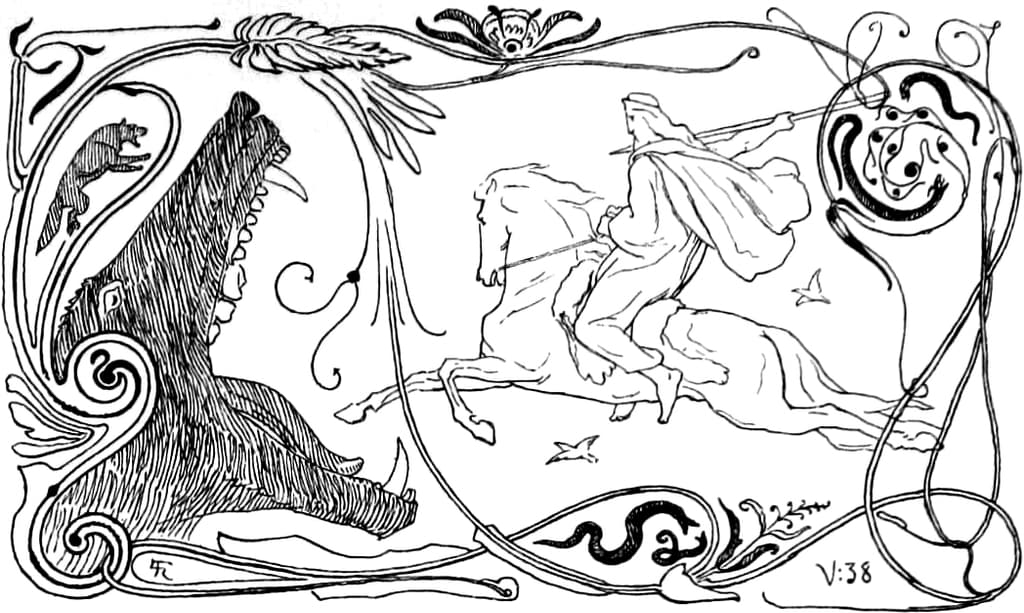
The gods raised him. That is the part everyone forgets, and it is the part the story is about.
Snorri says the Æsir knew the prophecies concerning Loki's three children by Angrboða and dealt with each accordingly — but the wolf they did not exile. They brought him home and kept him among themselves, and only Týr had the nerve to go near him with food. Fenrisúlfr grows up inside the household of the people who are afraid of him, watching them get more afraid, and by the time they propose the third game with the third fetter he has learned exactly what they are.
His condition for accepting it — that someone lay a hand between his jaws as surety — is not a monster's cruelty. It is a reasonable request for security from a party who has correctly assessed the counterparty's good faith, and the loss of Týr's hand is the price of the gods having been right about him and wrong about themselves.
The three fetters
Gylfaginning names them. Leyðingr was the first, strong enough that the gods thought no one could break it; the wolf snapped it at the first kick and gained a reputation. Drómi was the second, half again as strong; he broke that too, with more effort, and the phrase "to get loose out of Leyðingr" or "to strike out of Drómi" entered the language as an idiom for escaping a hard place — which is Snorri telling us the story was proverbial.
The third, Gleipnir, was made by dwarfs in Svartálfaheimr out of six things that do not exist, and it looked like nothing at all. The gods took him to an island in a lake called Ámsvartnir and framed the whole thing as another test of strength. He suspected a trick precisely because the ribbon was so slight — if it is made by cunning, he says, no fame comes to him for tearing it, and if it is made by craft he would rather they left him alone.
Once bound, the cord was threaded through a stone slab called Gjöll, driven into the earth, and secured with a boulder named Þvíti. He gaped and bit; they jammed a sword upright in his mouth, hilt in the lower jaw, point in the palate, and he has howled around it ever since. The river Ván — "expectation" — runs from his mouth, made of his slaver.
Every name in that paragraph is doing work. The gods bind the future with a rope of impossibilities, weight it with a stone called screaming, and the river that pours out of it is called hope.
What he will do
Völuspá and Vafþrúðnismál agree, independently of Snorri, that the wolf kills Odin. That is the fixed point of Norse eschatology: the god who spent his existence acquiring knowledge specifically in order to prepare for this is eaten by the animal he raised.
Víðarr avenges him immediately, and here the two main sources genuinely disagree about the method. Völuspá says Víðarr thrusts his sword into the wolf's heart. Snorri says he steps on the lower jaw with his reinforced shoe, takes the upper in his hand, and tears the mouth apart. Snorri quotes Vafþrúðnismál in support and then narrates the version the poem does not contain. Both are in circulation; the jaw-tearing is the one that got into every modern retelling, and it is the one with the weaker textual claim.
The other wolves, and the counting problem
Norse eschatology has more wolves than it can account for.
- Sköll and Hati Hróðvitnisson chase the sun and the moon and catch them at the end. Grímnismál names them; Gylfaginning makes them Fenrir's offspring by a giantess in Járnviðr, the Iron Wood.
- Mánagarmr, moon-hound, appears in Snorri as the mightiest of that brood and does the same job as Hati, and may simply be Hati under another name.
- Garmr bays before Gnipahellir in Völuspá's refrain, breaks loose, and fights Týr at the end. A long-running argument holds that Garmr and Fenrir are the same wolf doubled in transmission — the loose-breaking, the binding, the eschatological role and the Týr connection all rhyme too neatly. The poems keep them apart and never explain the difference.
Hróðvitnir, "famous wolf," is used both as a byname for Fenrir and as the father of Hati, which makes Fenrir his own son's father in one reading and a separate wolf in another. The corpus does not sort this out.
The island, and a geography that will not settle
Snorri places the binding on an island in the lake Ámsvartnir, and later says the wolf lies where a river runs through a fen. Lokasenna has Loki taunt Týr about the hand and refers to the wolf lying bound until the powers are torn apart, without locating him anywhere. Grímnismál does not mention the binding at all. Nothing in the corpus tells you where the most consequential prisoner in the mythology is actually kept, and the vagueness may be the point: he is somewhere out at the edge, waiting, and the edge is not on a map.
In stone
The Thorwald's Cross slab at Kirk Andreas on the Isle of Man, from around the tenth century, shows a man with a spear thrusting downward into the mouth of a large beast that is biting his foot, with a raven at his shoulder — and on the reverse, a figure with a cross and a book trampling a serpent. It is a Christian monument carrying a scene almost universally read as Odin and the wolf at Ragnarök, placed opposite the triumph of Christ. Whatever the carver meant, it is direct evidence that the wolf-devours-Odin image was current in the Norse Irish Sea world and could be put on a church stone.
The Ledberg stone in Östergötland and several Gotland picture stones have been read similarly, with less confidence.
The modern wolf
God of War Ragnarök makes Fenrir a beloved pet dog whose spirit is later transferred into a giant wolf — a genuinely inventive departure with no textual basis. Marvel has used him repeatedly as a monster. Fantasy fiction generally treats "Fenrir" as a shorthand for a huge malevolent wolf, and the name reached British bookshelves attached to a werewolf in the Harry Potter novels.
Almost none of these keep the thing that makes the medieval story unusual: that the gods knew, that they fed him anyway, that they lied to him, and that he warned them he could tell they were lying. See Ragnarök for what the breaking of the fetter starts, and the family tree for the branch of Loki's line that accounts for most of the deaths at the end.
Did anyone worship or fear Fenrir in actual Norse religion?
There is no cult, but there is a vocabulary. Wolves in Old Norse literature and law are the standard image of the outlaw — vargr means both wolf and criminal, and a man sentenced to full outlawry was declared skógarmaðr, forest-man, and could be killed by anyone. Fenrir is the outlaw at cosmic scale: raised inside the community, put outside it, and eventually returning to destroy it. That legal resonance is not decoration; it is probably what the figure is made of.
Why bind him instead of killing him?
Snorri gives the reason and it is a good one: the gods would not defile their sanctuary with blood, however much the prophecies said of the wolf. The same rule stops anyone avenging Baldr on the spot. Norse gods observe sanctuary law even when it is fatal to them, which is either the most admirable thing about them or the most self-destructive, and the corpus never says which.