No one has ever produced a theory of Loki that accounts for all of him. He is counted among the Æsir and is the son of a giant. He solves more problems than he creates for most of the corpus, and then engineers the murder of the best of the gods. He is the father of the wolf that eats Odin and the mother — physically, personally — of Odin's horse. Scholars have called him a fire spirit, a trickster, a culture hero, a devil imported from Christianity and a late literary invention, and each theory explains part of the evidence and breaks on the rest. That irreducibility is the honest subject of his page.
What the name will not tell us
The old and widely-repeated etymology connecting Loki with logi, "flame", is now largely rejected: Logi is a separate character who appears alongside him in one story precisely because they are distinguishable. Current suggestions link the name to words for knots, tangles and the meshes of a net — which is at least suggestive, given that he invents the fishing net and is caught in one.
His parentage is equally unhelpful and is genuinely odd. His father is the giant Fárbauti, "cruel striker"; his mother is Laufey or Nál. Norse patronymics are overwhelmingly paternal, yet Loki is consistently called Loki Laufeyjarson, after his mother. Nobody knows why, and any explanation offered confidently is speculation.
The useful Loki
For most of the surviving stories, he is the gods' fixer, and his method is always the same: he causes a crisis by carelessness or malice, is threatened with death, and then solves it by a cleverness nobody else possesses.
- The wall and the horse. A builder offers to fortify Asgard in one winter for the sun, the moon and Freyja. Loki persuades the gods to accept, on the assumption it is impossible; the builder's stallion Svaðilfari does most of the hauling and the work runs ahead of schedule. Loki, threatened, turns himself into a mare, lures the stallion away, and returns some months later with a grey eight-legged foal, Sleipnir, which he gives to Odin. He is Sleipnir's mother, told plainly and without embarrassment.
- The treasures. He cuts off Sif's hair for no stated reason, and to escape the consequences he plays two families of dwarfs against each other, wagering his own head. The result is Sif's new golden hair, Odin's spear, Freyr's ship and boar, and Thor's hammer — every major divine object in the mythology exists because Loki committed a piece of vandalism. He keeps his head on a technicality: he wagered the head, not the neck. The dwarfs sew his lips shut instead.
- Þjazi and the apples. He hands Idunn and her apples of youth to a giant to save himself, and then, as the gods age, has to retrieve her in falcon form with the giant burning up behind him.
- The hammer's recovery. He dresses Thor as a bride and talks the party through the wedding feast with a straight face.
The pattern is worth stating precisely because most modern retellings invert it: for the bulk of the corpus, Loki's cunning is what keeps the gods supplied and intact.
Then Baldr dies
The turn is absolute and the sources do not soften it. Baldr dreams of his death; Frigg extracts oaths from everything in the world not to harm him; the gods make a game of throwing weapons at him and watching them refuse. Loki, in disguise, learns from Frigg that mistletoe was overlooked as too young to swear. He puts a mistletoe shaft into the hand of the blind god Höðr and guides the throw.
Then he blocks the rescue. When Hel agrees to release Baldr if every living thing weeps for him, a giantess called Þökk — the sources say plainly that this was Loki — refuses, and Baldr stays where he is.
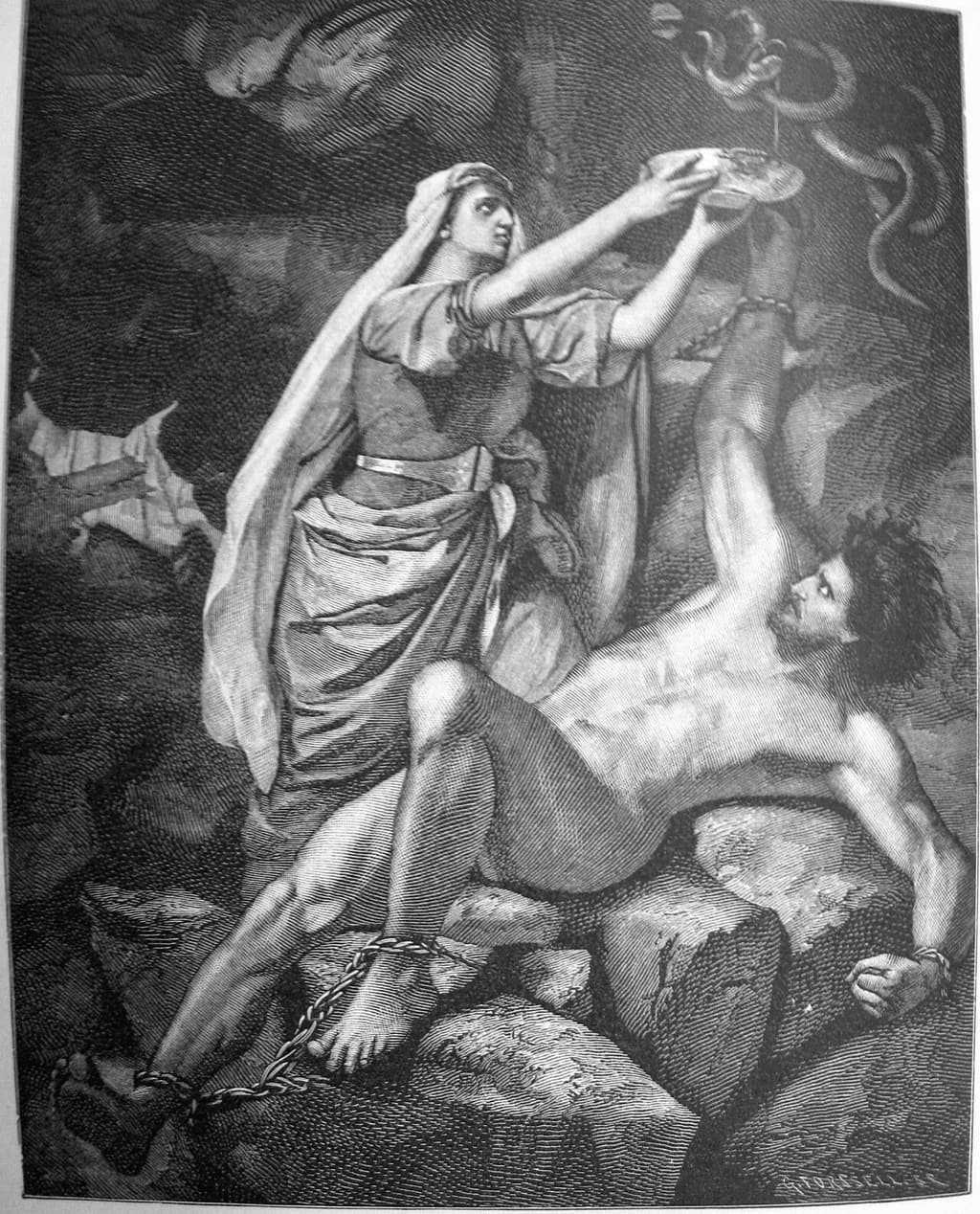
At the feast recorded in Lokasenna, Loki walks in and insults every god present in turn, and the insults are effective because they are true: infidelities, cowardice, the sexual disgrace of Odin's magic, Freyja having slept with every god in the room. He is finally driven out only by Thor's arrival with the hammer. Then he is hunted, caught as a salmon in the net he invented, and bound with the entrails of his own son Narfi, transformed into iron. A serpent drips venom onto his face; his wife Sigyn stands over him with a basin, and the intervals while she is carrying it away to be emptied are the only times the venom reaches him — his thrashing in those gaps is what the tradition offers as an account of earthquakes. He stays there until Ragnarok, where he steers the ship of the dead against the gods and kills Heimdall as Heimdall kills him.
Is he a god at all?
Three observations complicate every answer.
- No cult. There is no place-name containing Loki, no amulet, no attested sacrifice, no dedication. For a figure this prominent in the literature, the archaeological silence is total — which is why some scholars argue he is primarily a literary character rather than a worshipped deity.
- Category confusion. He is the sworn blood-brother of Odin, which is why he is at the table at all; Lokasenna has him remind Odin of the oath. Yet his children are the three monsters bound or thrown out of the world, and he ends on the giants' side.
- The Christian question. A bound adversary who brings about the death of a bright, beloved god and leads the enemy at the end of the world resembles a devil, and the manuscripts are Christian. Whether that shape is original or a thirteenth-century overlay is unresolved. Against the overlay theory: the Gosforth Cross in Cumbria, carved in the tenth century, appears to show the bound figure with the bowl-holding woman, which would put the scene comfortably in pagan currency.
The MCU problem
The single most widely-believed thing about Loki today is a comics invention: that he is Odin's adopted son and Thor's brother. He is neither. He is Odin's contemporary and blood-brother, and Thor's frequent travelling companion. The redemption arc has no source basis whatever — the medieval Loki ends bound under venom and comes back only to destroy the world.
What the adaptations get genuinely right is harder to dismiss: the charm, the utility, the sense that the gods keep him around because they need him, and the shapeshifting. He becomes a salmon, a fly, a falcon, a seal, an old woman and a mare, and unlike most mythological shapeshifting these transformations have consequences that stick.
Where the sources actually disagree
- His nature. Snorri lists him among the Æsir and simultaneously calls him the slanderer of the gods. The Eddic poems never resolve his membership.
- His children. Fenrir, Jörmungandr and Hel are his by the giantess Angrboða in Snorri; the Eddic poems allude to them without a tidy list. Narfi and Váli, his sons by Sigyn, appear chiefly in the binding.
- Whether he was ever benign. Sörla þáttr, a late saga, has him in an entirely different register again, which is a reminder that the corpus is not a single consistent document.
Two questions worth answering separately
Does Loki's gender-changing mean anything, or is it just plot?
It is structurally consistent enough to be significant. He changes sex to solve problems, bears a child, is accused of having spent eight winters underground as a milkmaid bearing children, and throws the same accusation at Odin. In a society where ergi was a serious and legally actionable insult, a figure who moves across that boundary freely is doing something the culture found genuinely disturbing — which is likely why he is both indispensable and, in the end, expelled.
Why do the gods punish him for Baldr rather than for anything earlier?
Because the earlier offences were repaired and this one cannot be. Norse social logic runs on compensation: a wrong is settled by payment or by an equivalent service, and Loki's method is to trade his way out. Baldr's death has no compensation available — the one route to it, universal weeping, he personally closes — and a wrong that cannot be settled is what turns an irritant into an enemy.