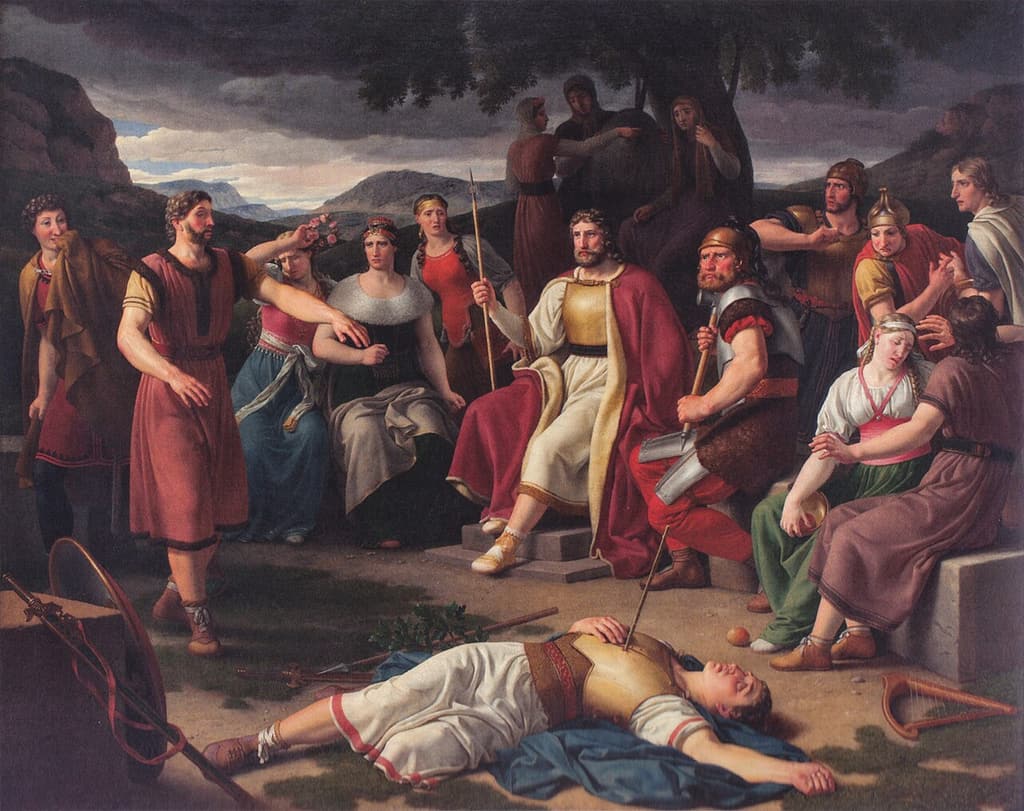
He dreamt about it first. That is how it starts — not with a weapon but with a young god sleeping badly and mentioning it at breakfast, and a household that takes bad dreams seriously enough to act.
Everything after that is a family doing all the right things and losing anyway.
The oath-taking
Baldr's dreams were of his own death, and when he told them the gods held a council. Frigg went out and took an oath from everything in the world not to harm her son: from fire and water, from iron and every other metal, from stones, from the earth itself, from trees, from sicknesses, from animals and birds, from poisons, from snakes. Every category of thing that could do damage swore.
So they invented a game. Baldr would stand up in the assembly place and the others would throw things at him — stones, spears, axes, whatever came to hand — and nothing would touch him, and everyone thought this was excellent. It is one of the few genuinely happy scenes in Norse mythology and it reads, in Snorri's telling, exactly like a crowd of armed men who have found a new drinking amusement.
Loki did not like it. He went to Frigg's hall in the shape of a woman and made conversation, and asked what was going on out there, and then asked whether everything had really sworn. Frigg, being proud of her work, said there was one thing: a shoot of mistletoe growing west of Valhalla, too young to bother asking.
The blind brother
Loki pulled up the mistletoe and made a shaft of it, and went out to where Höðr was standing at the edge of the crowd doing nothing, because he was blind and had no weapon and nobody had thought to include him.
The offer was framed as kindness: you should honour your brother like the rest of them; here, I will point you.
The shaft went through Baldr and he fell down dead, and — Snorri says — that was the greatest misfortune ever done among gods and men. What followed was worse than grief. Nobody could avenge him. They were standing on holy ground where blood-feud was forbidden, and every one of them knew who was responsible and could do nothing at all. Odin, who understood best what the death meant, said nothing that anyone recorded.
The funeral at the water's edge
They carried the body to his ship Hringhorni and could not launch it. They sent to Jötunheim for a giantess named Hyrrokkin, who arrived riding a wolf with vipers for reins, took the prow in her hands and shoved so hard that fire came out of the rollers and the whole earth shook. Thor wanted to break her skull for it and was talked out of it.
Nanna, Baldr's wife, watched the body carried aboard and died where she stood, and was burned with him. Odin walked up to the pyre and laid on it the ring Draupnir, from which eight more rings dripped every ninth night — the most valuable object he owned. Baldr's horse was led onto the ship in full harness. Thor consecrated the fire with Mjölnir, and a dwarf called Litr got in his way, and he kicked him into the flames, which is a detail nobody has ever explained and which tells you exactly what state he was in.
This scene is not only Snorri's. A skaldic poem called Húsdrápa, composed in the late tenth century to describe the carvings in an Icelandic chieftain's hall, refers to the wolf-riding giantess and the funeral procession, which means the story was being carved on wooden panels in Iceland two hundred and fifty years before the Prose Edda was written.
The ride to Hel, and one dry-eyed woman
Frigg asked who would ride down and offer a ransom. Hermóðr, another of Odin's sons, took Sleipnir and rode nine nights through valleys so dark he could see nothing, crossed the bridge over the river Gjöll — where the girl guarding it remarked that he made more noise alone than five companies of dead men had the day before — and jumped the gate.
He found Baldr sitting in the high seat. Hel heard his case and set a condition: if every single thing in the world, alive or dead, would weep for him, she would let him go. If one refused, she kept him.
Baldr sent Draupnir back to his father. Nanna sent a linen robe to Frigg and a gold ring to her attendant Fulla — small, exact, domestic gifts that make the scene unbearable.
Messengers went everywhere and everything wept: people, animals, earth, stones, trees, metals, the way things weep when they come out of frost into warmth. Then they found a giantess in a cave calling herself Þökk, whose name means Thanks, and she said she had never got any good from Baldr alive and would get none dead, and Hel could keep what she had.
Snorri adds, drily, that people think this was Loki.
Saxo's version, in which nobody is innocent
Around 1200, a Danish cleric named Saxo Grammaticus wrote a Latin history of the Danes containing an entirely different account, and it is worth reading beside Snorri rather than dismissing.
In Saxo, Balderus and Høtherus are rival warlords competing for a woman named Nanna, and Høtherus is not blind, not manipulated, and not sympathetic-by-default: he is a capable prince who swims, hunts, plays the harp and wins. Balderus is a demigod who cannot be hurt by ordinary steel, so Høtherus goes to find the one blade that will work — kept by a woodland creature called Miming — and gets it. They fight several campaigns with mixed results. Eventually Høtherus wounds him in open battle and Balderus takes three days to die.
There is no mistletoe. There are no oaths. There is no trickster, no funeral ship, no weeping world, and no attempt to fetch him back. It is a war story about two men who both want the same marriage.
Nobody has reconciled these. The most defensible position is that the name and the rivalry belonged to a tradition with regional variants, and that the version Snorri preserves — the innocent god, the universal oath, the single overlooked plant — is a specifically Icelandic literary development, or possibly the older sacred version that Saxo's sources had already euhemerised into politics. Both arguments have serious backing.
The scholarly arguments that will not settle
The Christian question. A blameless son of the highest god, killed by treachery, mourned by all creation, held in the underworld, and destined to return and rule after the world ends: the resemblance is obvious and has been argued about since the nineteenth century, when Sophus Bugge proposed the whole story was borrowed. That maximal position is not held now. But Snorri was a thirteenth-century Christian writing two centuries after Iceland's conversion, and the shaping is a live question rather than a settled one. The counterweight is Húsdrápa and the eddic poems, which are pre-Snorri and already contain the essentials.
The mistletoe. Frazer built a chapter of The Golden Bough on it, reading Baldr as a vegetation spirit whose life was hidden in a plant. The comparative machinery Frazer used has not survived scholarly scrutiny, and there is a practical objection too: mistletoe does not grow in Iceland and is uncommon in most of Scandinavia, so the poet was probably working from a plant he knew about rather than one he saw. Whether the shaft was a dart, an arrow or a spear varies between sources; Völuspá implies a shot, Snorri a thrown missile.
Whether Höðr is guilty. Old Norse law distinguished sharply between a killing and a manslaughter, and blindness plus deception is about as strong a mitigation as the system recognised. Yet he is killed for it anyway — by Váli, a son Odin fathers deliberately for the purpose, who is one night old when he does it, unwashed and uncombed. That is not justice; it is the vengeance obligation running on rails.
Why it is the beginning of the end
In Völuspá, this is not an isolated tragedy. It is the pivot. The gods lose the one member of their number who does no harm, they respond by binding Loki under a serpent whose venom his wife catches in a bowl, and from that binding the enmity runs straight to the last battle. Norse myth is fatalistic in a way Greek myth is not: the gods know how it ends, act anyway, and the actions they take to prevent it are the ones that bring it on.
And in the world after the fire, when the surviving gods gather on the new grass, Baldr comes back from Hel with the brother who killed him, and they sit down together.
Baldr after the Middle Ages
Matthew Arnold wrote a long poem on the funeral. The story gave the nineteenth century one of its favourite images of the noble north, and the twentieth century a great deal of trouble, since the same material was enthusiastically annexed by Nazi ideologues who liked a martyred fair-haired god.
Modern versions have mostly gone to Loki. Neil Gaiman keeps the mistletoe and the giantess in the cave and lets the reader feel the trap closing. The Marvel films dropped the death entirely for two decades. What almost nobody reproduces is the part that makes it work — that the gods spent an afternoon happily throwing axes at their favourite person, and that the game was the point.
Mistletoe itself has had the strangest afterlife of anything in the story: a parasitic evergreen that in another European tradition entirely became a licence to kiss under. The plant's tangle of meanings is worth separating out, because the Norse and the Christmas associations are not connected by any documented line.
Four things worth pinning down
Did Odin whisper something to Baldr on the pyre? Yes, and it is the great unanswered riddle of the tradition. In Vafþrúðnismál, Odin defeats a giant in a wisdom contest by asking what he said into his son's ear before the body was lifted onto the ship. Nobody can answer it, because only Odin knows, and the poem does not tell us.
Is Baldr a war god or a peace god? Snorri makes him gentle, beautiful and so bright that light comes off him, and says no judgement of his ever holds — which is a strange, double-edged compliment. Saxo makes him a fighter. His name may be related to a word for lord, and there is no reliable evidence for a cult of him anywhere in Scandinavia, which is remarkable for a figure this central to the literature.
What is Baldrs draumar? A short eddic poem in which Odin rides down and raises a dead seeress to ask what the dreams mean. She tells him the mead is already brewed for Baldr's arrival and that Höðr will send him, and Odin gives himself away with the questions he asks. It is the story told as prophecy rather than as narrative.
Who is Þökk actually? Snorri hedges. The name means "thanks", the character appears once and vanishes, and the identification with Loki is offered as popular opinion rather than fact — one of the several places where the Prose Edda declines to close a question.
Read on: the tradition, the family tree, the flyting where Loki says all of it out loud.