In 2014 a small tenth-century pendant was excavated at Købelev on the Danish island of Lolland. It is shaped like a hammer, and along the shaft runs a runic inscription reading hmar x is — "this is a hammer."
That find matters more than it sounds. Roughly a thousand hammer-shaped pendants have been recovered across Scandinavia, the British Isles, Iceland, Russia and beyond, and for a century their identification rested on inference: they look like hammers, Thor had a hammer, therefore. The Købelev pendant is the only one that names itself. A Viking-age craftsman labelled the object, and the label agrees with what everyone assumed.
What it is called and what the name means
Mjǫllnir has no agreed etymology. The main candidates are a root meaning "to crush" or "grind" — related to words for mill and meal; a connection to Old Church Slavonic mlŭnŭji and Welsh mellt, both meaning lightning; and a link to Old Norse mjǫll, new snow, giving something like "the shining one." All three are defensible and none has closed the argument.
Skalds simply call it hamarr, hammer, and the word doubles in Old Norse for a rock or crag — which may not be a coincidence in a mythology where the weapon shatters stone giants.
The wager that produced it
Skáldskaparmál frames the forging as a bet. Loki, having cut off Sif's hair, is sent to the dwarfs to replace it. The sons of Ívaldi make the hair, the ship Skíðblaðnir and the spear Gungnir. Loki then wagers his head with two other dwarfs, Brokkr and Eitri, that they cannot match those three. They make the boar Gullinbursti, the ring Draupnir, and the hammer — while Loki, in fly form, bites the bellows-worker to spoil the work. He fails twice and succeeds once, on the eyelid, and Brokkr's hand leaves the bellows for a moment.
The result is a hammer with a handle too short. That is the flaw, and it is the only thing wrong with it. The gods judge it the best of all six treasures anyway, because it is the defence of Ásgarðr against the giants — and Loki, having lost his head, argues that the wager did not include his neck. Brokkr sews his lips instead.
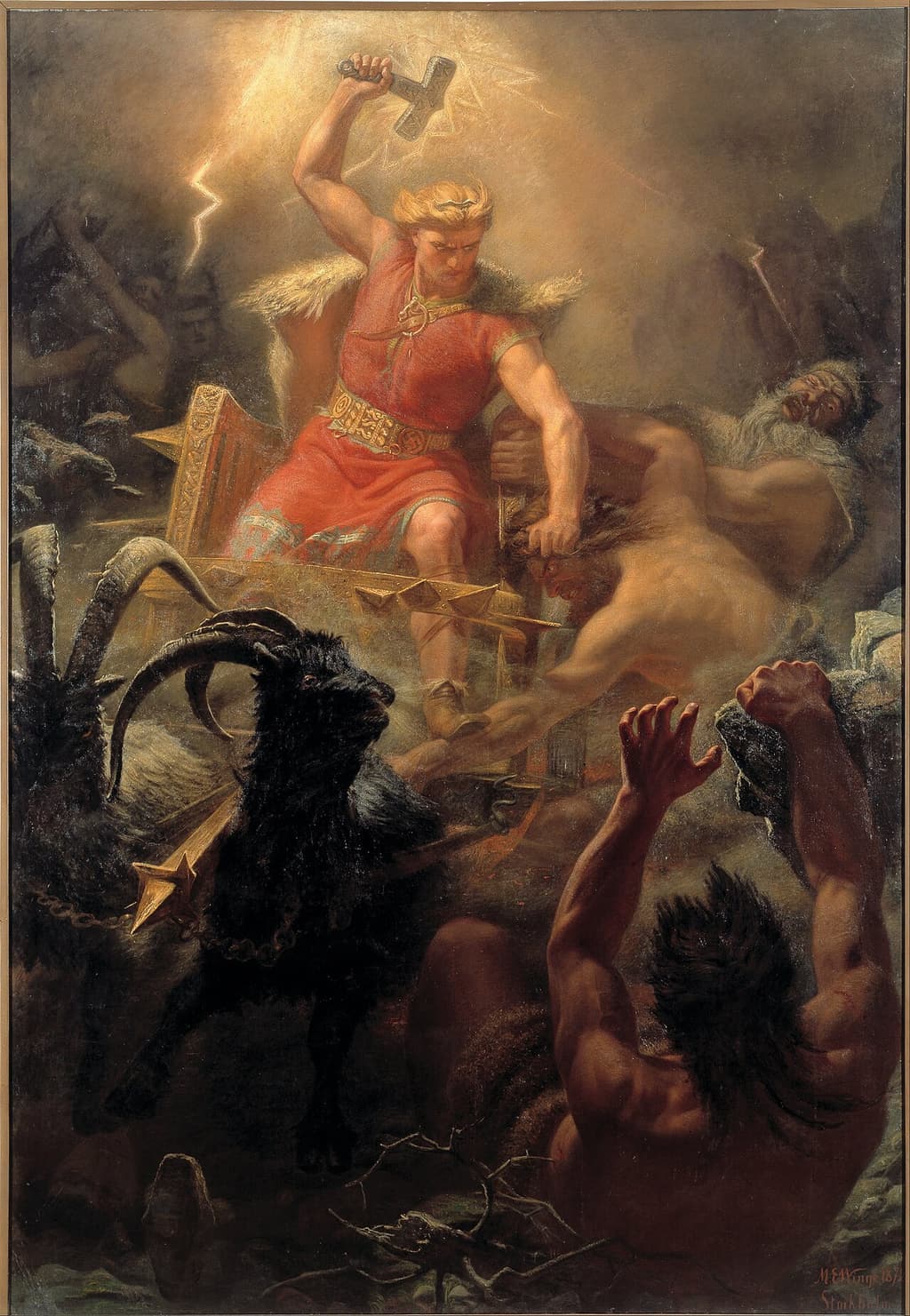
The other property, given in the same passage: it will never fail to hit what it is thrown at, it will never fly so far as not to return to the hand, and it can be made small enough to carry inside a shirt.
It hallows
The thing modern versions consistently drop is that Mjölnir is a ritual instrument as much as a weapon.
- In Þrymskviða, the hammer is brought in and laid on the disguised bride's knees to hallow the marriage — which is the moment the poem has been building to, and it tells us that a hammer at a wedding was a recognisable rite.
- At Baldr's funeral, Thor consecrates the pyre with it.
- Thor uses it to bless his goats back to life.
- Several rune stones carry the formula Þórr vígi — "may Thor hallow" — including the Glavendrup stone in Denmark, the Virring stone, and Sønder Kirkeby. The Glavendrup stone is a memorial that also carries a curse on anyone who damages it.
A hammer that sanctifies a marriage, consecrates a death and protects an inscription is not primarily a war-weapon. It is closer to a priest's implement that also happens to kill giants.
The pendants, and the conversion
The distribution of hammer amulets is the best evidence in Norse archaeology for what ordinary people did. They are made in silver, bronze, iron and amber, worn on neck-rings, buried in graves and hidden in hoards. Crucially, they become more common in the tenth century, not less — which is when Christian missionary activity intensifies.
The most quoted single object is a soapstone mould from Trendgården in Jutland that casts a cross and a hammer in adjacent matrices, from one workshop, presumably for one market. Whether that indicates a craftsman hedging, a syncretic period, or simply a business serving two clienteles is not decidable from a lump of soapstone, but it is a striking artefact.
Landnámabók and several sagas describe the sign of the hammer being made over a cup, and the Icelandic settler Helgi the Lean is said to have believed in Christ but invoked Thor at sea and in tight corners — which is probably the most honest sentence about religious change in the whole corpus.
What the modern hammer is
Marvel's version added an enchantment — worthiness — and an inscription about being worthy to hold the power of Thor. No medieval source contains any such condition. The comics also made it a war-hammer of fixed form; the sources make it a short-handled tool that returns.
Meanwhile the pendant has had a genuine second life. It is the recognised emblem of modern Ásatrú and Forn Siðr organisations, several of which are state-registered religious bodies in Iceland, Denmark and Norway, and the hammer was approved as a permitted religious symbol on US military headstones in 2013. It has also been appropriated by political movements with no interest in the mythology, which is a real problem for people who wear it for the original reasons. See symbol traditions for how the emblem has moved, and the Norse overview for the tradition it came out of.
Did anyone besides Thor use the hammer?
Vafþrúðnismál says that after Ragnarök, Thor's sons Móði and Magni will possess Mjölnir when Thor is dead — a detail that survives specifically to give the next generation something to inherit. Within the surviving myths nobody else wields it in combat, though it is repeatedly handled by others: the dwarfs make it, Loki carries it in the theft narrative's aftermath, and in Þrymskviða a giant's servants carry it in to a wedding. There is no suggestion anywhere that the object refuses a hand.
Are the amulets always Thor's hammer, or could they be something else?
Most are, but the category has fuzzy edges. Some pendants are cross-shaped and hard to assign; some have animal-head terminals that may be a different iconography altogether; a well-known class of pendants shaped like a rider's whip or a fire-steel has been reclassified more than once. The Købelev inscription settles the identification for one object and strongly supports the general reading, without proving every specimen. Archaeologists on the whole treat the T-shaped pendant with an expanded head as Thor's, and treat outliers case by case.