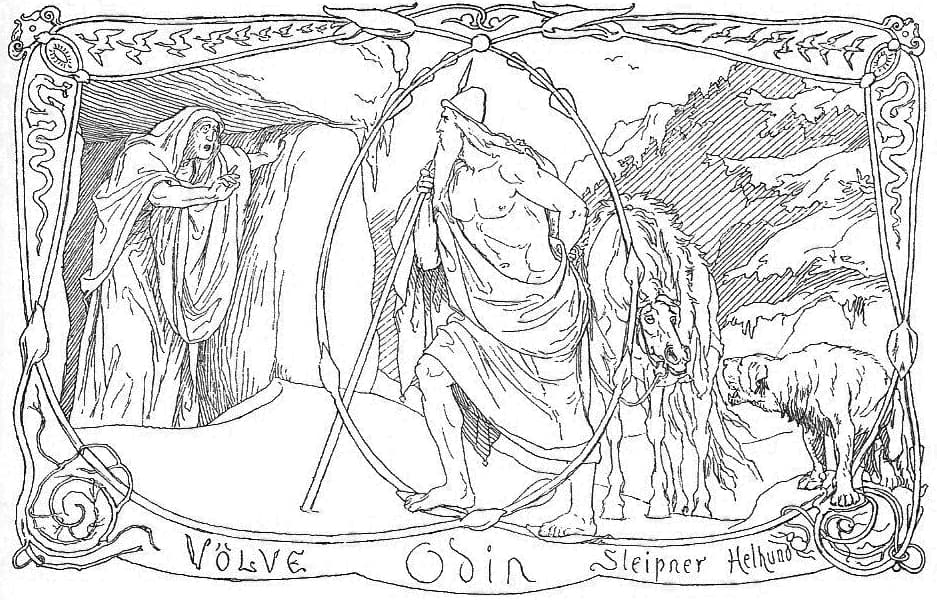
Grímnismál runs through a list of bests — best of trees, best of ships, best of gods — and when it reaches horses it says Sleipnir. That is the ordinary way the corpus refers to him: not as a marvel but as the top of a category, the way one might name the fastest ship in a fleet.
He has eight legs, and no Norse text ever remarks on it.
Where he came from
The story is in Gylfaginning and it is the aftermath of a construction dispute. A builder contracts to wall Ásgarðr in one winter, works with a stallion named Svaðilfæri that hauls stone at an impossible rate, and comes within three days of collecting a fee the gods cannot pay. Loki, who advised them to accept the terms, is told to fix it or die.
He turns himself into a mare. The stallion breaks its harness and runs after him into the woods, the builder loses a night's work and then his temper, and Thor kills him.
Some while later Loki bears a grey foal with eight legs, and gives him to Odin.
Snorri narrates this without a flicker. Loki is not merely a shapeshifter here — he is the mother, the sources use the maternal verb, and the family tree draws that line as maternal because that is what the text says. It is one of the most-cited facts about Norse mythology today and the medieval sources treat it as unexceptional.
The picture stones
Sleipnir is one of the very few Norse mythological subjects with unambiguous pre-Christian visual attestation.
The Tjängvide stone from Gotland, dated to the eighth or ninth century, shows a rider on a horse with eight legs, approaching a figure holding out a drinking horn. The Ardre VIII stone, from the same island and period, has a comparable scene. Both are usually read as a dead man arriving at a hall and being welcomed — the arrival scene familiar from Valhalla poetry — with the eight-legged horse carrying him.
That reading has a consequence. If the picture stones show a dead man riding Sleipnir, then the horse's function is not Odin's personal transport so much as conveyance between the living world and the other one.
What he is for
His recorded journeys support that. In Baldrs draumar, Odin saddles Sleipnir and rides down to Hel's gates to question a dead seeress. In Gylfaginning, Hermóðr borrows him for the nine-night ride to ransom Baldr, and leaps the gate Helgrind with him. Sigrdrífumál says runes were cut on Sleipnir's teeth, among other surfaces.
He is a horse for going to the underworld and coming back. Everything else attributed to him — battlefields, the sky — is inference.
His name means "the slipper" or "the sliding one," from a verb for gliding smoothly.
Why eight legs
There is no medieval explanation, so every answer is modern. Three have been proposed seriously.
- Speed as motion-blur. Eight legs are what a horse at full gallop looks like, and northern art frequently doubles limbs to indicate movement.
- The bier. A corpse carried by four bearers has eight legs beneath it. This reading, which makes Sleipnir a funeral procession seen as an animal, fits the death-journey pattern well and is attractive to many scholars.
- Shamanic parallel. Eight-legged horses appear in Siberian shamanic material, sometimes as the shaman's mount to the other world. The comparison is real and the transmission is not demonstrable, and it belongs to a broader and contested argument about Norse religion having shamanic components — an argument usually framed around the Sámi, seiðr and Odin's practices.
None of these can be tested against a source, and they are not mutually exclusive.
The horse he fathered
Völsunga saga says Sigurd's horse Grani, chosen out of a herd on the advice of an old man who is Odin in disguise, is descended from Sleipnir. That makes the greatest heroic horse in Norse legend the grandchild of a giant's stallion and a shapeshifted trickster, which the saga states as a straightforward pedigree. See Sigurd.
Eight legs in modern design
Sleipnir is one of the most reproduced Norse images in modern design — logos, tattoos, book covers, an Icelandic Coast Guard vessel, a common name for Scandinavian shipping and transport companies. Icelandic horses' tölt, the smooth four-beat gait unique to the breed, is regularly and appealingly linked to him in tourist material; there is no medieval connection, though the breed itself descends from horses the settlers brought.
He appears in God of War, in Marvel comics, and in a great deal of fantasy. What almost nothing keeps is the parentage, which is by some distance the strangest thing about him. For Odin, his rider, and the Norse overview for the tradition.
Is Sleipnir the only eight-legged horse in Norse material?
He is the only one named, but not quite the only one depicted. Some scholars have suggested that certain picture-stone horses with additional legs are conventional rather than specific — that the eight-legged form was a way of drawing a supernatural horse generally, and that Sleipnir is the surviving name for a wider type. The evidence is thin either way, and there are not many candidates. What can be said is that when a Gotlandic carver wanted to show a horse crossing into the other world, extra legs were the sign he used.
Did Loki's motherhood embarrass medieval writers?
Not visibly, and it is worth pausing on. Old Norse society had strong and legally-enforced attitudes about ergi — unmanliness, including passivity in a sexual sense — and calling a man argr was an actionable insult. Loki is taunted for exactly this in Lokasenna, where he is accused of having borne children and lived underground as a milkmaid, and where he throws the same charge at Odin over seiðr. So the culture had the vocabulary of shame available and used it, and yet Snorri narrates the foaling matter-of-factly, as an explanation of where a valuable animal came from. The insult and the origin story coexist without either cancelling the other.