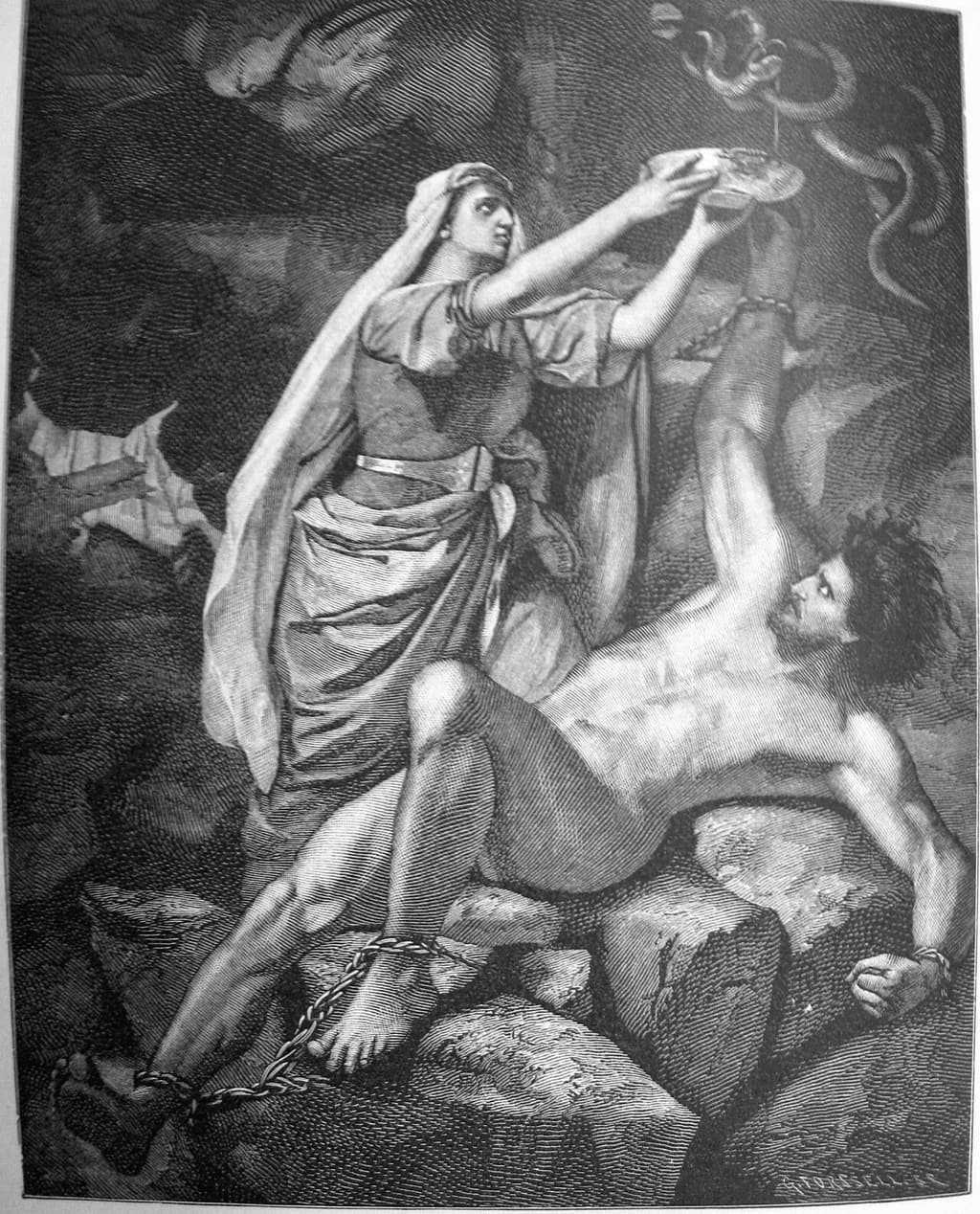
There is a stone cross in the churchyard at Gosforth in Cumbria, four and a half metres tall, carved around the middle of the tenth century. Among its panels is a bound male figure lying beneath a serpent, and beside him a woman holding a vessel over his face.
That is Sigyn, carved in England, on a Christian monument, roughly two hundred and fifty years before Snorri wrote anything down. Of all the figures in Norse mythology whose existence depends on the Prose Edda, she is emphatically not one.
What she does
Völuspá stanza 35 gives the scene in a few words: the seeress sees a captive lying under the grove of hot springs, in the shape of the guileful Loki; there sits Sigyn, and she is not glad of her husband.
Gylfaginning fills it out. After the gods catch Loki, they bind him on three stone slabs with the entrails of his own son, and Skaði fastens a venomous serpent above him so the poison drips onto his face. Sigyn stands beside him holding a basin under the drops. When the basin fills she must go and empty it, and while she is away the venom falls on him, and he writhes so violently that the whole earth shakes — which, Snorri says, is what people call an earthquake.
That is the entirety of her mythology. She holds a bowl. Everything about her position is defined by an interval: the time it takes to walk to the door, tip out the poison and come back.
Her sons
The binding is made from her children. Snorri names them Narfi — also given as Nari — and Váli, and says the Æsir turned one into a wolf, which tore the other to pieces, and used the dead son's intestines as the cord. Some manuscripts reverse which brother suffers which fate.
Völuspá speaks of bonds twisted from the entrails of a son without naming anyone, and the poem's terse phrasing has been read both as a reference to this and as something else entirely. What is not in dispute is that Sigyn's family is destroyed to manufacture the restraint she then spends eternity mitigating.
Nothing in any source records her reaction. The Eddic line — she is not glad of her husband — is all the interiority she is given, and it is a masterpiece of Norse understatement.
The name, and what little else survives
Sigyn is generally parsed as sigr, victory, plus vina, female friend: victory-friend, or friend of victory. It is a perfectly ordinary heroic-sounding name of a common Germanic type, and it fits her role not at all.
She is listed among the goddesses in Skáldskaparmál's catalogue, and skalds use her as a kenning element — Loki is "the burden of Sigyn's arms," which is a startling phrase referring to the moment of the bowl. Haustlöng by Þjóðólfr calls him that. She has no hall, no domain, no attributes, no parentage recorded, and no other appearance.
What kind of figure is this?
The temptation is to read her as a devoted wife, and the modern reception has largely done so — the standing patron of loyalty, endurance, and staying with someone through the unbearable.
The sources are more ambiguous than that. She is not described as loving Loki, forgiving him, or choosing her position; the texts do not say she was punished, nor that she volunteered. She is simply there, doing a thing that will never be finished and cannot succeed, because the bowl always fills.
If there is a theological content to Sigyn, it may be that: an image of mitigation without cure. The gods' most dangerous prisoner is not made harmless by his chains — the earthquakes prove the pain is getting through — and the only thing standing between the world and continuous seismic catastrophe is a woman's arms getting tired.
Sigyn as a patron of endurance
Marvel made Sigyn a minor figure and later fiction has taken her up repeatedly, generally as the sympathetic wife redeeming a charismatic villain — a reading that requires importing an emotional relationship the sources never describe. Modern heathen practice has adopted her widely as a figure of endurance and of caring for people in prolonged suffering, which is a genuine extension of the material rather than a distortion of it.
The Gosforth Cross remains the most important thing about her. A carver in Viking-age Cumbria, working on a Christian monument, thought this scene belonged among panels showing the crucifixion and the end of the world — and he expected people to recognise the woman with the bowl. See Loki for the binding's cause, Ragnarök for when it ends, and the Norse overview for the tradition around it.
Does Sigyn appear at Ragnarök?
No source places her there. The chains break, Loki sails with the crew from Hel's realm, and Sigyn is not mentioned again — not among the dead, not among the survivors, not in the world that rises afterwards. It is a conspicuous absence in a corpus that carefully accounts for who lives and who dies, and the most likely explanation is simply that the poets' interest in her ended with the tableau. She exists to be seen, once, in a cave.
Is the earthquake explanation a real folk belief or Snorri's invention?
It cannot be verified, but the mechanism is unusually well-suited to its audience. Iceland is seismically active, tremors are a normal part of life there, and Snorri lived with them. The Völuspá stanza mentions the bound figure and the hot springs — hveralundr, the grove of boiling springs — without drawing the earthquake connection, so the explanation may be Snorri's own inference from a landscape he knew. Either way, an Icelandic reader in 1230 who felt the ground move had a story ready for it, and that story was about a woman emptying a basin.