A serpent long enough to lie around the whole world and bite its own tail is a fact about geography before it is a monster. Miðgarðr is an enclosure; the sea is its boundary; and the boundary is alive.
Snorri says Odin threw Loki's second child into the deep sea that lies round all lands, and there it grew until it encircled everything and met its own tail. The name Jörmungandr is usually read as "huge staff" or "mighty wand" — jörmun- is an intensifier meaning vast, the same element as in Saxon Irmin — and the ordinary Norse name for it is simply Miðgarðsormr, the serpent of Miðgarðr.
The most carved scene in the Viking world
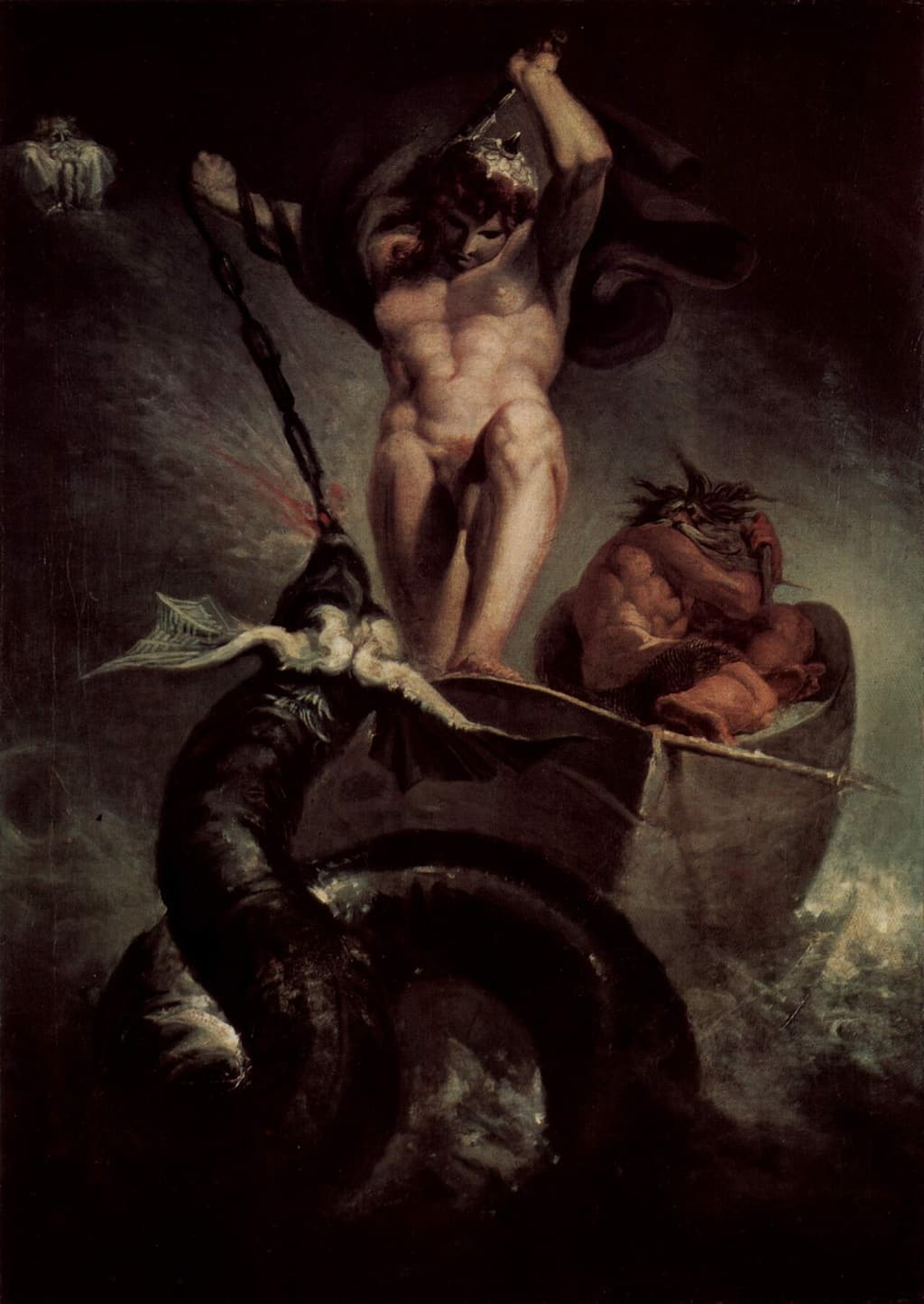
Thor's fishing expedition is told in Hymiskviða and again in Gylfaginning, and unusually for a Norse myth it can be checked against stone.
- The Altuna stone in Uppland, Sweden, from around 1100, shows a figure with a hammer in a boat, one foot pushed through the hull, a line going down to a serpent.
- The Gosforth fishing stone in Cumbria shows two figures in a boat with an ox-head bait on a line.
- The Hørdum stone in Thy, Denmark, shows the same, again with a foot through the boat.
- The Ardre VIII picture stone from Gotland has been read as a fourth.
Four monuments in three countries depicting one episode is by far the strongest attestation any Norse myth has. Whatever else was current in the tenth and eleventh centuries, this scene was.
The narrative belongs to Thor's entry and to the fishing trip; what belongs here is the disagreement about how it ends. Snorri says the giant Hymir panicked and cut the line, and the serpent sank back. Hymiskviða is ambiguous enough that some readers take Thor to have struck the serpent's head, and the tenth-century skald Úlfr Uggason in Húsdrápa, along with Bragi's Ragnarsdrápa, describe the encounter in terms several editors have read as a kill. There may once have been a version in which Thor won, and Snorri may have suppressed it in order to keep the serpent available for the end of the world.
The cat in Útgarðr
The world serpent's second appearance is a joke at Thor's expense. In Útgarða-Loki's hall he is challenged to lift a large grey cat off the floor and manages to raise one paw. Afterwards the king admits what the audience has half-guessed: the cat was the Miðgarðsormr, and everyone present was terrified when Thor got a foot of it off the ground.
It is the same relationship as the fishing trip, told as farce — Thor unknowingly almost dislodging the boundary of the world, and the giants stopping him.
The end
Völuspá has the serpent writhe in giant-rage and churn the waves as the world begins to break; Snorri says it will come ashore spitting so much venom that it sprays air and sea. Thor kills it and walks nine paces before the poison takes him, which is one of the few deaths in the corpus given a precise measure.
Their mutual destruction is the tidiest thing in Norse eschatology. The god of the boundary and the boundary itself cancel out.
What kind of monster is it?
Not a dragon. Old Norse distinguishes ormr — snake, serpent, worm — from the winged fire-breathing figure of later heraldry, and Fáfnir, the corpus's other great ormr, is a shapeshifted man who crawls. The Miðgarðsormr has no wings, no fire, no hoard, no speech and no motive. It is not guarding anything and it does not want anything. Compare Níðhöggr, who at least eats the dead, and see dragons and serpents across the traditions for how unusual an unmotivated monster is.
The tail-biting circle resembles the Egyptian and Greek ouroboros closely enough that borrowing has been suggested, and there is no evidence for it. The likelier explanation is that a serpent long enough to ring the world has to end up somewhere.
The serpent as an ally
God of War (2018) made Jörmungandr an enormous, essentially benign, time-displaced ally, which is a bold inversion. Marvel has used it as a kaiju. The image of the world-circling snake has become a common tattoo and logo, generally without the venom — see symbol traditions.
The medieval version has no personality at all, and that is precisely what makes it frightening. It is not evil. It is simply what is out there past the last fence, and it is the exact length of everything. For its siblings, see Fenrir and Hel; for the family, the Norse family tree.
Why does Thor keep meeting it if he can never kill it?
Because the confrontation is the theology, not the plot. Thor's function is to hold a boundary against what lies outside it, and a boundary is not a problem you solve once. Each encounter — the fishing line, the cat, the final poisoning — restages the same standoff at a different register: nearly, comically, fatally. A Norse audience did not need the serpent dead. They needed to know somebody was out there pulling on the line.
Was the serpent thought to cause real natural events?
The sources connect it to the sea's behaviour rather than to specific disasters: it lies in the deep, and when it moves at the end the waters rise and the land floods. Later Scandinavian folklore has plenty of sea-serpents that overturn boats, and it is reasonable to think the Miðgarðsormr sat behind those, but no medieval text says "this storm was the serpent." Compare Iceland's very real volcanic and seismic experience, which shows up much more clearly in Ragnarök's fire imagery than in anything the serpent does.