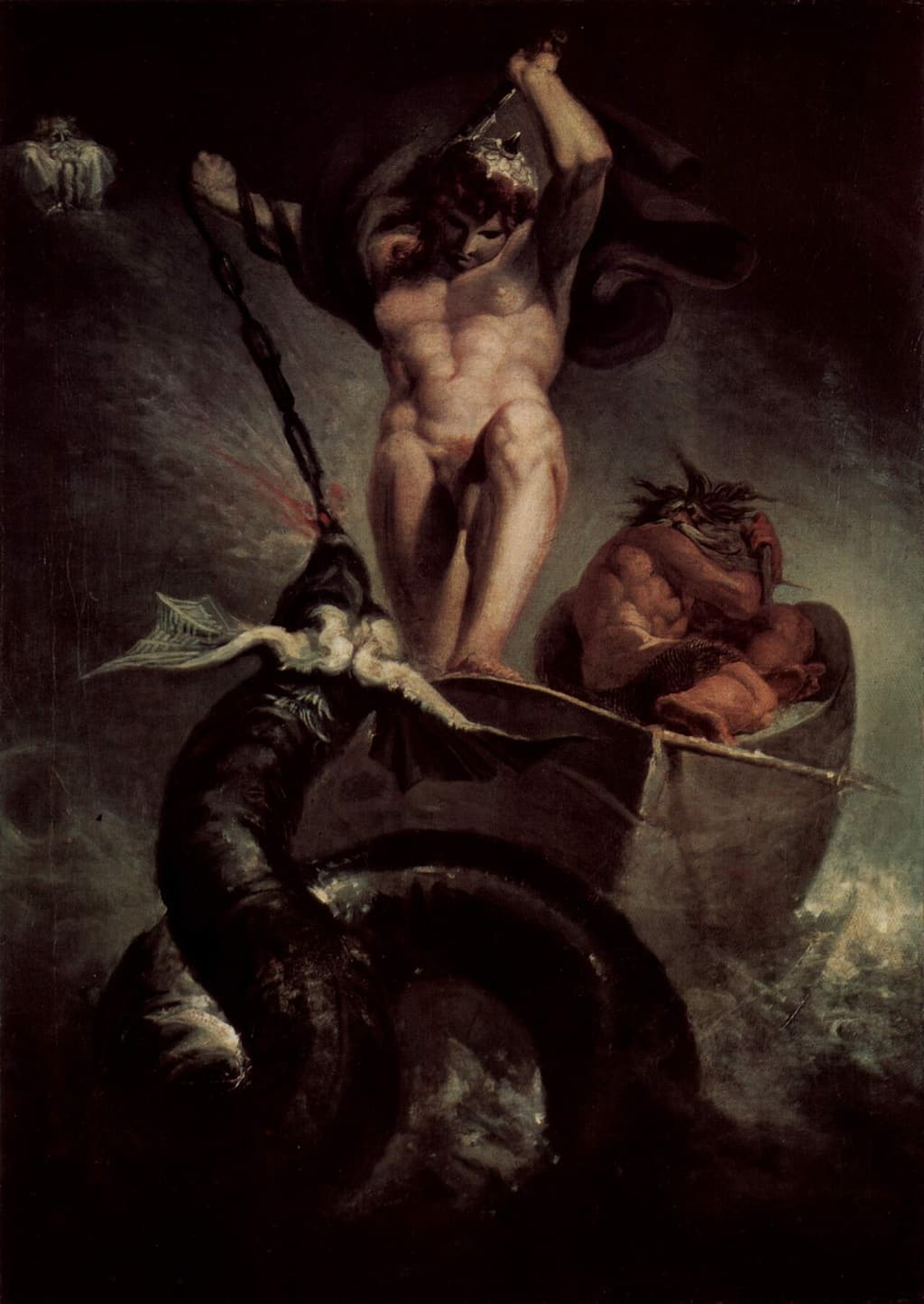
If you want to know which story about the Norse gods was actually popular — not popular with Victorian anthologists, popular with the people who commissioned carvings and paid poets — this is it. A god and a giant in a small boat, an ox's head on a line, and a moment of eye contact over the gunwale. It survives in two Eddic sources, at least five skaldic poems, and on stones in Sweden, Denmark and England that are still standing where you can go and look at them.
Bad company for a day's fishing
Thor came to the sea-giant Hymir's place looking, in the fuller poetic version, like a young man rather than a god, and invited himself along on the morning's fishing.
Hymir was unimpressed. A boy that size would freeze, he said, if they went out as far as he normally went. Thor, who could be needled by absolutely anyone, said nothing useful and asked for bait. Get your own, said Hymir.
So Thor walked to the giant's herd, picked the largest ox in it — a beast called Himinhrjóðr, Heaven-bellower — and tore its head off.
They put out. Thor took two oars in the stern and rowed with such violence that Hymir, who had spent a long life on that water, found himself impressed against his will. At the flat ground where he normally caught halibut, Hymir said this would do. Thor kept rowing. Hymir said, with some feeling, that going further out put them in reach of the Midgard Serpent. Thor kept rowing, then shipped the oars, put the ox's head on a hook, and dropped it over the side.
The thing on the line
The serpent that lies coiled round the whole of Midgard with its tail in its jaws took the bait, and the hook went up into the roof of its mouth.
What happens next is the image that got carved. Thor hauled. The pull was such that he braced both feet against the bottom of the boat and drove them through the planking, so that he was standing on the sea floor to get leverage. Hand over hand he brought the serpent up until its head came clear of the water at the side of the boat.
Then the two of them looked at each other. The poetry lingers on this: the god glaring down, the serpent glaring up and blowing poison, and nothing said. Hymir went the colour of a dead man, because his boat was filling and because the world's largest animal was inside arm's reach and both of the others in the scene wanted a fight.
As Thor reached for Mjölnir, Hymir cut the line.
The serpent went down. Thor threw the hammer after it into the water and then punched Hymir over the side, and waded to shore.
Two versions that do not agree about the ending
The prose account in Snorri Sturluson's Gylfaginning ends as above, and Snorri adds an editorial note of the kind he rarely bothers with: some people say the hammer took the serpent's head off on the sea bed, but he reckons the truth is that it is still alive out there in the ocean. He needs it alive, because the serpent has an appointment with Thor at Ragnarök, and he knew his audience knew that.
The Eddic poem Hymiskviða frames the whole thing differently. There the fishing is an episode inside an errand: the gods want to drink at Ægir's hall, Ægir demands a brewing cauldron a mile deep, Týr says his father Hymir owns one, and Thor and Týr go to fetch it. Thor eats two of Hymir's oxen at supper, which is why they need to fish at all. The poem's account of the catch is compressed and, at the crucial line, ambiguous: Thor strikes at the serpent's head, and whether the blow lands, and what it does, is not stated in terms that settle the argument. The poem then moves briskly on to a cup that has to be smashed against the giant's skull, the theft of the cauldron, and a running fight with giants on the way out.
The two accounts also disagree about who is in the boat's story: Snorri's Thor arrives disguised and alone, while Hymiskviða makes the visit Týr's family business.
Five poets and a hall full of carvings
This is the best-attested Thor myth in skaldic verse, which is a stronger form of evidence than either Edda, because skaldic poetry is dated, attributed and metrically difficult to alter.
- Bragi Boddason, possibly the earliest named skald, described the scene in Ragnarsdrápa as part of a set of pictures on a shield.
- Úlfr Uggason, in Húsdrápa, described it among the carvings in a new hall built at Hjarðarholt in Iceland around 985 — meaning a wealthy Icelander had the fishing trip cut into his own woodwork as a status object.
- Eysteinn Valdason, Gamli gnævaðarskáld and Ölvir hnúfa all left fragments on it as well.
The verses agree on the details that matter: the ox head, the strain, the venom, the stare.
The stones you can go and see
Four monuments are standardly identified with this myth, and they are the reason the fishing trip is called the most-depicted scene in Viking-Age art.
- The Altuna stone (Uppland, Sweden), eleventh century. A single figure with a hammer sits in a boat, a line running from his hand to a big-headed creature below, an ox head on the line — and one foot pushed clean through the hull. Altuna's carver has Thor alone, following the version where Hymir does not matter.
- The Hørdum stone (Thy, northern Jutland). Two figures in a boat, one with a foot through the bottom, the line going down.
- The Gosforth fishing stone (Cumbria, England), from the same tenth-century Norse-Christian workshop tradition as the great Gosforth cross. Two men in a boat, an ox head on the hook.
- Ardre VIII (Gotland), a crowded picture stone on which a boat-and-line scene is generally read as this episode among many others.
Take the group together and you have people carving the same story in Sweden, Denmark and Cumbria within a century or so of each other — a genuinely shared Norse-world image, not a literary curiosity.
Why this scene and not another
A reasonable guess, and it is a guess, is that the fishing trip is a still frame from the end of the world. Thor and the serpent are fated to kill each other at Ragnarök; here they meet early, and the encounter is broken off by a frightened bystander with a knife. That gives an audience the confrontation and withholds the ending, which is exactly the shape a memorable picture needs.
There is a second, cheaper reason worth stating: it is a good story about fishing, told to people who fished. The bickering about how far out to row, the too-heavy catch, the ruined boat and the one man on board who wants to go home are all recognisable from any small vessel in a northern sea.
Details readers often ask about
Why an ox's head? Because bait must be proportionate, and because taking it is a deliberate insult to a host who has just refused to supply any. It also sets up Hymiskviða's domestic joke, in which the god has already eaten most of the herd at dinner.
Does Thor's foot go through the boat in every version? No. It is explicit in Snorri and clearly carved at Altuna and Hørdum, and it is the detail that turns a fishing anecdote into a cosmological one — the god stands on the floor of the world-ocean to pull. Hymiskviða handles the bracing more vaguely.
Is Hymir a coward? He is the only sane person present, which in Norse narrative amounts to the same charge. His cutting of the line is the hinge of the plot: without it the serpent dies here and Ragnarök has no second act.
What happened to the cauldron? In Hymiskviða he upends it over his head and walks off wearing it, the rings clanking down at his heels, kills the giants who come after him, and the gods get their ale. That is the poem's actual plot; the fishing is the digression that everyone remembered instead.
Is there any chance the serpent died? Only in the reading Snorri names in order to reject. Every text that looks forward to the end of the world assumes the serpent is alive and waiting, so a decapitation here would break the whole chronology.
Related reading: Jörmungandr itself, the wider bestiary of dragons and serpents and sea monsters, Thor's other trip into giant country at Útgarða-Loki's hall, and the Norse tradition hub.