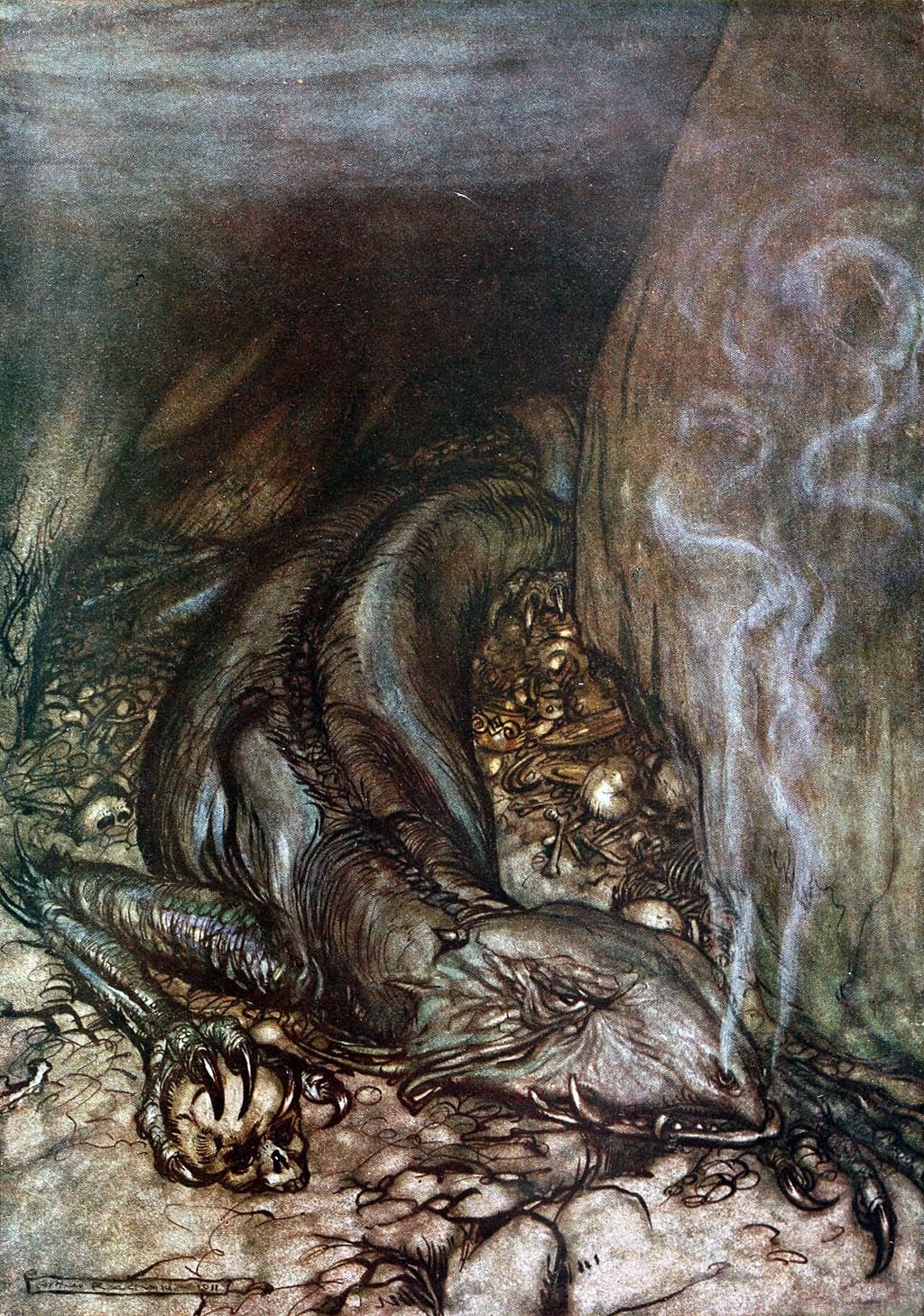
The dragon-slaying is the famous part, and it is not the point. The point is that the gold was cursed by name, by a robbed dwarf, in front of witnesses, before a single character in the main plot was born — and that everybody who takes it afterwards has been told, explicitly, what it will do to them, and takes it anyway. That is not a monster story. It is a story about knowing better.
An otter, and a bill nobody could pay
Three gods were walking: Odin, Hœnir and Loki. At a waterfall they saw an otter on the bank with its eyes shut, eating a salmon, and Loki killed it with a stone and was pleased with the throw.
That evening they asked for lodging at a farm and showed off the skin. The farmer was Hreiðmarr; the otter had been his son Ótr, who liked to fish in that shape. Hreiðmarr and his surviving sons, Fáfnir and Regin, took the three of them prisoner and set the ransom: the otter's skin was to be stuffed with gold, and then the whole of it covered over, so that not one hair remained visible.
Loki was sent to fetch the gold. There was a dwarf named Andvari who lived in that same water in the form of a pike; Loki borrowed a net, caught him, and took everything he had. Andvari tried to keep back one ring, and Loki took that too.
So the dwarf, going into the rock with nothing, cursed the hoard and the ring particularly: they would be the death of every man who owned them. It cost him nothing to say and it turns out to have been an accurate forecast.
They stuffed the skin, stood it up, and heaped gold over it. One whisker was still showing. Odin had kept Andvari's ring back for himself, and now had to put it on the whisker to finish the job — and as he handed it over he repeated the curse to Hreiðmarr's face, in detail, as a parting gift.
Two brothers and a hoard
Hreiðmarr had no intention of sharing the ransom with the sons who had helped extort it. Fáfnir killed him for it and took the lot out to a heath called Gnitaheiðr, where he settled onto the gold, put on a helm of terror, and stopped being anything a person could talk to. Norse tradition is casual about the transformation: he lay on the hoard and he was a serpent, and the sources do not fuss about the mechanism.
Regin got nothing. He was a smith, small and clever and full of ancient knowledge, and he went to the court of King Hjálprekr, where he became foster-father and tutor to a boy called Sigurd — the posthumous son of Sigmund of the Völsungs, a family with a bad history and an excellent bloodline.
Regin talked to the boy about the gold for years.
Getting equipped
Sigurd did two sensible things before going anywhere near a dragon.
He got a horse. An old one-eyed stranger appeared while he was choosing and advised driving the whole herd into a river; the one that swam rather than turned back was Grani, descended from Sleipnir, which tells you exactly who the stranger was.
And he got a sword, eventually. Regin forged him one, and it broke on the anvil. Regin forged another, and that broke too. Then Sigurd went to his mother and asked for the pieces of his father's sword, Gram, which had been shattered in Sigmund's last fight when a spear was held up against it. Regin welded the fragments and the third blade split the anvil down to the block and sliced a tuft of wool drifting on the river current.
He also insisted on doing his own family's business first, and rode out and killed the sons of Hunding, who had killed his father. Then he came back for the dragon.
The pit
Regin's plan was to dig a trench in the track Fáfnir used going down to drink, get into it, and stab upward as the body passed over. He did not mention what several tons of venomous blood would do to a man in a hole.
The old one-eyed stranger turned up again while Sigurd was digging, and pointed out mildly that he might want to dig several channels for the blood to run off into, and Sigurd did, and that is the only reason he survived his own ambush.
The serpent came down, breathing poison ahead of it, and the ground shook, and Sigurd stayed where he was. As the body passed above him he drove Gram up under the left shoulder to the hilt.
The conversation
What follows is the strangest scene in Norse heroic poetry, and it takes up most of the poem named after the dragon. Fáfnir does not die immediately. He lies there bleeding out, and he and the man who has just killed him have a long, careful, mutually respectful conversation.
He asks who the boy is and whose son he is. Sigurd does not answer — the old belief being that a dying man's curse is far more dangerous if he can name you — and gives evasive replies about being a creature with no kin. Eventually he tells the truth anyway.
Fáfnir's response is a warning delivered without malice, which is what makes it land. The ringing gold, he says, will be Sigurd's death exactly as it has been his; go home, go anywhere, do not take it. And when Sigurd says he intends to take it regardless — every man wants wealth until the day he dies — Fáfnir gives him the second and better warning: Regin betrayed me, and he will betray you.
Then, since he is dying anyway and has been alive a long time, he answers questions. Sigurd asks him about the norns who attend births, and about where the gods and Surtr will meet at the end. It is a wisdom-contest grafted onto a death scene, and the poem is entirely comfortable with the join.
The heart, the thumb, and the birds
Regin came out of hiding once the shaking stopped. He cut out the heart, drank blood from the wound, and asked Sigurd to do him the favour of roasting the heart while he slept off what he had drunk.
Sigurd spitted it over the fire. To see whether it was done he pressed it with a finger, burned himself, and put the finger in his mouth — and the dragon's blood touched his tongue, and the birds in the branches above him stopped being noise and started being speech.
There were several of them and they were talking about him with some contempt. He should be eating that heart himself, not cooking it for someone else. Regin was lying over there working out how to kill him. He should take Regin's head off and keep the gold. And — this last one is the hinge of everything that follows — he should ride south to a mountain called Hindarfjall, where a woman in armour lies asleep inside a ring of fire.
He beheaded Regin, ate some of the heart and kept the rest, loaded the hoard onto Grani, and rode to the mountain. On it he found a wall of shields and firelight, and inside it a sleeping figure in mail so tight to the body that he had to cut it away, and the sleeper woke and turned out to be a valkyrie, punished by Odin with sleep for awarding a battle to the wrong king. She greeted the day and the night and the gods, and then taught him runes — victory-runes, ale-runes, birth-runes, sea-runes, speech-runes — and a long list of practical counsels about how to conduct himself.
The rest of Sigurd's life goes badly, and the gold is the reason. He arrives among the Gjúkungs, is handed something to drink that takes his memory away, marries Gudrún, wins Brynhild for her brother Gunnar by riding through her fire in Gunnar's shape, and is murdered when the deception comes out. Brynhild has him killed and then will not outlive him. The hoard goes into the Rhine, and everyone who has touched it is dead within a generation.
Where the story is written down
- The Poetic Edda. Reginsmál covers the otter's ransom and the arming; Fáfnismál the killing and the dying conversation; Sigrdrífumál the waking on the mountain. All three are in the Codex Regius, and all three are mostly dialogue with prose links.
- Völsunga saga, an Icelandic prose retelling of about 1270 that works the whole cycle into one continuous narrative. It is our only complete text for the middle of the story, because the Codex Regius has lost a gathering of eight leaves — the famous great lacuna — and the saga's author was working from a manuscript that still had them.
- Snorri's Skáldskaparmál tells the ransom episode, because Norse poets called gold "the otter's payment" and Snorri's job was explaining kennings.
- The German tradition — the Nibelungenlied, around 1200 — has the same skeleton with different flesh: there Siegfried washes himself in what comes out of the dragon and cannot afterwards be wounded, apart from one patch of skin that a falling lime leaf had covered — a detail with no counterpart anywhere in the Norse material. The two traditions should not be blended, and popular retellings blend them constantly.
Carved on stone and on doors
This story was illustrated more often than any other in the medieval north, and several of the images survive intact.
The Ramsund carving in Södermanland, Sweden, cut around 1030, is effectively a comic strip in rock. The dragon's body forms the runic band; a man stabs it from below; nearby he sits at a fire sucking his thumb with the heart on a spit; birds sit in a tree; a horse stands tied to the trunk loaded with something; and a headless smith lies among his own tools and bellows. Everything above is on that rock. The nearby Gök stone copies it, badly.
The Hylestad stave church portal from Norway, twelfth century, carries the sequence up the door-jambs: the sword being reforged, the thrust from the pit, the roasting, the birds, the beheading. It was carved for a church, which is worth sitting with. Fragments of the same scenes appear on stone crosses in northern England and on the Isle of Man.
History underneath it
Parts of the cycle attach to real people. Gunnar is Gundahari, king of the Burgundians, whose people were destroyed by Hunnish forces in 437. Atli is Attila. Jörmunrekkr is Ermanaric, the Gothic king who died around 376. These are fifth- and fourth-century events, remembered in verse for seven or eight hundred years before anyone wrote them in Iceland.
Sigurd himself has no identified historical original, and attempts to find one have not succeeded. Brynhild is sometimes linked to Brunhilda of Austrasia, the Frankish queen killed in 613, on the strength of the name and a violent death; the link is asserted more often than it is argued.
Wagner, Tolkien, and the ring problem
Richard Wagner used the Norse material rather than the German for most of the Ring — the reforged sword, the dragon's blood, the bird's speech, the woman asleep in fire — and fused Sigurd's story with a curse-bearing ring made from stolen river gold. A great deal of what modern readers "know" about Sigurd is actually Wagner.
Tolkien knew the poems professionally; he lectured on them and wrote his own verse version of the cycle, published long after his death as The Legend of Sigurd and Gudrún. Asked about the resemblance between his ring and Wagner's, he is reported to have said that both were round and the resemblance stopped there — which is a good joke and slightly unfair to the sources they share.
Questions this cycle keeps raising
Is the woman on the mountain Brynhild? Völsunga saga says yes and treats them as one person. The Eddic poems are less clear, and the name sigrdrífa may be an ordinary noun meaning something like victory-bringer rather than a personal name, in which case a scribe may have turned a title into a character. The lacuna in the manuscript sits exactly where the answer would have been.
Why conceal his name from a dying enemy? Because words spoken at the moment of death were held to carry weight, and a curse needs a target. Sigurd's evasions are legally cautious, not cowardly, and Fáfnir treats them as a normal precaution.
Does eating the heart do anything? The blood on the tongue is what grants the birds' speech; the heart itself is what the birds say Sigurd should have kept for himself. In Völsunga saga he saves a portion of it and later gives it to Gudrún, and it is said to change her. The texts are not systematic about it.
Is Fáfnir a dragon or a man? Both, without explanation. Old Norse uses words meaning serpent and worm; the winged four-legged dragon of later art is not what these texts describe. He talks, reasons and gives good advice throughout, which no later dragon in European literature quite manages.
Why does Odin keep appearing to help? He does this to the whole Völsung line, and then destroys it. The family are his protégés, his descendants and eventually his casualties; the same one-eyed adviser who picks the horse is the one who broke Sigmund's sword with his spear.
For the aftermath see Brynhild and Sigurd; for the wider bestiary, dragons and serpents; for the smith-craft world these characters live in, Völund. The tradition is mapped at the Norse hub.