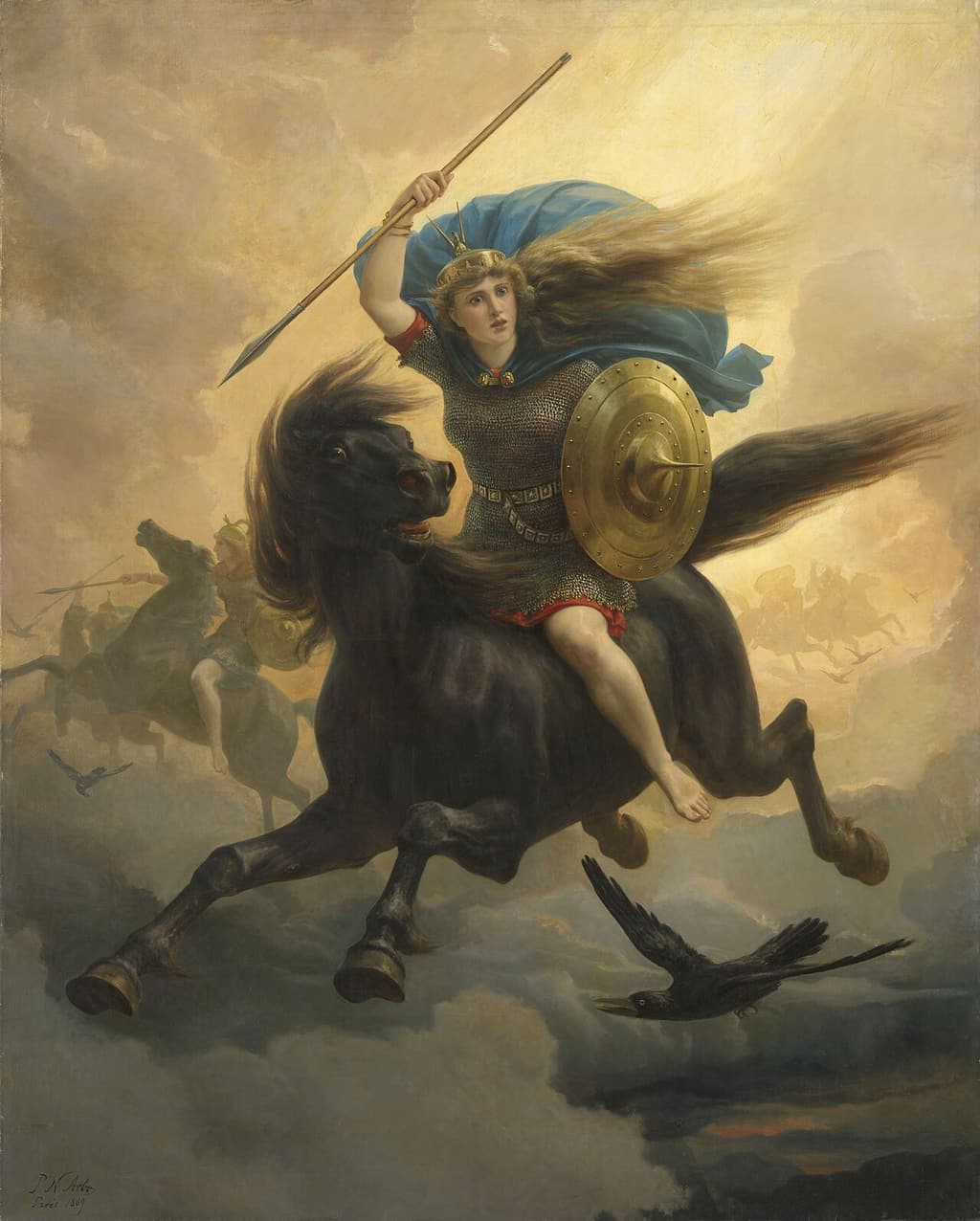
In Njáls saga, on Good Friday in the year 1014, a man in Caithness named Dörruðr looks through the window of a hut and sees twelve women at a loom. The warp is made of human intestines, weighted with severed heads; the shuttles are arrows, the beater a sword. They sing while they work, naming themselves and the outcome of a battle being fought that morning in Ireland. Then they tear the cloth apart, each keeping a piece, mount their horses and ride away — six to the south, six to the north.
The poem they sing is called Darraðarljóð, and the battle is Clontarf. This is the valkyries as the sources actually present them, and it bears no resemblance whatever to the armoured women in winged helmets who arrived in the nineteenth century.
The name is a job description
Valkyrja is transparently compounded: valr, the slain on a battlefield, plus a noun from kjósa, to choose. Chooser of the slain. Not carrier, not honourer — chooser. The Old English cognate wælcyrge appears in glossaries translating Latin Erinys and Bellona and in a homily by Wulfstan listing the kinds of criminal and monstrous person plaguing England, alongside witches and murderers. English clerics did not think of them as beautiful.
The verb governs the whole idea: someone decides who dies today, and that decision is made before the fighting, not after. In Völuspá they are ready to ride to the gods' people; in Grímnismál Odin lists thirteen of them — Hrist, Mist, Skeggjöld, Skögul, Hildr, Þrúðr, Hlökk, Herfjötur, Göll, Geirahöð, Randgríð, Ráðgríð and Reginleif — who carry ale to the einherjar. Their names run to war and violence: Battle, Tumult, Shrieker, Spear-Truce, Host-Fetter.
Herfjötur is the most interesting of them. Herfjöturr means "army-fetter," and it names a real battlefield phenomenon that Old Norse literature describes repeatedly: the sudden paralysis that takes a fighter at the wrong moment. A valkyrie is the agency behind it. That is a mythology built by people who had been in fights.
Two layers
The corpus contains two rather different kinds of valkyrie and they do not fully reconcile.
The first are functionaries of Odin — anonymous, plural, dispatched, serving mead in Valhalla, sometimes called his óskmeyjar, wish-maidens. Eiríksmál and Hákonarmál, both tenth-century memorial poems for real kings, use them exactly this way: Odin sends Göndul and Skögul to choose which king shall join him, and the poets treat the machinery as familiar.
The second are individuals with names, families, husbands and grievances — Brynhildr, Sigrún, Sváva, Kára — who fall in love with heroes, are punished for choosing the wrong man to kill, take human form and, in the Helgi poems, are reborn. Völundarkviða opens with three women spinning by a lake with swan-cloaks beside them; they are called valkyries and they are also swan-maidens out of folktale, and they leave after seven years.
Whether the individuated heroic valkyrie is a literary development of the collective one, or the two were always distinct, is unsettled. What is clear is that the second type dominates the poems modern readers meet first, and it is the type furthest from the Darraðarljóð loom.
The archaeology
Small female figures in Viking-age metalwork have been identified as valkyries for a century, usually depicting a woman with a knotted ponytail offering a drinking horn — the greeting scene from the memorial poems. They appear as pendants, on the Tjängvide picture stone from Gotland, and in the Oseberg tapestry fragments.
The strongest single find is the Hårby figurine, a three-dimensional silver-gilt figure just under four centimetres tall, excavated in Denmark in 2012 and dated to around 800. It shows a woman in a trailing dress with her hair in a knot, holding a sword in one hand and a shield in the other. It is the only known contemporary Scandinavian depiction of an armed woman in the round.
What it proves is that the image existed. It cannot tell us whether the Norse considered these figures divine, semi-divine, or a kind of fate-spirit, and the sources are equally unhelpful — Fáfnismál mentions norns of different kindreds and the boundary between norn, dís, fylgja and valkyrie is porous everywhere you look. See the Norns for the neighbouring category.
Wagner, and everything after
Nearly all the popular imagery is nineteenth-century German. The winged helmet is an invention of the costume designer Carl Emil Doepler for the 1876 Bayreuth premiere of the Ring; no Norse or Germanic helmet ever had wings or horns. The name of Die Walküre's most famous eight minutes has since attached itself to helicopters, adverts and parodies, and the word "Valkyrie" in English now means, functionally, a heroic blonde woman with a spear.
Modern reception has also entangled them with the historical question of women fighting in Viking-age Scandinavia — a debate sharpened by the 2017 genomic study of the Birka chamber grave Bj 581, which identified a richly-equipped weapon burial as biologically female and set off an argument about grave-goods and interpretation that is still running. That is an archaeological question about human beings. It is not evidence about valkyries, and the two get conflated constantly.
For where the chosen are taken and what they do when they arrive, see Valhalla; for the god who employs them, Odin; and for the wider tradition, the Norse overview.
Do valkyries decide the outcome, or just collect the results?
Darraðarljóð is unambiguous that they determine it: the weaving is the battle, and the outcome is the cloth. Elsewhere the language is weaker — Odin sends them, they select — and Völuspá has fate assigned by other powers entirely. The sharpest way to put the tension is that Norse sources give fate several different departments and never publish an organisational chart. Weaving as a metaphor for deciding what happens recurs across the corpus, and the loom is the most physical version of it.
Were valkyries thought to be dead women, spirits, or a kind of goddess?
None of the three, consistently. Brynhild is a king's daughter demoted from valkyrie status by Odin and married off, which implies living women could hold the office. Sigrún is reborn as another woman. The dísir — a broader class of female powers who received an autumn sacrifice, the dísablót, attested in Egils saga and in Swedish place-names — overlap with valkyries in the vocabulary without being the same thing. The likeliest picture is a spectrum of female fate-and-death powers that the poets moved between freely and never sorted into species.