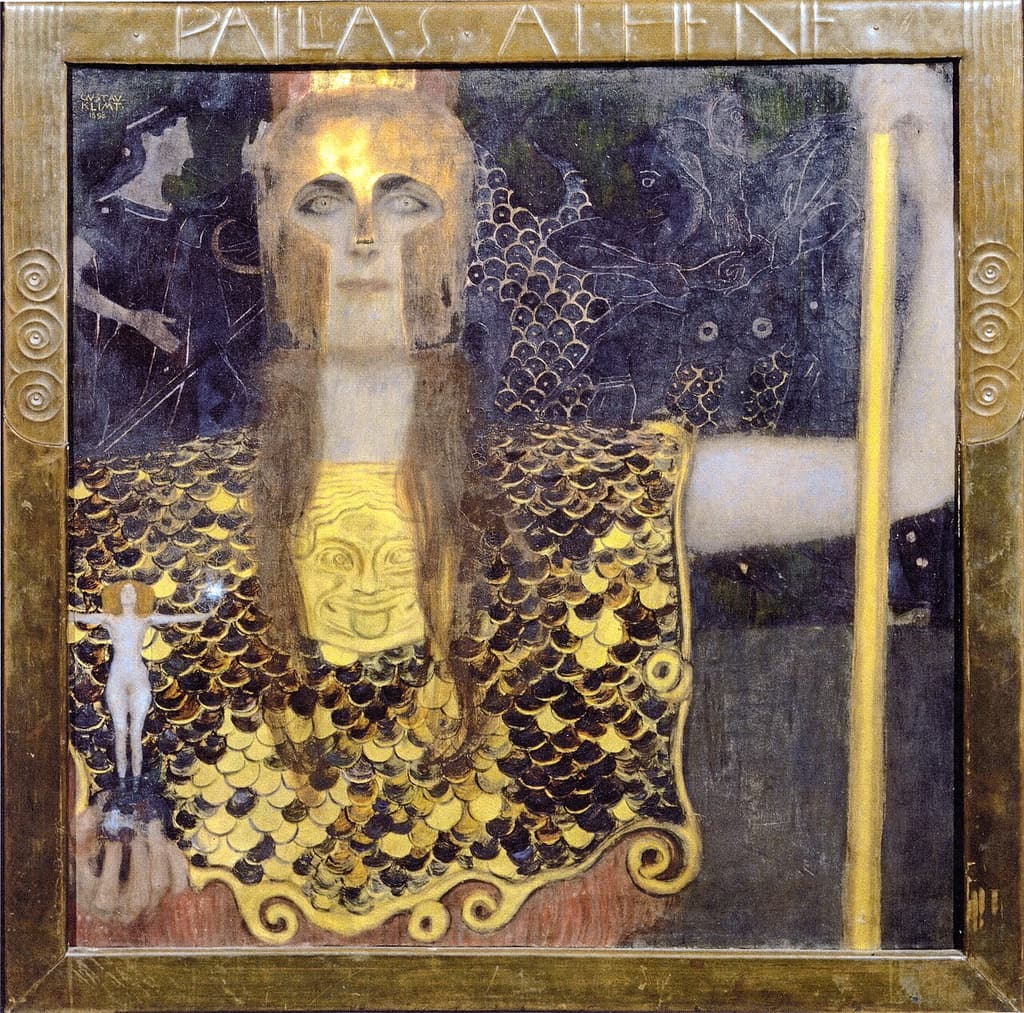
Athena is the only Olympian with no mother in the version that mattered most — and the reason is a story about a father eating a threat. Zeus was warned that his consort Metis, whose name means cunning intelligence, would bear a son greater than himself. So he swallowed her while she was pregnant, and in due course suffered a headache so severe that Hephaestus split his skull with an axe, and a fully armed goddess stepped out shouting. Hesiod's Theogony tells it as a piece of divine statecraft: the sky-king absorbs the intelligence that could displace him, and what comes out is a daughter who will never challenge him.
The consequences run through everything about her. She has no independent maternal line, no marriage, no children, and an unusually close and unironic relationship with her father — she alone is permitted to use the aegis and, in some accounts, to handle the thunderbolt.
Two skills, one goddess
Modern versions almost always reduce her to strategic warfare, and the ancient evidence puts craft at least level with it.
The war side is specific: she is the goddess of the disciplined fight, of the tactic and the campaign, in explicit contrast to the battle-frenzy her half-brother represents. In the Iliad she fights Ares directly and flattens him with a boundary stone, and Homer has him described as a shifting, unreliable creature while she is effective. She fights on the side that wins because she chooses the side that should.
The craft side is at least as prominent in cult. She is Athena Ergane, the worker — patroness of weaving, pottery, metalwork, shipbuilding and the ox-yoke. Athenian potters dedicated to her; the great festival's central act was the delivery of a woven robe. The story of Arachne, told at length in Ovid's Metamorphoses and only alluded to earlier, is a weaving contest in which the mortal's tapestry — depicting the gods' rapes and deceptions — is technically flawless, and the goddess destroys it and transforms her. Ovid tells it as a story about the danger of being right in front of power.
The city that took her name
The contest for Attica is the founding story: Poseidon struck the Acropolis rock and produced a salt spring or a horse, Athena produced an olive tree, and the citizens judged the olive the better gift. The tokens were still shown on the Acropolis in Pausanias' day — a mark in the rock, a salt well, and an olive by the Erechtheion which was said to have burned in the Persian sack and regrown a full shoot within a day.
Her cult on that rock was not one cult but several, and they belonged to different sides of her:
- Athena Polias, of the city — the oldest and most important, whose ancient olive-wood image, not the famous ivory statue, was the object that actually mattered. It was washed and dressed, and it received the new robe at the Panathenaia.
- Athena Parthenos, the maiden, in the Parthenon: Pheidias' twelve-metre gold-and-ivory statue, whose gold plates were removable and were counted as state reserves.
- Athena Nike, victory, in the small temple on the bastion by the entrance.
- Athena Promachos, who fights in front, a colossal bronze whose spear-tip was said to be visible from the sea.
She was not only Athenian. Her cult at Tegea, at Lindos on Rhodes, at Sparta as Athena Chalkioikos "of the bronze house", and at Troy as the goddess whose ancient image the Palladion protected the city, are all independent and old. Where Athens made her a civic patron, other cities kept a more archaic armed goddess.
What "Pallas" means, and three answers to it
Her constant epithet is Pallas, and the Greeks themselves offered incompatible explanations. Apollodorus reports that Pallas was a childhood companion whom Athena accidentally killed in a practice fight, and that she took the name in grief and made the Palladion in her likeness. Another tradition makes Pallas a giant or Titan she killed and flayed. A third takes it simply as a word for a young woman. The site records all three because Greek sources record all three, and no modern etymology has settled it.
The aegis is similarly layered: a goatskin, tasselled and fringed with snakes, with the Gorgon's head at its centre, which is Zeus' and which she wears. Whether it began as an actual goat hide, a shield, or a storm cloud is argued; in art it is unmistakable and it is hers far more often than his.
The owl is her bird and appears on Athenian coinage so consistently that "owls to Athens" became the Greek proverb for pointless activity. Whether the owl came from an earlier bird-goddess or was attached for its association with night vision is not recoverable.
The parts that are uncomfortable
Two episodes resist the tidy "goddess of wisdom" reading, and both are in the sources rather than in modern retellings.
Hephaestus attempted to rape her; she pushed him away and his seed fell on her leg, which she wiped off with wool and dropped to the earth. From that the earth bore Erichthonios, whom she raised in secret in a chest, forbidding the daughters of Cecrops to look inside. They looked, saw a child with a serpent's coils, and threw themselves from the Acropolis. Athenian aristocrats claimed descent from that child: their autochthony, their claim to have sprung from the soil of Attica itself, runs through this story.
And in Ovid's version of the Gorgon's origin, it is Athena who transforms Medusa after she is assaulted in Athena's own temple — punishing the victim for the pollution of the sanctuary. That version is Roman and late, and it is the one virtually everyone now knows; the Greek sources have no such episode at all, and the difference is set out on Medusa's own page.
The Roman equation, and where it fails
Minerva takes her wisdom and her crafts, sits in the Capitoline triad with Jupiter and Juno, and receives the guild dedications. What she does not take is ownership of a city: Athena is Athens in a way Minerva is not Rome, and the difference explains why so much Athenian art is really political argument about her. The comparison page works through the rest, including the Etruscan Menrva who stands behind the Roman goddess independently of any Greek route.
Athena since
She has had an unusually respectable afterlife. Enlightenment and republican iconography took her as the emblem of reasoned government — she stands over parliaments, universities and libraries across Europe and the Americas, generally in the Parthenos pose with owl and spear. Contemporary fiction and games use her constantly, almost always as the strategist, and the loom disappears entirely; the Percy Jackson books and Assassin's Creed Odyssey are typical in this.
Her name is also one of the most commonly borrowed from Greek myth for modern children, particularly in English-speaking countries since the 2000s, where its meaning and history as a given name has become a question people ask far more often than they ask about her cult.
Three questions people bring to this page
Was she really a virgin goddess, or is that a later idea?
It is old and it is structural. Parthenos is her defining epithet at Athens, and unlike Artemis her chastity is not framed as a vow or a preference but as a condition of what she is: the intelligence that belongs to no household. The Erichthonios story is precisely a demonstration of it — she acquires a son without conception.
Why does she help Odysseus so much and Achilles so little?
Because she rewards the quality she embodies. Odysseus is the tactician, the liar, the man who survives by intelligence, and the Odyssey makes their relationship almost collegial — she appears to him, argues with him, and enjoys his lies. Achilles is force, and she intervenes with him once, memorably, to stop him drawing his sword in an argument. She is not a goddess of heroism; she is a goddess of the correct decision.
What happened to the great statue in the Parthenon?
It stood for around eight hundred years and then disappears from the record. A late source says it was taken to Constantinople, where it was probably destroyed in rioting or fire; another tradition has it burning in Athens. Nothing survives except Roman copies at smaller scale, ancient descriptions, and the accounting records for the gold.