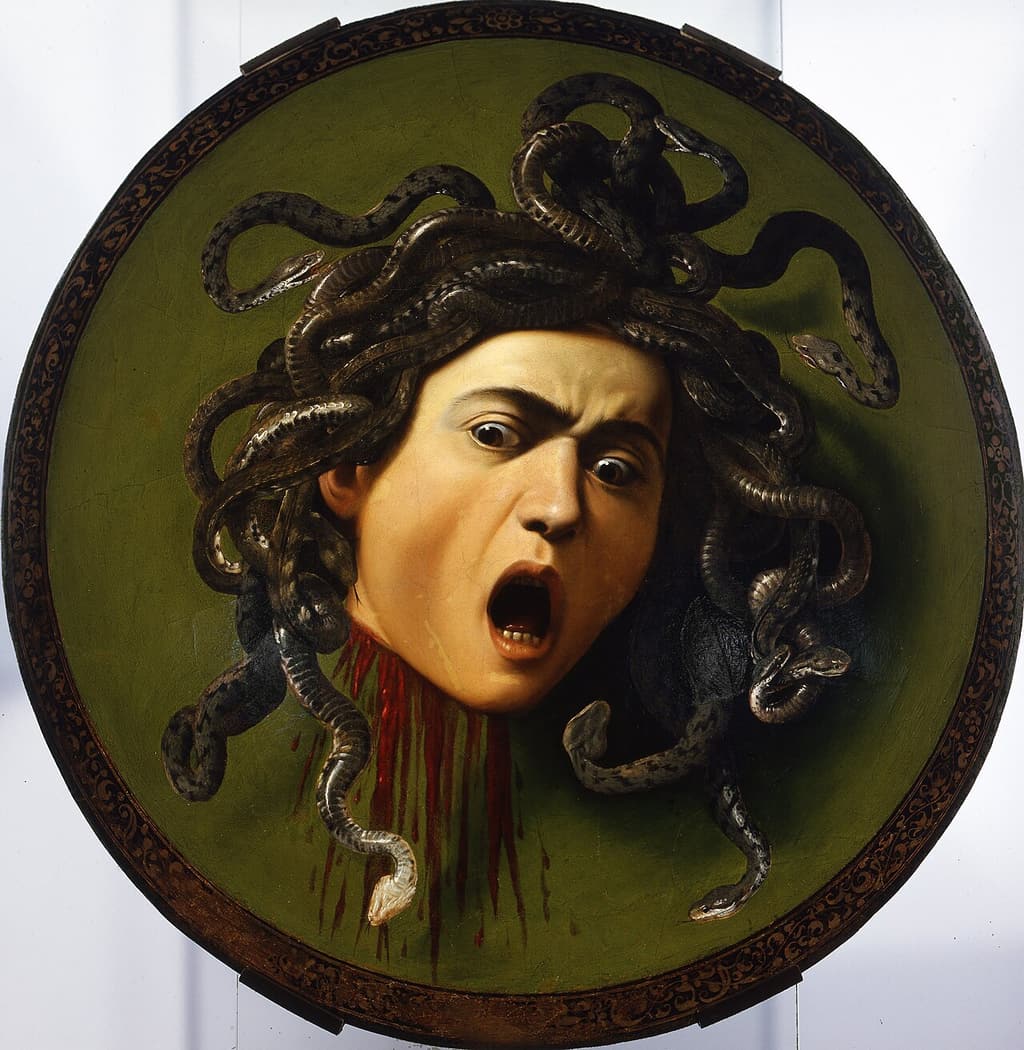
The face came first. Before there was any story about a woman punished in a temple, before Perseus, before the reflecting shield, Greeks were putting a wide grinning mask with staring eyes, tusks and a lolling tongue onto shields, breastplates, roof tiles, ovens, coins and grave markers. The gorgoneion is one of the oldest recurrent images in Greek art, and its job was apotropaic: it repels harm by being unbearable to look at. The myth explaining who owned that face is younger than the face itself, and understanding Medusa means keeping that order of events in view.
Hesiod's Medusa, who was always a monster
The earliest surviving account is in the Theogony, and it is brief and unsentimental. Phorcys and Ceto, sea-deities of the older generation, had three daughters, the Gorgons: Sthenno, Euryale and Medusa. Two were immortal and ageless. Medusa was mortal, and Hesiod says so as a plain fact without explanation — which is the crucial detail, because it is what makes her killable and therefore what makes her a story.
Poseidon lay with her in a soft meadow among spring flowers. When Perseus cut off her head, out of her neck sprang the winged horse Pegasus and the golden-sworded Chrysaor. That is nearly everything the archaic tradition gives. There is no beautiful woman, no temple, no punishment, no curse — she is a monstrous being of the far west, born monstrous to monstrous parents, and her death produces two remarkable offspring.
Pindar, in the twelfth Pythian ode, adds something the later versions lose entirely: Athena invented the aulos, the double pipe, in imitation of the keening wail the surviving Gorgon sisters made over Medusa's death. The Gorgons mourn her. It is the only note of grief in the early material and it comes from a poem about a musical competition.
Ovid's Medusa, who was a woman
Some seven hundred years after Hesiod, a Roman poet supplies the version now known to almost everyone. In Book 4 of the Metamorphoses, Perseus explains that Medusa was famous for her beauty, above all for her hair, and was the object of many suitors. Neptune — Ovid's Poseidon — violated her in the temple of Minerva. The goddess turned away, covered her eyes with the aegis, and transformed the girl's hair into serpents.
Ovid is doing what Ovid does throughout that poem: taking inherited monsters and giving them a moment at which they became monstrous, usually through the action of a god and usually unjustly. It is deliberate literary work by a sophisticated poet, and it is not evidence for what an archaic Greek thought about the Gorgon. Nothing in Hesiod, Pindar or Apollodorus contains it.
Both versions are on this site because both are real; what is not honest is presenting Ovid's as the myth, which is what most popular retellings do without dating it. The difference between them is one of the clearest illustrations of why the sources need naming rather than blending.
What actually happens in the killing
Apollodorus' Bibliotheca gives the fullest account of the equipment, and it is worth noting how much of it Perseus needs, because it tells you how the Greeks rated the danger. He gets directions by stealing the single shared eye of the Graiai; winged sandals, a kibisis (a special bag to hold the head), and Hades' cap of invisibility from the nymphs; a sickle from Hermes; and from Athena the instruction to look at the bronze of her shield rather than at the Gorgon. He strikes while she sleeps, drops the head into the bag, and flees invisible while her immortal sisters hunt him.
The head keeps working after death. This is the point of the entire episode, and it is why the story exists: Perseus uses it as a weapon, turning Atlas to stone in one tradition and a wedding party in another, and finally gives it to Athena, who fixes it on the aegis. The monster is not defeated so much as acquired — the terrible face is transferred from an enemy to the protector of the city, which is exactly the logic of an apotropaic image.
The blood is potent too: Apollodorus reports that Asclepius was given blood from her left side, which kills, and from her right side, which raises the dead. Libyan snakes were said to have grown from the drops that fell as Perseus flew over.
The face itself, and how it changed
Archaic gorgoneia, from the seventh and sixth centuries BCE, are deliberately hideous: circular, frontal, boar's tusks, protruding tongue, staring eyes, sometimes a beard. Frontality is itself unusual — Greek art is overwhelmingly in profile, and the Gorgon looks straight out at the viewer, which is precisely what makes the image work.
From the fifth century onward the face softens, and by the Hellenistic period there is a distinct type, the "beautiful Gorgon", a serene woman's face with small wings in her hair and two snakes knotted at her throat. Ovid's version arrives into a visual tradition that had already made her beautiful, which is worth remembering when the change is credited entirely to him.
As a protective symbol the head outlived Greek religion comfortably. It appears on Roman armour and mosaics, on medieval and Renaissance shields, and it is still the emblem of a major fashion house — one of the very few ancient apotropaic devices in continuous use for twenty-six centuries.
Where she is not a person at all
Two contexts strip the narrative away entirely. In Homer, the Gorgon head is a thing rather than a character: it is on Agamemnon's shield in the Iliad, on Athena's aegis, and in the Odyssey Odysseus flees the underworld in fear that Persephone will send "the Gorgon head" against him. There is no suggestion of a biography.
And in practice the image was mass-produced onto objects with no mythological pretension at all — bread ovens, drinking cups, roof antefixes, amulets for children. This was a face that ordinary people used to keep bad things away, not a character they told stories about.
The modern reclaiming
Since the 1970s Medusa has become one of the most politically charged figures in classical reception. The reading is specific: a woman assaulted in a sanctuary and punished for it by another woman, whose rage is then weaponised by the men who kill her. That reading rests entirely on Ovid, and its proponents are generally explicit about that — it does not require Hesiod's version to be wrong, only for Ovid's to be the version worth thinking with.
Feminist criticism from Hélène Cixous onward, the use of the head in protest imagery, Luciano Garbati's 2008 sculpture of Medusa holding Perseus' head, and a large body of contemporary fiction all belong to this. Alongside it runs the older use: the Uffizi's Caravaggio, Cellini's bronze Perseus in Florence, and countless "monstrous feminine" readings in film criticism.
Games and films are less careful. Where a modern adaptation gives Medusa a lower half like a snake, that is a hybrid form which appears occasionally in later antique art and is mainly a modern fantasy convention; the classical Gorgon has legs, often wings, and sometimes runs.
Questions this page is asked
Did the Greeks think she was beautiful or hideous?
It depends when you ask. For the archaic period, hideous, unambiguously, and the hideousness is functional. By the fifth and fourth centuries BCE artists were producing a beautiful, sorrowful Gorgon, and that shift happens in the visual record before it appears in any surviving text. Both were available to a Roman reader, which is part of why Ovid's story worked.
Why does Pegasus come out of her neck?
No source explains it, which is itself informative — it is one of those genealogical facts that a myth reports rather than justifies. It is worth noting that her partner was the god associated with horses, that the winged horse and the golden-sworded Chrysaor emerge together, and that decapitation as a moment of birth is a pattern in Greek myth rather than an oddity confined to her.
Are the sisters ever named as doing anything?
Rarely. Sthenno and Euryale exist chiefly to be immortal — to make Medusa's mortality meaningful — and to pursue Perseus after the killing. Pindar's aulos story is the one place they act with any interiority, and the fact that their single characteristic moment is grief has been much used by modern writers.