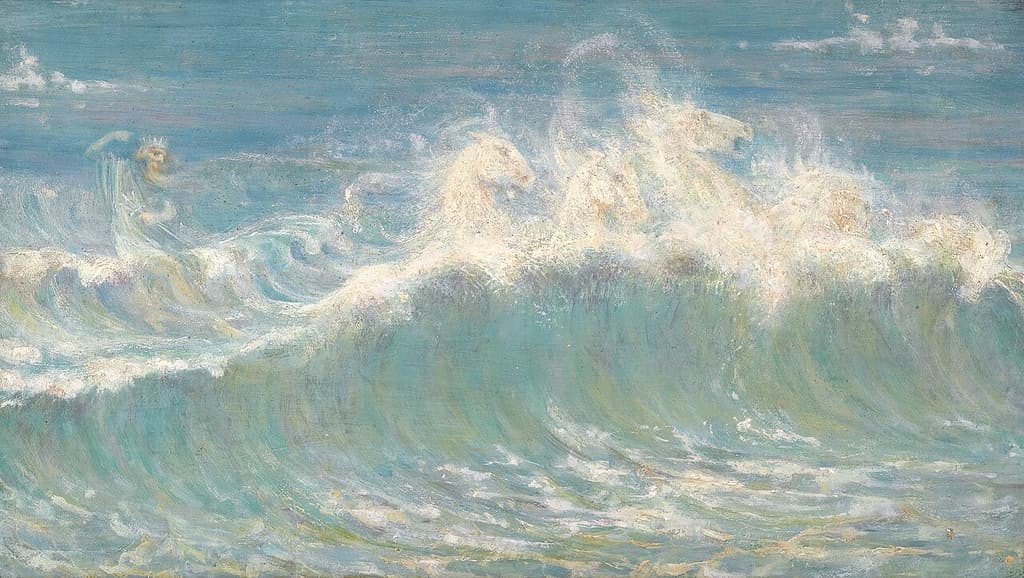
The trident and the sea are so fixed in the modern image that it comes as a shock to find the Bronze Age evidence pointing somewhere else. On the Linear B tablets from Pylos, po-se-da-o receives more offerings than di-we — Zeus — and appears to be the leading deity of that palace. His oldest and most persistent cult title is not maritime at all: Enosichthon and Ennosigaios, "earth-shaker", the god of the seismic ground, and Hippios, the god of horses. Greece is one of the most earthquake-prone regions in Europe, and the god who moved the ground was not a specialist in one element among four. The sea came to dominate his portfolio, but it did not start there.
Earth-shaker: the god who drowned Helike
In 373 BCE the Achaean city of Helike, on the Gulf of Corinth, was destroyed in a single night by an earthquake and the sea that followed it. The whole population died. Every ancient writer who mentions it — Pausanias at length, Strabo, Diodorus, Aelian — attributes it to Poseidon, and specifically to the citizens having killed or expelled Ionian suppliants who had come to take a token from the sanctuary of Poseidon Helikonios. Pausanias reports that the ruins remained visible under the water for centuries, with a bronze Poseidon still standing among them and snagging fishermen's nets. Excavation since 2001 has located a destroyed classical settlement in a former coastal lagoon nearby.
That event is the key to him. He is not a benign patron of sailors; he is the reason the ground is not to be trusted. Sacrifices to him were often precautionary. Horses were driven into the sea for him at some sites, and at the Isthmian sanctuary near Corinth — one of the four panhellenic games, held in his honour — the imagery is chariots and horses at least as much as fish.
The contest for Athens, and how a god loses
The best-known story about him is a defeat. Competing with Athena for the patronage of Attica, Poseidon struck the Acropolis rock with his trident and produced a salt spring — Pausanias says the marks were still shown in the Erechtheion, along with the well, and that the water sounded like the sea in a south wind. Athena planted the olive. The judges, variously the Athenians themselves, Cecrops, or the twelve gods, chose the olive. Poseidon flooded the Thriasian plain in anger. Apollodorus adds the detail that in one version the women of Athens voted for Athena, the men for Poseidon, the women were one vote more numerous, and the men afterwards stripped the women of the vote in reparation to the god — an aetiology invented to explain a political arrangement, and a good example of Greek myth being used to justify institutions after the fact.
What is not usually noticed is that Poseidon kept a substantial cult in Athens anyway. He is worshipped there as Poseidon Erechtheus, fused with the earth-born early king, in the same building he supposedly lost. The pattern repeats: he competes for Argos against Hera and loses, and dries up the Argive rivers; he competes for Corinth against Helios and gets the isthmus while Helios takes the height; he competes for Aegina, Naxos, Delphi and Troezen with mixed results. The contest myth is a story-shape used all over Greece to explain why an older, powerful, dangerous god is present in a city that belongs to somebody else.
The Odyssey's antagonist
In Homer's Odyssey Poseidon is the obstacle. His son the Cyclops Polyphemus, blinded by Odysseus in Book 9, prays that the man never reach home or reach it late, alone, on someone else's ship and find trouble waiting — a curse the poem then executes in full. Poseidon smashes the raft in Book 5 with a wave he raises himself, and afterwards petrifies the Phaeacian ship that carried Odysseus home, turning it to stone within sight of its own harbour because that people ferried strangers too easily. He is not persuaded, converted or reconciled; the poem simply waits until he is away among the Ethiopians to move its plot.
The Iliad's Poseidon is different and more interesting: aggrieved. He and Apollo built the walls of Troy for King Laomedon, who then refused to pay them, which is why Poseidon fights for the Greeks. In Book 15 he refuses a direct order from Zeus, arguing that they drew equal lots and that he is no man's subordinate, and only backs down on the grounds of seniority within the family. That is the sharpest challenge to Zeus' authority anywhere in the poem, and it comes from his brother.
The children: horses, monsters and one hero
His offspring divide unusually neatly. With the sea-nymph Amphitrite, whom he abducted after she fled to Atlas and who was found for him by a dolphin — set among the stars for the service — he fathered Triton, the merman herald with the conch. But most of his other children are either monstrous or violently strong: Polyphemus, the giant Antaeus, the boxer Amycus, Orion, the twin Aloadae who piled mountains to storm heaven, and Procrustes, the bed-fitting bandit killed by his own son.
That son is Theseus, whose double paternity Athens never resolved: mortal king Aegeus in one telling, Poseidon in another, sometimes both in the same night. Bacchylides has Theseus dive into the sea to retrieve a ring and return dry with a wreath, proving the divine claim.
Then there are the horses. Pursuing Demeter, who turned herself into a mare to escape him among a herd in Arcadia, he became a stallion; the offspring were the immortal horse Arion and a daughter whose name was too holy for the uninitiated to speak, called simply Despoina. At Phigalia in Arcadia Demeter was worshipped in a cave as Melaina, "the black", horse-headed, specifically in memory of that rage. Poseidon is also, in Hesiod, the father by Medusa of Pegasus and Chrysaor, though whether the winged horse leaps from the severed neck as Hesiod has it, or springs from earth soaked by the Gorgon's blood as some later sources say, is genuinely disputed.
Sounion, Isthmia and the tang of salt
The temple of Poseidon on the cliff at Cape Sounion, built in the 440s BCE, is the image that everyone carries — white marble on a headland, first thing an Athenian sailor saw coming home. Isthmia was the institutional heart: biennial games, a pine wreath, and Corinth's control of the traffic between two seas. Poseidon Helikonios at Helike served the Ionian league before the disaster; Panionion on Mount Mykale in Asia Minor served it after. Onchestos in Boeotia held a strange rite described in the Homeric Hymn to Apollo in which a new chariot team was driven riderless through a grove and the chariot left where it wrecked.
Neptune, and the modern soft focus
The Roman Neptune began as a god of fresh water and springs — his festival, the Neptunalia in late July, falls at the height of drought — and acquired the sea only through identification with Poseidon. His consort Salacia is a Roman figure, not Amphitrite in translation.
The modern Poseidon is a genial bearded ocean-king: the Percy Jackson novels' warm and absent father, Disney's Little Mermaid Triton (borrowing the son's name for the father's role), the calm giant of children's mythology anthologies. The earth-shaker has almost entirely gone, and with him the reason the Greeks were frightened. Where he does appear as a threat it is usually via the Odyssey's storm, which is his least characteristic mode of destruction. A more faithful modern Poseidon would be a god of the ground failing under your feet without warning.
The trident, the sea’s older owners, and a drowned city
Did he always carry a trident?
The trident is his in art from the archaic period onward, and it looks like a fishing spear — the tunny-fishermen's implement — which fits a Mediterranean coastal god. But the etymology of his name may not be maritime at all: one long-standing proposal reads Poseidon as "lord/husband of Da", taking Da as an old name for earth, which would make him the earth's consort before he was the sea's ruler. It is a contested reading, not a settled fact.
What is the relationship between Poseidon and Nereus or Oceanus?
They coexist rather than replace each other. Oceanus is a Titan, the world-encircling river; Nereus, styled the sea's old man, changes form under questioning and tells the truth once held; his fifty daughters include Amphitrite and Thetis; Proteus is another such. Poseidon rules the sea as an Olympian sovereign without absorbing these older water powers, and Greek sailors could pray to any of them.
Why are so many of his sons villains for heroes to kill?
Because a hero's story needs an opponent of divine strength but no divine standing, and the sea-god's line supplies exactly that. Theseus kills Sciron, Cercyon and Procrustes, all Poseidon's; Heracles kills Antaeus; Odysseus blinds Polyphemus. The pattern also carries a political charge — the heroes belong to city foundations, and the sons of Poseidon tend to hold the roads and coasts those cities needed.
Was there a real Helike?
Yes. It was a substantial Achaean city, its destruction in the winter of 373 BCE is recorded by several independent authors, and the search for it ran from antiquity to the present. Since 2001 excavation in the Helike delta has found a Hellenistic and a classical-era destruction layer inland from the modern shore, in what was once a lagoon. It is one of the few cases where a myth of divine punishment attaches to an event we can date and locate.