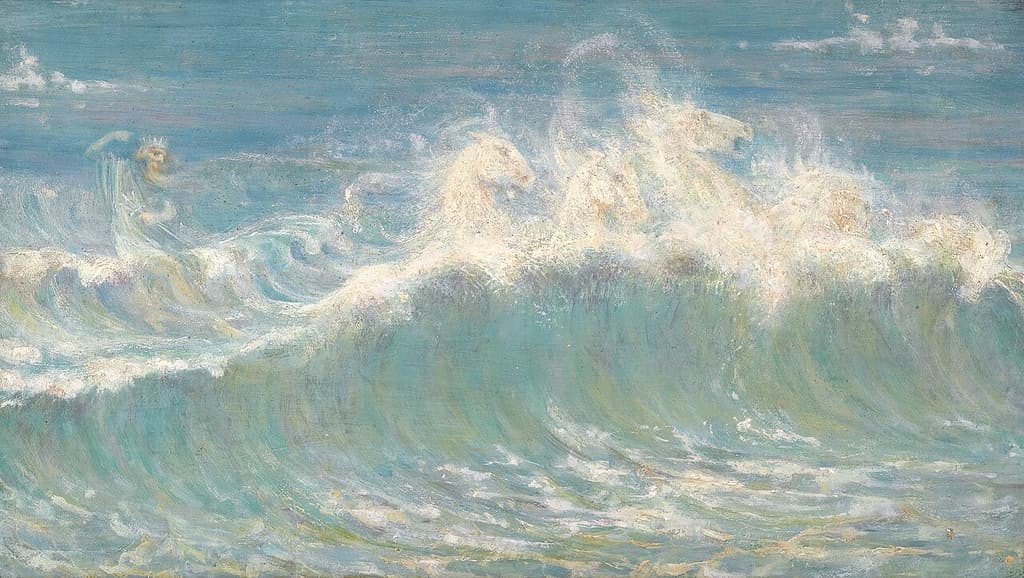
Neptune's festival fell on 23 July, in the worst of the Roman summer, when the streams were lowest and the city was thinking about water rather than shipping. Romans built shelters of branches and leaves — the sources call them umbrae — sat in the shade and drank. Nothing in the Neptunalia suggests the sea. Everything in it suggests a community worried about springs drying up.
That is the first and most important fact about him, and it goes missing every time he is introduced as "the Roman Poseidon". Rome was not a naval power until the middle of the third century BCE, having no fleet worth the name before the First Punic War. A maritime god was not a thing the early city needed.
A name nobody can explain
Neptunus has resisted etymology. The most-cited proposal links it to an inherited Indo-European figure of the waters, comparing the Vedic Apām Napāt, "descendant of the waters", and the Irish Nechtan, whose well overflows to make a river. The comparison is attractive and remains genuinely unproven; alternative derivations from a root meaning "moist" are also in circulation. Anyone stating a confident origin is over-reporting the evidence.
His Latin consorts are more informative than his etymology. Salacia, whose name Roman writers connected with salum, the open swell, and Venilia, connected with incoming waves — a pair of Latin water-powers with no Greek equivalents, preserved in Varro's catalogue of divine functions and quoted back at Rome by Augustine, who thought the whole system absurd. Once the Greek scheme arrived, Salacia was flattened into Amphitrite, and the specifically Roman shading was lost.
The horses under the Circus
His oldest known title is Neptunus Equester, Neptune of horses, and Roman antiquarians identified him in that capacity with Consus, an archaic god whose altar lay buried under the sand of the Circus Maximus and was uncovered only for his festivals. At the Consualia in August and December, horses, mules and donkeys were garlanded and rested, and chariot races were run over the altar's hiding place.
That festival is the setting for the seizure of the Sabine women, whom Romulus invited the neighbours to watch. So the earliest surviving story attached to Rome's water-and-horse god is not a sea myth but a piece of civic history involving a covered altar and a crowd at the races.
When the sea arrived
Once Rome had fleets, Neptune acquired the trident, the dolphins and the marine retinue from Greek art, and a temple in the Circus Flaminius on the Campus Martius that seems to have been connected with naval victory. The famous reliefs conventionally called the "Altar of Domitius Ahenobarbus" — now divided between Paris and Munich, one side showing a Roman census and lustration, the other a marine wedding procession with tritons and nereids — very probably come from a Neptune monument, and their pairing of dry Roman administration with imported Greek sea-fantasy is a fair picture of the god's double character.
The sharpest historical use of him is Sextus Pompeius, who held Sicily against Octavian with a fleet in the 30s BCE and styled himself son of Neptune, wore a sea-blue cloak and threw horses into the water as offerings. Octavian's propaganda after defeating him took the trouble to answer the claim, which suggests it was working.
What Rome did without, that Greece had
Poseidon is Enosichthon, the earth-shaker, and earthquakes belong to him throughout Greek religion. Neptune never acquires that function. Rome handled earthquakes as prodigies to be expiated, and — this is one of the most revealing details in Roman religious practice — the state made offerings in such cases without naming the god, on the formula si deus si dea, "whether god or goddess", precisely because it did not know whose business it was. A religion that will address an unknown deity by an if-clause rather than guess is doing something structurally different from Greek myth.
Nor is there a Roman contest for a city, no counterpart to the olive and the salt spring on the Athenian acropolis. Neptune's Roman jurisdiction had to be enlarged by literature; his cult stayed narrow.
Neptune since
The planet, discovered in 1846 after its position was predicted from perturbations in Uranus's orbit, carries his name, and the element neptunium follows it in the periodic table because uranium is followed by the planet's namesake. The trident is the standard emblem of maritime power, from Britannia's coinage to the Trident missile, and King Neptune presides over the equator-crossing ceremony that navies and merchant fleets still perform. Giambologna's Neptune in Bologna and the Trevi Fountain's central figure — an Oceanus, strictly, though almost everyone calls him Neptune — are among the most photographed sculptures in Italy.
Details readers ask about Neptune
Why is his festival in the driest month?
Because the point was probably to petition for water when it was scarcest, in the same way that Roman agricultural rites cluster at moments of risk rather than of plenty. The leafy shelters have been read as both practical shade and a ritual gesture towards the woodland springs. No ancient source explains the timing directly, so both readings are inference from the calendar.
Did Roman sailors pray to him before a voyage?
Yes, and to a wider set than modern retellings suggest — Neptune, the Dioscuri, Fortuna, the Cabiri and local harbour deities all take vows from seafarers, and Portunus, who held the keys of harbours, has his own festival on 17 August. Roman sea religion was a portfolio, not a single patron.
Is Neptune connected to Rome's aqueducts?
Not officially. The water supply had its own set of powers — the goddess Juturna, whose spring in the Forum was used for state rites, and the nymphs of individual sources — and the aqueducts were an engineering department. Neptune's freshwater profile belongs to a much older layer than the Republic's plumbing.
Why does he look exactly like Poseidon in every painting?
Because European painters worked from Roman copies of Greek statuary and from Ovid, and there was no independent Roman iconographic tradition to work from. The archaic Neptune of the Neptunalia left no images. Every bearded man with a trident in Western art is Greek in origin, wearing a Latin label.