Every word for coined money in English runs back through one of Juno's temples. The mint on the Arx, the northern summit of the Capitoline hill, stood beside her shrine as Juno Moneta, and the coins struck there took the epithet with them: moneta gives Italian moneta, French monnaie, English money, and — by way of the building itself — mint. It is the single most consequential piece of Roman religious vocabulary still in daily circulation anywhere on earth.
The epithet did not originally mean anything financial. Moneta is from monere, to warn or remind, and the standard ancient explanation is that her voice warned the city of an earthquake, or that her sacred geese warned the citadel of the Gauls climbing it by night. A goddess who gives notice became, by pure architectural accident, the goddess of currency.
Not one goddess but a bench of magistrates
Roman gods are addressed by function, and Juno has more distinct working identities than any other Roman goddess. They do not obviously add up to a single character, and it is better to read them as separate offices sharing a name than as facets of a personality.
- Juno Lucina, who brings children into the light, with a grove and temple on the Esquiline. Women in labour loosened their hair and untied every knot on their clothing in her cult, on the principle that binding anywhere in the house bound the birth.
- Juno Sospita, "the saviour", of Lanuvium: armed, in a goat-skin cloak with the horns still attached, carrying a shield and spear and wearing shoes with turned-up toes. Coin portraits show the outfit clearly. Nothing about her resembles a Greek goddess of marriage.
- Juno Curitis, invoked with the spear, in a rite Plutarch tries and fails to explain in his Roman Questions.
- Juno Regina, the queen, in the Capitoline temple beside Jupiter and Minerva — and, separately, on the Aventine, where she arrived as a prisoner of war.
- Juno Caprotina, of the wild fig, whose July festival belonged to slave women.
The snake at Lanuvium
The strangest surviving Roman fertility test belongs to Juno Sospita's sanctuary. Propertius describes it in a poem written to needle his mistress: a sacred snake lived in a deep cave beneath the precinct, and each year girls were lowered blindfold into the dark carrying barley cakes to feed it. If the snake ate, the girl was chaste and the year's harvest was secure; if the food came back untouched, both propositions failed at once.
Cicero, whose own family came from nearby, reports the sanctuary from a different angle in De Divinatione: a consul's dream in which Juno Sospita complained about the state of her temple. Lanuvium's cult was absorbed by Rome in 338 BCE and thereafter Roman consuls sacrificed there annually, which is why an Italic snake-oracle ended up as an obligation of the Roman state.
Calling a goddess out of an enemy city
The rite of evocatio is one of the clearest windows onto how Rome thought divinity worked, and Juno is its most famous subject. Before the fall of Veii in 396 BCE, the Roman commander Camillus formally invited Juno Regina to leave the Etruscan city she protected and take a better temple in Rome. Livy tells the story with a detail he clearly enjoys: when the soldiers came to move the statue, one of them asked the goddess in jest whether she wanted to come, and she nodded — or someone said she did.
The logic is contractual rather than triumphal. A city under divine protection cannot simply be taken; the protection has to be transferred first, by offer and acceptance. Her Aventine temple was the result. Roman writers claim the practice was used again at Carthage, and the surviving formula for that occasion is preserved by Macrobius.
Her month, her day, and the wedding season
Juno owns the Kalends — the first day of every month — and she owns June, which Ovid opens the sixth book of the Fasti by having her claim in person against two rival etymologies, in a scene that is comedy as much as scholarship.
Two festivals matter most. The Matronalia, on 1 March, was the married women's day: they went to Lucina's Esquiline grove, husbands gave presents and prayed for their wives, and mistresses served their household slaves — the mirror image of what happened at the Saturnalia in December. The Nonae Caprotinae on 7 July inverted the social order differently: slave women wore their mistresses' clothes, feasted under a wild fig tree, and performed a mock battle, in commemoration of a story about servant women who saved Rome by impersonating free brides in a marriage demanded by a besieging enemy.
The residue of Juno Lucina's marriage jurisdiction is the still-current preference for June weddings, and the Roman rule behind it is more specific than the modern habit: much of May was religiously unsuitable because of the Lemuria, the festival of restless dead, so June was the first clean month.
Uni, Tanit, and how much of her is Italic
Juno reaches Rome through Etruria at least as much as through Greece. Uni is a major Etruscan goddess, part of the Etruscan triad that lies behind the Capitoline arrangement, and the gold Pyrgi tablets of about 500 BCE — a bilingual Etruscan and Phoenician dedication — equate her with the Phoenician Astarte. That equation matters for how Roman writers later understood Carthage's chief goddess Tanit as a Juno, worshipped under the empire as Juno Caelestis.
It also explains the most extraordinary piece of Roman literary theology. Virgil's Aeneid makes Juno the enemy of the hero and the patron of Carthage — a goddess of the Roman state working full-time against Rome's founding, and reconciled only in the last book on the condition that the Trojans lose their name and language and become Latins. The Roman family tree marks her Greek genealogy as imported; her hostility in the epic is not imported at all, but grown out of a real Punic-Italic identification and two Punic wars.
Hera is a poor guide to her
The equation with Hera is old and it does real work in literature: both are wives of the sky-god, both are queens, both are angry about their husbands' children. But the Greek goddess's defining cult sites, the Argive Heraion and the Samian sanctuary, have no functional counterpart in Rome, and the Roman goddess's defining functions — warning, coinage, evocation, the armed Lanuvine cult, the iuno that every Roman woman possesses — have no counterpart in Greece.
That last one is worth dwelling on. Just as every Roman man had a personal Genius, every Roman woman had a iuno: a divine double, born with her, receiving offerings on her birthday. A goddess whose name is also a common noun for the divine element in every woman alive is doing something Greek Hera never did.
Juno since Rome
The month keeps her, and so do the given names Juno and June, which is a live modern first name with an entirely Roman origin. Asteroid 3 Juno was named in 1804, and NASA's Juno probe reached Jupiter in 2016 with a mission-name joke built in: in the myth Jupiter drew clouds around himself to hide his misbehaviour, and Juno could see through them. She turns up as the interfering queen in Purcell and in Handel, as the title of Sean O'Casey's Juno and the Paycock, and as the film Juno, whose heroine's name is glossed in the script itself.
Things worth asking about Juno
Was the goose story really about her?
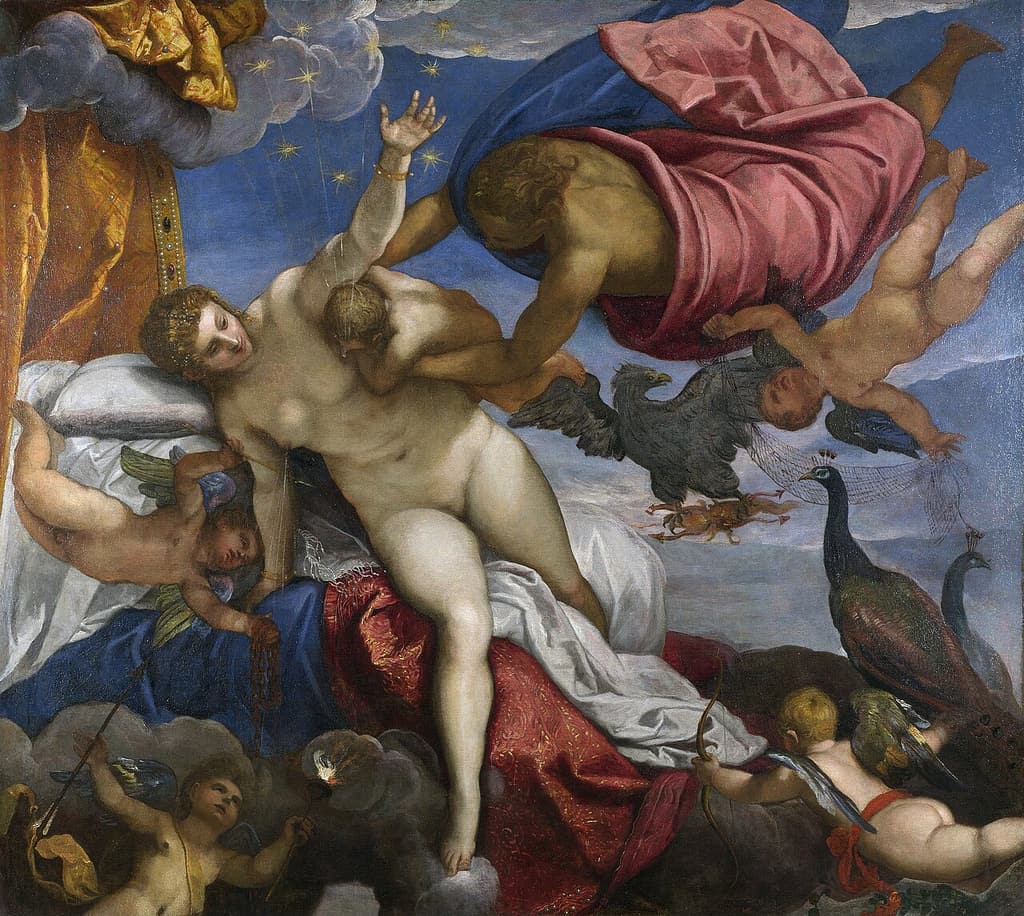
The geese kept on the Capitol were her sacred birds, and their alarm during the Gallic siege is the version Livy gives. The peacock, which appears in every later painting of her, is Greek — it belongs to the Hera myth of Argos and his hundred eyes, and it arrives in Roman art with the literature, not with the cult. If you want an authentically Roman Juno bird, it is the goose.
What happened at her Aventine temple after the war with Veii?
It became a place the state went in emergencies. In 207 BCE, after a series of frightening prodigies, twenty-seven maidens sang a hymn composed by the poet Livius Andronicus in procession to Juno Regina — one of the earliest datable performances of Latin literature, staged as crisis management. Livy records the whole ritual programme, including a gift of a golden basin paid for by the married women of Rome.
Is she related to the word "junior"?
No, though the resemblance is not accidental in the deep sense. Iunior is the comparative of iuvenis, young. Juno's own name is more likely from the same root complex meaning vital force or youthful vigour — the connection is at the level of Indo-European etymology, not of Latin word-formation, and it is one reason some scholars read her original character as the power of maturation rather than of marriage.
Why is she armed at Lanuvium if she is a marriage goddess?
Because "marriage goddess" is a Greek-derived summary that fits her Roman profile badly. Several central Italian goddesses combine protection of the community with weaponry and with women's life-transitions, and Sospita is one of them. The Roman state accepted the whole armed package when it absorbed Lanuvium rather than editing her into something more Hera-shaped, which is a useful reminder that Roman religion tolerated far more untidiness than modern retellings do.