The single most useful text for understanding Mars is not an epic. It is a farming manual. Cato the Elder's De Agri Cultura, written around 160 BCE for landowners who wanted their estates run properly, gives the exact words for the suovetaurilia — the purification of the fields with a pig, a sheep and a bull driven round the boundary. The prayer is addressed to Mars pater, and it asks him to keep away disease, barrenness, ruin and bad weather, and to keep the crops, the vines, the orchards and the herdsmen and flocks in health.
Nothing in that prayer is about war. It is a proprietor asking a god to police the perimeter of his land, and it is one of the oldest pieces of continuous Latin religious language we have.
Ares was despised; Mars was the father of the Roman people
This is the comparison that has to be made carefully rather than dismissed. In Homer, Ares is disliked by the other gods, wounded by a mortal with Athena's help, and called a nuisance by his own father. In Rome, Mars stands second only to Jupiter in the archaic hierarchy, has one of the three great flamens to himself, owns a month, owns the field where the citizen army assembled, and fathers the founder of the city. Roman writers equated the two figures because both were war gods and the equation was convenient; almost nothing else about their standing matches.
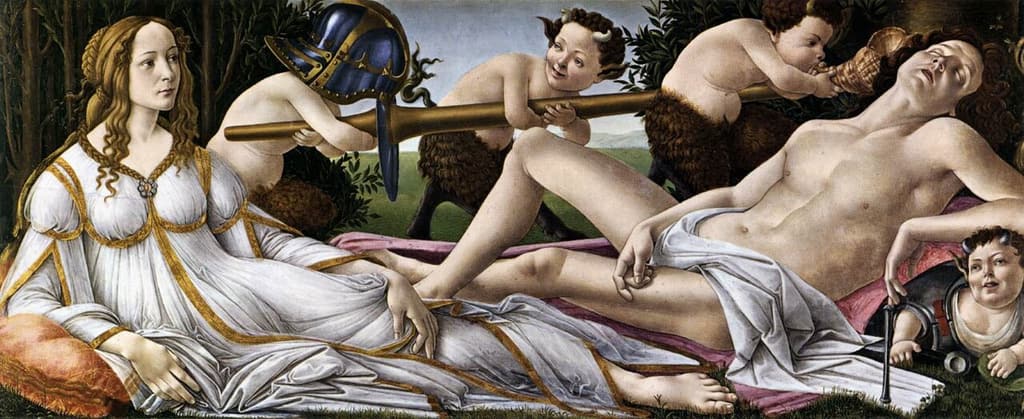
The interpretatio is therefore real but shallow. Where Ovid gives Mars a Greek plot — the affair with Venus caught in a net, taken from the Odyssey — you are reading translated literature. Where the Arval Brethren chant to him, you are reading Roman religion.
The Carmen Arvale and the priests who could not read their own hymn
The Arval Brethren, a college of twelve, preserved a hymn so archaic that by the imperial period it was chanted from a written text nobody fully understood. It survives because their proceedings were inscribed on stone at their grove outside Rome, including a copy of the hymn from 218 CE. It calls on the Lares, then on Marmar — a reduplicated form of the god's name, alongside the variant Mavors — asking him not to let ruin fall upon more people, and ends with a triple triumpe.
A liturgy transmitted phonetically for centuries after its Latin had stopped being intelligible is orthopraxy in its purest form: the performance was the obligation, and comprehension was optional.
The dancing priests and the shields that fell from the sky
Mars had his own sodality, the Salii, twenty-four patrician youths who processed through the city in March and again in October, in archaic bronze armour and peaked caps, beating figure-of-eight shields with staves and performing a leaping dance at set stations. Their hymn, the carmen Saliare, was as incomprehensible to Augustan Romans as the Arval one.
The shields were the ancilia. One was said to have fallen from the sky in the reign of Numa Pompilius as a pledge of Rome's survival; Numa had eleven copies made so that a thief could not identify the original. They were kept in the Regia and moved only for the processions.
That March-to-October frame is the campaigning season, and it is why Mars owns both ends of it. March — Martius — opened the old Roman year, and its festivals are his: the Equirria horse races, the Quinquatrus, the Tubilustrium purifying the war trumpets. October closes it with the Equus October, in which the right-hand horse of the winning chariot team was sacrificed on the Campus Martius, its tail carried at speed to the Regia so the blood could drip on the hearth, and its head fought over by two neighbourhoods.
Campus Martius, and the wall he stood outside
Armed force did not belong inside the sacred boundary of the city. The pomerium excluded it, magistrates gave up military command on crossing it, and the assembly that voted as an army — the comitia centuriata — therefore met outside, on the flood plain of the Tiber called the Field of Mars. His altar there is older than any of his temples in the city, and his first temple, vowed during a plague, stood outside the Porta Capena.
The spatial logic is exact. Mars belongs at the edge: the boundary of the farm in Cato's prayer, the boundary of the city in the placement of his cult, the boundary of the year in March and October. The compound title Mars Silvanus in Cato's stock-blessing formula, which women were forbidden to attend, points the same way — toward the uncleared margin where Silvanus also operates.
Mars Ultor, and a god turned into a monument
Octavian vowed a temple to Mars the Avenger before Philippi in 42 BCE, where he and Antony defeated Caesar's assassins. It was dedicated forty years later, in 2 BCE, as the centrepiece of the Forum of Augustus, and it took over functions from the Capitol: the Senate met there to debate wars and triumphs, generals departing for provinces set out from it, young men assumed the toga of manhood there, and the standards recovered from Parthia in 20 BCE were displayed inside.
Three columns and part of the podium still stand. Augustus also built the temple into a family argument: statues of Aeneas and the Julian line filled one colonnade, Romulus and Rome's generals the other, with Mars and Venus — father of Romulus, mother of Aeneas — standing together in the cult group as the two divine ancestors of the same city and the same family.
Rhea Silvia, and a paternity that solves a problem
Mars fathers Romulus and Remus on a Vestal of the Alban royal house. Livy notes drily that she named the god as the father, and lets the reader decide whether that was belief or the only survivable answer available to a Vestal who had broken her vow. Rome did not need the story to be pretty; it needed the founder to have a divine father, and Mars was the one who made the Romans a warrior people by descent rather than by choice. The Roman family tree treats this line as the second foundation genealogy, running parallel to the Trojan one.
Was the farmer's Mars or the soldier's Mars first?
This is a live scholarly argument and the page should not pretend otherwise. One reading, associated with Georges Dumézil, keeps Mars a war god throughout and explains Cato's prayer as protection of the fields — a warrior stationed at the boundary, not a fertility power. The opposing reading takes the agricultural material as primary and the martial specialisation as a later narrowing driven by Rome's history. The evidence both sides use is largely the same evidence: Cato 141, the Arval hymn, the Silvanus compound, the placement of the cult sites. Nobody has produced a text that settles it, because the relevant period predates Latin literature entirely.
The month, the planet and the metal
Mars kept more of the modern world than most Roman gods. March is his month in every European language descended from Latin. Dies Martis is French mardi, Italian martedì. The planet carries his name, and with it Mars bars, Martians, and the entire science-fiction tradition of a red war-world — which exists because the planet is red because of iron oxide, and because ancient astronomers assigned the red one to the war god. Alchemy made iron his metal and gave it his symbol, ♂, which biology then borrowed as the sign for male. The given names Marcus, Marcellus, Martin and Martina all descend from him, which makes him one of the most productive divine names in modern use. Mars Attacks!, Total Recall and The Martian all trade on a planet named by Roman priests.
Points people raise about Mars
Why is his month the third one if the year began in March?
Because the calendar was reformed and the names were not. The old Roman year opened in March, which is why September, October, November and December still mean seventh, eighth, ninth and tenth. Once January became the opening month, those numerals went permanently out of step, and Mars kept a month whose position no longer matches its logic.
What was the woodpecker about?
The picus Martius was his bird, and it was watched in augury alongside the wolf. There was also a separate figure, Picus, an early Latin king who appears in Ovid and Virgil as a prophetic being turned into a woodpecker; the overlap between the god's bird and the king's name is old and not fully explicable. In one version of the twins' infancy a woodpecker brings food to them alongside the she-wolf.
Did Roman soldiers actually worship him on campaign?
Dedications to Mars from serving soldiers are common across the frontier provinces, but so are dedications to Jupiter Optimus Maximus, to the emperor's genius, to Victory, and to local gods given Roman names — a Romano-British altar to Mars Nodens or Mars Thincsus is honouring a native deity with a Latin label. Mars is not the default soldier's god so much as one of several, and the compound names are the best evidence anywhere for how interpretatio Romana actually operated on the ground.
Is the Capitoline "Mars" statue really him?
Most surviving armoured male statues from Roman Italy get identified as Mars by default, and many identifications are shaky — a cuirassed figure without a preserved attribute could equally be an emperor or a hero. The securest images are on coinage, where the legend names him, and on the Ara Pacis and the Forum of Augustus reliefs, where the programme fixes the identification from context.