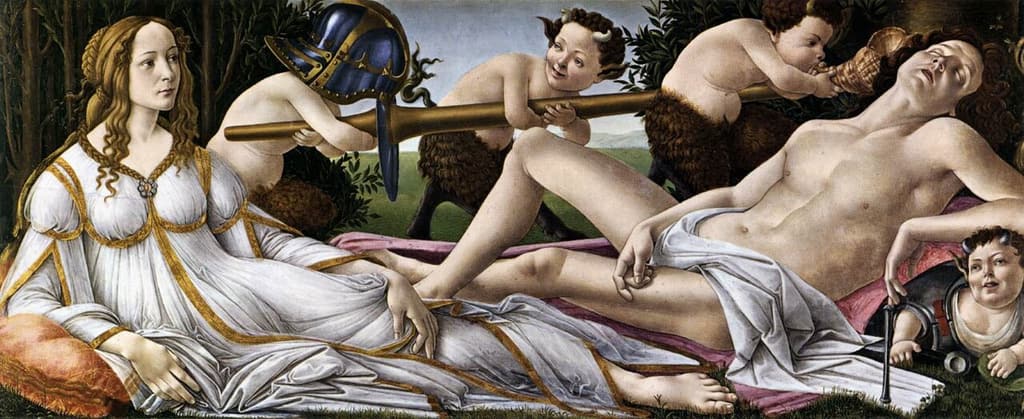
In Book 5 of the Iliad, Diomedes drives a spear into Ares' belly with Athena leaning on the shaft, and the god screams — Homer says the noise was like nine or ten thousand men shouting — flies to Olympus, and complains to his father. Zeus' reply is the most quoted verdict on any Olympian: of all the gods who hold Olympus, you are the most hateful to me, since strife and wars and fighting are forever your delight. Ares is the only major Greek god whose own pantheon is on record as disliking him, and he loses nearly every fight he is given.
This is a literary judgement, not a religious one, and it is worth separating the two before going further. Athens had an Areopagus — the hill of Ares — where the oldest homicide court in the city sat. Thebes traced its foundation to his serpent. Sparta sacrificed to him. Thracians, Herodotus says, worshipped only Ares, Dionysus and Artemis, with the kings adding Hermes. A god the poets mock is not necessarily a god nobody honoured.
What the Iliad does to him
Homer's Ares is not war in the abstract; that is closer to Athena, who wins because she thinks. Ares is battle as it feels from inside — the noise, the rush, the loss of judgement. His companions are named accordingly: Deimos (terror) and Phobos (rout), his sons; Eris, strife; Enyo, the sacker of cities, whose masculine counterpart Enyalios is sometimes a separate god and sometimes just another name for Ares himself.
He also changes sides mid-poem. He promises Hera and Athena he will fight for the Greeks and then fights for the Trojans, having been talked round by Aphrodite. In Book 21 Athena knocks him down with a boundary stone and taunts him for it. In Book 15, told his son Ascalaphus is dead, he starts to arm for revenge and has to be physically stopped and stripped of his armour by Athena, who points out he will get them all punished. He is impulsive, loud, easily beaten and easily led — a comprehensive characterisation, and a deliberate one. The Iliad is a poem about war that refuses to make the war-god admirable.
The one exception in the epic tradition is the short Homeric Hymn 8, which addresses him in an entirely different key: strong-armed, sceptre-bearing, help of law, defender of Olympus, father of victory, and — remarkably — asks him for the courage to keep the peace and avoid strife. It is generally thought to be a late composition, possibly Orphic, and its philosophical framing makes it an outlier. It is still evidence that a Greek could pray to Ares for restraint.
The affair, and the net
The most famous story about him is a comedy told inside another poem. In Odyssey 8, the bard Demodocus sings for the Phaeacians how Ares and Aphrodite slept together in the house of her husband Hephaestus; how Helios saw and told; how the smith forged chains finer than spider silk, invisible, unbreakable, and hung them from the bedposts; and how he then announced a trip to Lemnos. The lovers were caught, held immobile, and displayed to the assembled male gods, who laughed — and Hermes, asked whether he would trade places, says he would take three times the chains for the privilege. Poseidon eventually negotiates the release.
The scene has a serious edge under the farce: Hephaestus demands the return of the bride-price, treating adultery as a property matter, exactly as Athenian law would. And the pairing is not only comic. In Thebes, the daughter of Ares and Aphrodite is Harmonia, whose marriage to Cadmus is the city's founding event and the last wedding the gods attended in person. Violence and desire producing harmony is a genuinely thought-out theogonic idea, and later poets and philosophers made much of it.
Thebes, the serpent and the court
Ares' most consequential myth is not a battle. The spring at Thebes was guarded by a serpent sacred to him; Cadmus killed it, sowed its teeth on Athena's advice, and the armed men who sprang up fought each other until five remained — the Spartoi, "sown men", ancestors of the Theban nobility. For the killing Cadmus served Ares for a "great year", eight years, in servitude. Theban aristocrats therefore descended from the god's own serpent, and the necklace of Harmonia, made by Hephaestus, ran as a curse through the Theban royal house for generations.
At Athens, the Areopagus was where homicide cases were tried, and the aetiology is that Ares himself stood trial there first, for killing Halirrhothius, a son of Poseidon, who had raped his daughter Alcippe. He was acquitted by the gods. Aeschylus' Eumenides makes the same court the setting for Orestes' trial and the founding of civic justice. That means the Greek war-god's principal Athenian association is with a homicide tribunal — a god of killing being institutionally attached to the process by which killing is judged.
The one time he acts as a father
The story of the Aloadae, the giant twins Otus and Ephialtes, has them capture Ares and shut him in a bronze jar for thirteen months, until Hermes gets him out nearly dead. Homer mentions it in passing without embarrassment. Against that, the Theban and Thracian material takes him seriously as an ancestor and protector, and his daughter by the Amazon queen tradition — the Amazons are called his children in several sources — gives him a lineage of warriors in Asia Minor. Whether the Amazons' descent from Ares is old or an inference from their manner of life is not clear from the sources.
Mars is a different god
The equation of Ares with the Roman Mars is one of the least accurate in the standard table of correspondences. Mars is second only to Jupiter in Roman state religion, has his own flamen, his own priestly college of leaping Salii who danced with the sacred shields, and his own month at the head of the old calendar. His earliest attested functions include agriculture: the surviving prayer in Cato's De agri cultura asks Mars to keep disease, bad weather and barrenness from the fields and the herds. He is the father of Romulus and Remus, and therefore the ancestor of the Roman people, and Augustus built him a temple as Mars Ultor, the avenger.
No Greek city was founded by Ares in that way, no Greek priesthood of his approached the Salii, and no Greek would have prayed to him for the health of cattle. When a Latin poet writes Mars and a translator writes Ares, a state god of Roman identity has been swapped for a figure his own family calls hateful. This is the single clearest case in the pantheon where the Greek and Roman "equivalents" are not equivalent at all.
The modern war god
Modern retellings have almost universally promoted Ares. God of War built its first game around him as the primary antagonist; the Wonder Woman film made him the war behind the First World War; Percy Jackson gives him a leather-jacketed biker menace; countless games use his name for a weapon or a boss. All of these grant him competence, which the Iliad pointedly denies him. The planet Mars, its two moons named Phobos and Deimos in 1878 after his Homeric companions, keeps the older family arrangement in the sky, and the word martial keeps the Roman god in English while the Greek one survives mainly in areopagus and in scholarly prose.
Whether he had a cult at all, and three doubts that follow from it
Did he have real temples?
Fewer than most Olympians, and often shared or late. Pausanias records a temple at Geronthrai in Laconia where women were barred and an annual sacrifice took place in a sacred grove, and altars and precincts at Argos, Athens, Therapne and elsewhere. The temple of Ares standing in the Athenian Agora is a fifth-century building that was dismantled and moved there from elsewhere in Attica during the reign of Augustus — one of several "wandering temples" the Romans relocated stone by stone.
Is Enyalios the same god?
Sometimes. Homer uses Enyalios as an epithet of Ares, but the Linear B tablets from Knossos list e-nu-wa-ri-jo separately, and at Sparta and on Rhodes Enyalios received cult in his own right, with a separate statue at Sparta shown in fetters so that the spirit of war could not leave the city. The likeliest account is an older independent war-daemon absorbed into Ares by the epic tradition but never fully dissolved by cult.
Why is his symbol a vulture and a dog?
Both are battlefield scavengers, and the Iliad returns constantly to the image of the dead being left for dogs and birds — it is the poem's third line. The association is not decorative: to be given to Ares' animals is the specific horror the epic threatens its characters with. The boar and the woodpecker also appear as his in scattered sources.
Where does the planet's name come from?
From the Roman god, via Babylonian and earlier observers who had already associated the red planet with war and with the god Nergal. The astrological character assigned to Mars in the Hellenistic tradition — heat, iron, conflict, surgery — descends from that chain rather than from anything in the Iliad, and it is the version that reached medieval Europe through Arabic astronomy.