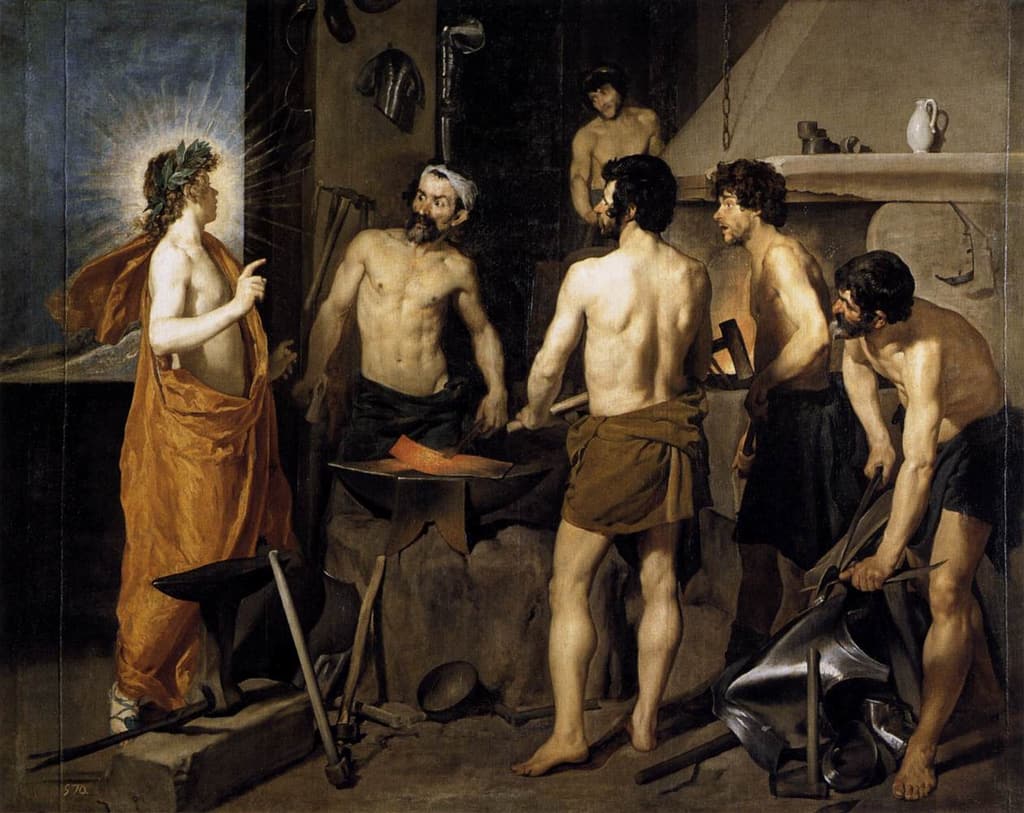
Every other Olympian is idle by definition — the gods are the ones who do not have to labour. Hephaestus works. He has a workshop, an anvil, bellows, apprentices, and a body that hurts. He is the only major Greek god who is disabled, and one of very few whose disability is not cured, disguised or made into a moral lesson. When he enters the Iliad's divine banquet in Book 1, limping and bustling about with the wine cups, the gods laugh; but the laughter defuses a quarrel between Zeus and Hera that was about to ruin the evening, and he engineers it deliberately. He is the god who knows exactly what the room thinks of him and uses it.
Thrown from Olympus — twice, and for different reasons
The Iliad contains two separate falls and never reconciles them. In Book 1 Hephaestus says Zeus threw him from the threshold of heaven for taking Hera's side in an argument; he fell all day and landed at evening on Lemnos, where the Sintians took care of him. In Book 18 Hera says she threw him out herself, ashamed because he was born lame, and that Thetis and Eurynome caught him in the sea and hid him for nine years in a cave under Ocean, where he made jewellery for them.
The two accounts put the lameness on opposite sides of the fall — cause in one, consequence in the other — and the difference matters. If he is thrown because he is lame, his mother's rejection is the origin of the story. If he is lamed by the throw, the injury is an industrial accident of divine politics. Hesiod adds a third frame in the Theogony: Hera bore him alone, without a father, in rivalry with Zeus, who had produced Athena from his head. That version makes Hephaestus a deliberate assertion of independent power by Hera, and it is flatly incompatible with the Homeric passages where Zeus is his father.
His revenge on his mother, told by Alcaeus and shown on vases in one of the most popular scenes in archaic art, is elegant: he sends her a golden throne that binds her when she sits. No god can free her. Ares tries force and is driven off with firebrands. Dionysus gets him drunk and brings him back to Olympus on a mule, in a procession — the Return of Hephaestus — which is one of the very few myths where the resolution is a party.
The armour, the automata, and Greek robots
Book 18 of the Iliad, in which Thetis asks him to make new armour for Achilles, is the longest description of making anything in Greek literature. Before the shield is described, Homer describes the workshop: twenty bellows that blow to order, self-moving wheeled tripods that carry themselves to the assembly of the gods and back, and — most striking — golden attendants in the likeness of living girls, who have intelligence, speech, strength and skill taught them by the gods, and who support him as he walks.
These are the earliest artificial intelligences in Western literature and they appear in a poem from roughly the eighth century BCE. The shield itself, hammered in five layers, holds a whole cosmos: earth, sky and sea; two cities, one at peace with a wedding and a lawsuit being argued, one under siege; ploughing, harvest, vintage, a lion attacking cattle, a dancing floor; and the river Ocean running round the rim. It is the founding text of ekphrasis, description of art within art.
Elsewhere he makes Talos, the bronze giant who circles Crete three times a day and is killed in Apollonius' Argonautica when Medea causes the plug in his ankle to open and the single vein of ichor to drain out; the chain-net that catches Ares and Aphrodite; the fetters that hold Prometheus; the sceptre of Agamemnon; and, in Hesiod's Works and Days, the body of Pandora, moulded from earth and water at Zeus' instruction. Historians of technology cite the tripods and the golden servants constantly; the Iliad passage they come from is quoted much less often than it deserves.
Lemnos, Athens, and the god of the actual crafts
Two centres, with different characters. Lemnos is where he lands and where his oldest cult sits; the island's volcanic character and its Mosychlos hill were connected to his forge in antiquity, and the Lemnian rite involving the annual extinction and reimportation of fire from Delos, described by Philostratus, is one of the strangest fire ceremonies in Greek religion. The later association of his forge with Etna and with the Lipari islands is largely a Sicilian and Roman development.
Athens made him a civic god because Athens made things. The Hephaisteion, standing above the Agora and the best-preserved Greek temple anywhere, overlooked the metalworking and pottery quarter and held cult statues of Hephaestus and Athena together. The Chalkeia festival honoured them jointly as patrons of bronzeworkers, and the Hephaisteia included a torch race. Plato's Protagoras has the two of them give humanity the technical arts jointly, which is a fair summary of the Athenian arrangement: she supplies design, he supplies fabrication.
The strangest Athenian connection is Erichthonius. Hephaestus pursues Athena; she resists; his seed falls on her thigh, she wipes it away with wool and throws it to the ground, and Earth conceives the child who becomes an early king of Athens and the ancestor of its people. Athenian autochthony — the claim to have sprung from their own soil rather than migrated — rests on a story in which the smith-god is the biological father and the ground is the mother.
Marriage and the joke that runs both ways
Homer gives him Aphrodite as wife and then gives him the Odyssey's comic set-piece in which he catches her with Ares and demands the bride-price back. Hesiod, who does not tell that story, marries him to Aglaea, youngest of the Graces. The mismatch of the ugliest god with the most beautiful goddess is often read as a joke at his expense; it can equally be read the way the Odyssey actually plays it, with the cuckolded craftsman as the only competent person in the room, trapping a god of war in a net so fine it cannot be seen.
Vulcan, volcanoes and vulcanised rubber
The Roman Vulcan is genuinely old and genuinely different: a god of destructive fire whose temple, the Volcanal, stood outside the pomerium because you do not invite that fire inside the walls. His August festival, the Vulcanalia, involved throwing live fish into a bonfire — a substitution sacrifice whose logic nobody has convincingly explained. The Greek identification then gave him the forge, the lameness and Venus.
His afterlife is unusually productive: volcano itself, from the Lipari island of Vulcano; vulcanisation, Charles Goodyear's rubber process; the hypothetical intra-Mercurial planet Vulcan proposed in 1859 to explain Mercury's orbital anomaly, and abolished by general relativity; and, from that, the name of a certain logical species in Star Trek.
The modern smith
Modern retellings tend to give him one of two roles: the wronged, decent craftsman in the background, or — increasingly — the centre of disability readings of Greek myth, which have real material to work with. Ancient depictions do not hide his feet: vases show them turned, and one persistent modern medical reading of the twisted-feet iconography connects it to arsenic exposure in bronze-working, which produced peripheral neuropathy in smiths across the ancient world. That hypothesis is speculative but well argued, and it would make his lameness an occupational injury rather than a birth defect — which is, interestingly, closer to the Iliad Book 1 version than to Hesiod's.
A non-Greek name, self-moving furniture, and the donkey
Is his name Greek?
Almost certainly not. It resists Greek etymology, and it appears on a Linear B tablet from Knossos in what looks like a personal name formed from it, so the god is at least Bronze Age. A pre-Greek or Anatolian origin is the standard suggestion — Lemnos was home to a non-Greek-speaking population into the classical period, and the Lemnos stele's language is related to Etruscan.
Did he have any children besides Erichthonius?
Several minor and mostly local figures: Palaemon among the Argonauts, Ardalos who was said to have invented the pipe, and — in a story Apollodorus tells — Periphetes the club-bearer, killed by Theseus on the road to Athens, who is described as lame like his father. He is also given the Cabeiri of Lemnos and Samothrace in some accounts, which links him to a genuine and secretive mystery cult.
What are the wheeled tripods for?
They are serving furniture. Homer says he was making twenty of them, with golden wheels, so that they could roll by themselves into the gathering of the gods and return again — the ancient equivalent of a self-propelled drinks trolley. The detail is casually thrown in as evidence of his skill, which is precisely why it is remarkable: automation is not the point of the passage, just an illustration of it.
Why is the donkey his animal?
Because of the Return: he comes back to Olympus riding one, drunk, led by Dionysus, in the scene painted on more archaic vases than almost any other myth. The donkey is a working animal and a comic one, and its presence keeps the god of labour firmly outside the register of Olympian dignity — which appears to have been the point.