The first word of the Iliad is mēnin — wrath. Not war, not Troy, not Achilles. The poem announces itself as the story of one man's anger and its consequences, and it keeps that promise with a discipline that still startles: it covers a few weeks in the tenth year of a war it never shows starting or ending, and its hero spends most of it sitting in a tent.
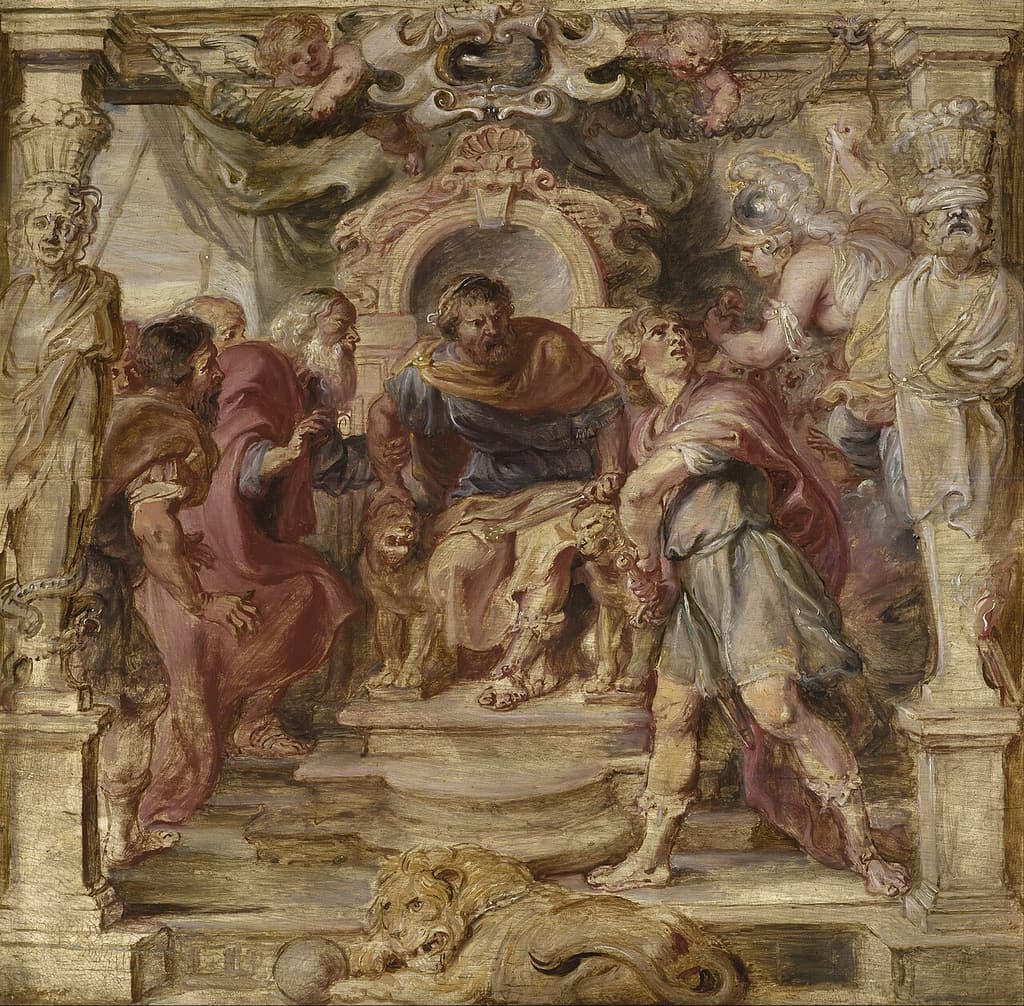
What he is angry about is not, at first, worth it. Agamemnon takes the captive woman Briseis from him as a display of rank. Achilles withdraws, and asks his mother Thetis, a sea-goddess, to persuade Zeus to let the Greeks lose until they understand what he is worth. Thousands die because a commander humiliated a subordinate. The poem does not excuse this, and neither does Achilles; when the embassy comes to him in Book 9 with an enormous offer of restitution, he refuses it in a speech that goes far past the quarrel and questions whether any amount of prizes can be worth a life, since a man's life cannot be won back by raiding.
The choice, and the thing that changes it
He knows his fate, and this is what separates him from every other figure in the poem. Thetis has told him: stay at Troy and die young with imperishable glory, or go home and live long and be forgotten. In Book 9 he says openly that he is considering going home, and means it.
What ends the withdrawal is not persuasion but grief. Patroclus, his closest companion, goes into battle wearing Achilles' armour to frighten the Trojans, and is killed by Hector with Apollo's help. Achilles' reaction is the emotional centre of the epic: he pours dust on his head, his mother and the Nereids come up out of the sea to mourn with him, and he goes back to fight not for honour but for revenge, knowing it will kill him — Thetis tells him plainly that his own death follows soon after Hector's, and he answers that he will accept it.
The rage that follows is genuinely appalling. He kills Lycaon, who begs for his life, and tells him that Patroclus was better and died anyway. He fights the river Scamander, which chokes on the bodies. He kills Hector, ties his body to the chariot, and drags it around the tomb for days while the gods preserve it from harm.
The last book, which is the point
Iliad 24 is where the poem justifies itself. Priam, king of Troy, comes alone at night to the tent of the man who killed his son, guided by Hermes, and kisses his hands. He asks Achilles to think of his own father. They weep — Priam for Hector, Achilles for Patroclus and for Peleus — and then eat together, and Achilles gives the body back and grants a twelve-day truce for the funeral. It is the oldest scene in European literature in which an enemy is recognised as a person, and the poem ends there, with Hector's burial, before Achilles dies and before Troy falls.
Anyone who takes Achilles as a straightforward warrior-ideal has stopped reading at Book 22.
The heel is not in Homer
This needs saying plainly: the Iliad contains no invulnerability, no dipping in the Styx, and no heel. Homer's Achilles is faster and stronger than other men and has divine armour, but he bleeds — he is wounded in the Aethiopis tradition and Homer's world assumes he can be hurt. His death, foretold within the poem and narrated in the lost Aethiopis and in the Odyssey's account of his funeral, comes from Paris' arrow with Apollo's guidance, and no early source specifies the heel.
The invulnerability appears much later. Statius, writing his unfinished Achilleid in the 90s CE, gives the version in which Thetis dips the infant in the Styx holding him by the ankle. Earlier variants have her burning away his mortality in fire at night and anointing him with ambrosia, interrupted by Peleus — the same motif as Demeter and Demophoon. The vulnerable-heel detail as we know it is Roman-era, roughly nine centuries after the Iliad took shape.
The Achilles tendon got its name from that late story: it enters anatomical usage through the Flemish anatomist Philip Verheyen around 1693, with earlier related coinages, and the phrase "Achilles' heel" for a fatal weakness follows. A medical term and an everyday English idiom both derive from a detail the founding text does not contain, which makes him the best available demonstration of how myths keep growing after their canonical version is fixed.
Skyros, the girls' clothes, and the wider Trojan cycle
The material outside Homer is substantial and much of it survives only in summary. He is raised by the centaur Chiron on Mount Pelion, fed on the marrow of lions. Thetis, trying to prevent the prophecy, hides him among the daughters of Lycomedes on Skyros dressed as a girl, where Odysseus exposes him by laying out gifts including weapons and sounding an alarm — he seizes the arms. Statius' Achilleid tells this at length, and the episode became a favourite subject for Baroque painters and for Metastasio's much-set opera libretto.
At Troy he kills the Amazon queen Penthesilea and, in a tradition attested from the Aethiopis onward, falls in love with her at the moment of the killing when he lifts her helmet. He kills Memnon, the Ethiopian son of Eos. He sacrifices twelve Trojan youths on Patroclus' pyre — the poem's most disturbing single act, and one that later Greeks found hard to defend. After his death his armour is awarded to Odysseus rather than Ajax, who kills himself; Sophocles built a play on it.
Cult: a hero with real shrines
He was worshipped, seriously and over a wide area. A tumulus on the Trojan plain was identified as his tomb from at least the archaic period and was visited by Alexander, who ran round it naked and laid a wreath, reportedly saying that Achilles was fortunate to have had Homer to proclaim him. Caracalla staged an elaborate funeral there for a favourite in imitation.
The stranger cult is in the Black Sea. Leuke, "the white island" — usually identified with Zmiinyi (Snake Island) off the Danube mouth — held a shrine where Achilles was said to live on after death with Helen; sailors reported hearing him singing, and left offerings. Hundreds of dedications to Achilles Pontarches, "lord of the sea", have been found around Olbia, where he was effectively a maritime protective deity rather than a dead hero. A warrior from Thessaly ended up as a patron of Black Sea shipping, which is the sort of thing that happens to popular heroes over a thousand years.
Achilles and Patroclus
The Iliad never states that they are lovers and never states that they are not. It gives them extraordinary intimacy — Achilles says he could not suffer worse if his own father died, and asks that their bones be mixed in one urn — within a poem whose vocabulary for such a relationship is hetairos, companion.
Classical Athens read them as lovers and argued only about which was which: Aeschylus' lost Myrmidons made Achilles the elder partner, and Plato's Symposium has Phaedrus object and argue that Patroclus was older, so Achilles must have been the younger. Xenophon's Socrates, by contrast, denies a sexual relationship. Modern scholarship generally accepts that the Homeric text is not making the claim and that fifth-century Athenians read their own institution of pederasty back into it — and that the relationship's importance to the poem does not depend on the question. Madeline Miller's The Song of Achilles (2011) made the romantic reading the default for a very large modern readership.
Achilles since Homer: Logue, Oswald, Barker — and Brad Pitt
Troy (2004) gave him the Brad Pitt version, cut Patroclus to a cousin, and removed the gods entirely. Christopher Logue's War Music is the outstanding modern poetic version; Alice Oswald's Memorial strips the Iliad down to its death-notices and similes, sidelining him deliberately. Pat Barker's The Silence of the Girls retells the quarrel from Briseis' perspective and recovers the fact — flat in Homer, easily skated over — that the woman at the centre of the poem's dispute is a war captive whose city Achilles sacked and whose husband and brothers he killed.
Meanwhile "Achilles heel" and the tendon carry his name into daily use, and the Iliad remains, by a wide margin, the ancient poem most often set, filmed, and rewritten.
Epithets, etymologies and the length of the sulk
Why is he called swift-footed so often?
Podas okus is a formulaic epithet, fitted to a metrical slot, and Homeric formulae are partly a technology for oral composition. But the speed is not decorative: it is what lets him run Hector down around the walls in Book 22, and the chase is described as being like a dream in which the pursuer cannot catch and the pursued cannot escape. The formula and the plot agree.
What language did the Myrmidons' name come from?
Ancient sources derived it from myrmex, "ant", and told a story in which Zeus repopulated the plague-emptied island of Aegina by turning ants into people at Aeacus' request — Aeacus being Achilles' grandfather. Ovid tells it in Metamorphoses 7. Whether the etymology is genuine or invented to explain the name is unresolved, and it is a good example of a myth generated backwards from a word.
Is his own name Greek?
It has no agreed etymology. The most-discussed modern proposal reads it as a compound meaning something like "grief of the host", which would make his name a comment on what the Iliad is about — his anger brings grief to the Achaeans. It is elegant and contested. The name does appear in Linear B as a-ki-re-u, so it was a real Bronze Age Greek personal name whatever it meant.
Did he really refuse to fight for so long?
His absence runs from Book 1 to Book 18 of a twenty-four-book poem — roughly two thirds of it, covering four days of fighting. That structural fact is often lost in retellings, which tend to show him fighting throughout. The poem is built around a hole where its hero should be, and everything that happens in that space, including the whole career of Diomedes and the death of Patroclus, exists because he is not there.