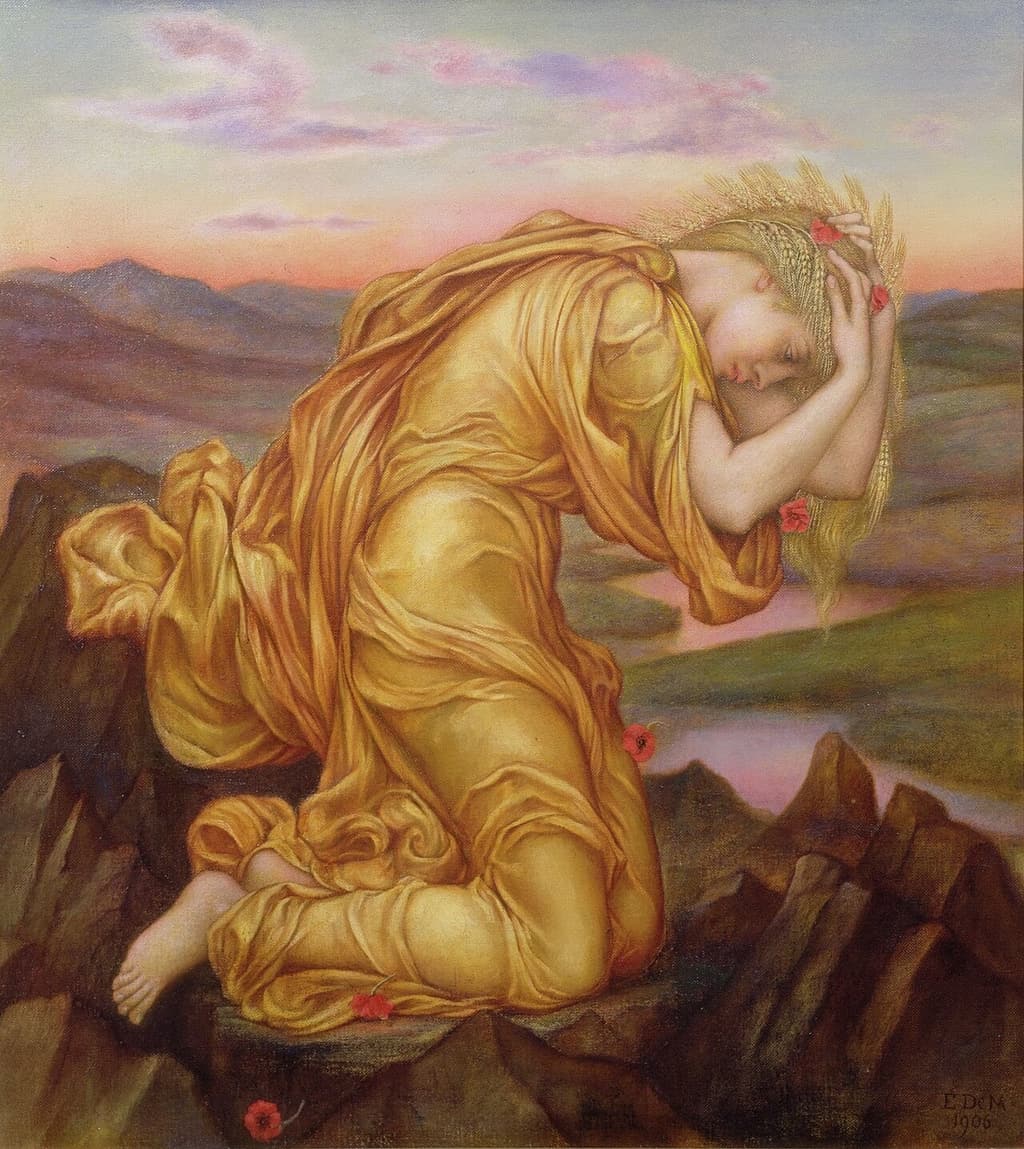
For roughly a thousand years, from perhaps the seventh century BCE until the sanctuary was destroyed in 396 CE, tens of thousands of people were initiated at Eleusis into rites they were forbidden to describe. Almost all of them kept the secret. Aeschylus was reportedly prosecuted for revealing something of it on stage; Alcibiades was condemned in absentia partly for parodying it at a private party. This is the most remarkable fact in Greek religion — a mass rite, open to women, slaves and foreigners, whose central content we still cannot state — and it belongs to Demeter, the grain goddess whose daughter was taken.
The Homeric Hymn, which is the primary text
The Homeric Hymn to Demeter, probably late seventh or early sixth century BCE, is the earliest full narrative and it reads as a foundation charter for the Eleusinian rite. Persephone is gathering flowers in a meadow when the earth opens and Hades takes her — with the collusion of Zeus, which the hymn states plainly and which is the detail most retellings soften. Demeter hears the cry, searches nine days with torches, eats nothing, and learns the truth from Helios, who saw it.
She then withdraws in the disguise of an old woman to Eleusis, sits by the Maiden Well, and is taken in by the family of King Celeus to nurse the infant Demophoon. She feeds him ambrosia and lays him in the fire each night to burn away his mortality; his mother sees, screams, and the working is spoiled. Demeter reveals herself, orders a temple built, and then makes the earth barren — no seed sprouts, and the gods begin to lose their sacrifices because there are no humans left to make them. That is the leverage that forces Zeus to negotiate. Hermes fetches Persephone, but she has eaten pomegranate seeds, and so is bound to return for a portion of each year. Before leaving, Demeter teaches her rites to the Eleusinian nobles — and the hymn says explicitly that those who have seen them have a better lot after death.
Note what the hymn does not say: it never explains the seasons in the tidy modern way. The barrenness is a strike, not a natural cycle, and the Mediterranean agricultural year has its dead period in the scorching summer when grain is stored underground, not in a cold northern winter. The "winter equals Persephone underground" reading is a later tidying-up.
What the Orphic version changes
A rival tradition, transmitted through Orphic material and reported with disgust by Christian writers such as Clement of Alexandria, moves the setting and adds a figure absent from the hymn: Baubo, a woman who breaks the mourning goddess's fast not with a kind word but by lifting her skirts, making Demeter laugh. In this version the household names change too — Dysaules and his family replace Celeus'. The ritual drink, the kykeon of barley, water and pennyroyal, appears in both. Anyone who tells you what "the" myth of Demeter is, without naming the version, is choosing one and not saying so.
What can honestly be said about the Mysteries
There is a great deal of respectable evidence about the frame and almost none about the core.
- The Lesser Mysteries were held at Agrai near Athens in the spring, a preliminary purification.
- The Greater Mysteries ran for around nine days in the month of Boedromion (roughly September–October). Sacred objects were carried from Eleusis to Athens; a herald proclaimed who might be admitted — anyone who spoke Greek and was not polluted by unavenged bloodshed, including women and slaves; initiates bathed in the sea with a piglet each; and the procession walked the twenty-odd kilometres of the Sacred Way, with ritual mockery at the bridge over the Kephisos.
- Inside the Telesterion, a great square hall with rock-cut steps on all sides and a small inner structure called the Anaktoron, something was done, said and shown. The ancient terms are dromena, legomena, deiknymena.
- Initiates came away, in the words of several sources, without fear of death. Cicero wrote that Athens gave nothing finer to the world.
What was shown is unknown. An ear of grain reaped in silence is reported by one hostile Christian source; a light in darkness is often mentioned; the theory that the kykeon was psychoactive through ergot-infected barley is a modern hypothesis with no ancient support. This site does not resolve it, because it is not resolvable from the evidence.
Thesmophoros: the lawgiver nobody remembers
Her second great cult is the Thesmophoria, and it is the most widespread festival in the Greek world — attested in dozens of cities — and closed to men entirely. Women camped for three days at the Thesmophorion; the days were named Anodos (the ascent), Nesteia (the fast, sitting on the ground on mats of chaste-tree), and Kalligeneia ("fair offspring"). The central act was the retrieval of the decayed remains of piglets thrown into pits at an earlier festival, brought up by women called Antletriai and mixed with seed corn on the altar.
Her title here is Thesmophoros, "law-bringer" or "bringer of what is laid down". Ancient sources connect it to the belief that agriculture made settled law possible: a people who plough must hold land, and holding land requires marriage, inheritance and boundaries. That is a serious claim about civilisation, and it is the part of Demeter that modern retellings drop almost without exception in favour of the grieving mother.
Arcadia's furious black goddess
Nothing prepares a reader of the Homeric Hymn for the Demeter of Arcadia. At Phigalia, Pausanias reports, she was worshipped in a cave as Demeter Melaina, the Black, with the body of a woman and the head and mane of a horse, snakes growing from her head, a dolphin in one hand and a dove in the other. The reason given is her rape by Poseidon, who took stallion form when she became a mare to escape him; her children by him were the immortal horse Arion and a daughter called only Despoina, "the Mistress", whose real name was reserved for initiates. At nearby Lykosoura, Despoina's own sanctuary produced the colossal group by Damophon, fragments of which survive. This Demeter is not a mother in mourning; she is an angry chthonic power, and she is at least as old as the Eleusinian one.
Ceres, and where the word cereal comes from
The Roman Ceres had a genuine independent origin: an Italic goddess of growth with an ancient flamen, worshipped on the Aventine in a triad with Liber and Libera, closely tied to the plebeians, whose officials kept their records in her temple. Her festival, the Cerialia, involved games and a startling rite in which foxes were released into the Circus with burning brands tied to them. Ovid's Fasti and Metamorphoses then retold the Greek abduction in Latin, moving it to the plain of Enna in Sicily and adding the boy Ascalaphus, turned into a screech-owl for reporting that Persephone had eaten. Sicily's claim to the story is Roman-era and strong, and Cicero's prosecution of Verres makes much of the plundered Sicilian shrines.
Grief, romance retellings, and the strike nobody dramatises
Contemporary retellings have taken the abduction almost exclusively from Ovid's angle and made it a mother-daughter novel: Demeter is grief, Persephone is agency or victimhood depending on the author, and Hades is either a villain or, in the current wave of romance retellings, a brooding love interest. The strike — a goddess starving the gods out by withholding harvest until she gets her way — is a political act and it rarely survives. Nor does Thesmophoros. The most faithful modern uses are oblique: the recurring figure of the bereaved mother in poetry from Tennyson to Rita Dove's Mother Love, and the deliberate framing of the Eleusinian promise in works about what people want from an afterlife.
The pig, the rivalry with Delphi, and the closing of Eleusis
Why a pig?
Pigs are her animal throughout, and they are cheap, fertile and associated with the earth. Initiates bathed a piglet each in the sea before the Greater Mysteries and sacrificed it; the Thesmophoria's pits held piglet remains to be mixed with seed. One aetiology says a swineherd named Eubouleus had his pigs swallowed by the same chasm that took Persephone. The practical logic is that pigs are the sacrifice ordinary households could actually afford, which is consistent with a cult that admitted the poor.
Was Eleusis in competition with Delphi?
They were not rivals in function. Delphi answered questions; Eleusis conferred a status. Eleusis was, however, in a political relationship with Athens, which annexed the sanctuary early and administered the Mysteries through Athenian officials while the hereditary priestly families, the Eumolpidae and Kerykes, kept the ritual offices. That arrangement made the rite a piece of Athenian soft power across the whole Greek world.
What ended the Mysteries?
The Roman emperors were largely enthusiastic — Hadrian and Marcus Aurelius were initiated. The end came with the Christianisation of the empire: Theodosius I's legislation against pagan cult in 392 CE, and the sack of Eleusis by Alaric's Goths in 396 CE. Eunapius, writing near the end, records the last legitimate hierophant's prediction that after him the sanctuary would fall.
Is there any relation to Near Eastern grain goddesses?
Comparisons are frequently drawn to the Mesopotamian descent narratives of Inanna and to the Anatolian mother goddess, and the pattern of a deity's disappearance causing agricultural failure is genuinely widespread — the Hittite myth of the vanishing god Telipinu is the closest structural parallel. Whether these represent inheritance, borrowing or independent invention is unsettled, and the honest answer is that the parallels are real and the transmission is not demonstrated.