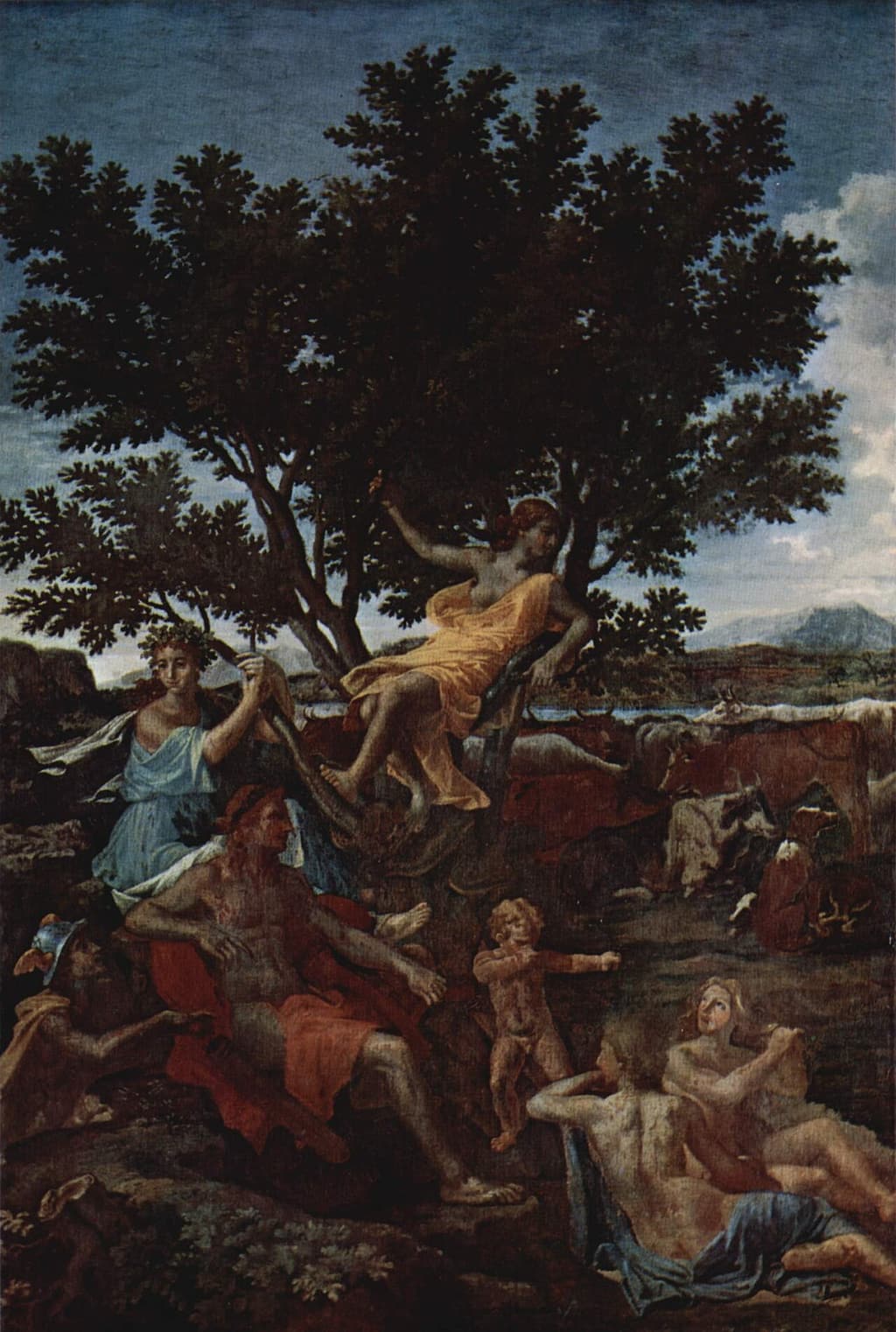
The Iliad opens with a plague, and the god who sends it is Apollo. Chryses, his priest, has been refused the return of his daughter; he walks along the shore and prays, and the god comes down from Olympus "like night", firing arrows into the mules first, then the dogs, then the men, for nine days. The same god is called Paian, the healer, and is the father of Asclepius, whose sanctuaries were the closest thing antiquity had to hospitals. Nothing needs reconciling here: the power that causes epidemic disease and the power that ends it were understood as one thing, because that is what the experience of an epidemic is like. Apollo's arrows are sudden death, and his cult titles include Smintheus, the mouse-god, which some ancient readers already connected with the vermin that arrive with pestilence.
Delos, and a birth on a floating island
Leto, pregnant by Zeus, could find no land willing to receive her — Hera had forbidden it. The Homeric Hymn to Apollo has her go from place to place until barren, rocky Delos agrees, on condition that the god swear to build his temple there and not despise the island for its poverty. Leto labours for nine days and nights, holding a palm tree, while the goddesses attend and Hera keeps Eileithyia away on Olympus until Iris bribes her with a nine-cubit necklace of gold and amber. Artemis, in most versions, is born first and helps.
Delos became one of the two poles of his worship and eventually the treasury of the Delian League. Purification of the island went to an extreme: in 426 BCE the Athenians removed every grave, and thereafter no one was permitted to be born or to die there. The other pole is Delphi, and the hymn tells the journey between them.
Delphi: killing the serpent, taking the ground
Arriving at Krisa under Parnassus, Apollo kills the great she-serpent that guarded the spring — Python in later sources — and lets her rot there, from which the hymn derives the name Pytho. He then takes the form of a dolphin, seizes a Cretan merchant ship, and beaches it at Krisa to install its crew as his first priests: hence Delphinios. The killing is not treated as unambiguously clean. A strong tradition, dramatised in the ninth-yearly Septerion festival, has Apollo go into exile to the Vale of Tempe to be purified for the blood, and return crowned with laurel. A god who requires purification for a sanctioned killing is a theologically odd thing, and it is the root of Apollo's role as the god who purifies homicides — which is why Orestes goes to him in Aeschylus' Eumenides.
Delphi's procedure is better evidenced than its mystique suggests. On the seventh of the month, nine months a year, after the sacrificial goat was sprinkled and shivered to show the god's consent, the Pythia — a local woman, not necessarily young or aristocratic — took her seat on a tripod in the adyton and answered. Plutarch, who was himself a priest at Delphi, describes a sweet-smelling exhalation from the room, discusses openly why the oracle had declined in his day, and says most responses in his time came in prose rather than verse. Geological survey of the site since the 1990s has identified faults crossing beneath the temple and traces of light hydrocarbon gases including ethylene in the local springs — suggestive, much debated, and not proven to have reached the adyton in the classical period.
His epithet Loxias, "the oblique", names the oracle's most famous trait. Croesus is told that if he attacks Persia he will destroy a great empire; he destroys his own. Herodotus tells this as the god's ambiguity being fair warning rather than deceit. The two maxims carved at the temple, "Know yourself" and "Nothing in excess", made Delphi a moral authority as much as a predictive one.
Music, and two contests that end badly
The lyre is his, and he did not make it. In the Homeric Hymn to Hermes, the newborn Hermes invents the instrument from a tortoise shell on his first morning, steals Apollo's cattle that evening, and eventually trades the lyre to his brother in settlement. Apollo, who elsewhere is the guarantor of proportion, is a savage competitor: he flays the satyr Marsyas alive for losing a music contest to him, and when King Midas judges against him in a contest with Pan, he gives Midas donkey's ears. His Muses' patronage, as Apollo Mousagetes, sits beside those stories without softening them.
The loves are mostly disasters and mostly aetiological. Daphne becomes the laurel — his tree, and the crown of the Pythian Games — fleeing him, in the version Ovid made canonical in Metamorphoses 1. Hyacinthus, a Spartan youth, is killed by a discus and becomes a flower; his festival, the Hyakinthia at Amyklai, began in mourning and ended in celebration and was one of Sparta's most important. Coronis is shot for infidelity while pregnant, and Apollo pulls the unborn Asclepius from her body on the pyre. Cassandra receives the gift of true prophecy and, refusing him, the curse of never being believed.
What the sun has to do with it
Very little, at first. Homer keeps Helios and Apollo entirely distinct — Helios drives the chariot and sees everything, Apollo does not. The identification appears in the fifth century BCE, in Euripides and in the Presocratic and later allegorising traditions, and hardens through the Hellenistic and Roman periods until Apollo is routinely radiate and solar in Roman art and in every subsequent European allegory. Calling archaic Apollo "the sun god" is not a translation; it is importing a later theology.
The epithet Phoebus — Phoibos, "bright" or "pure" — is old and genuinely his, which is part of how the merger happened. The origin of the name Apollo itself is unresolved; the ancient derivation from apollymi, "to destroy", punned on in Aeschylus, is folk etymology, and a Northwest Greek connection to apella, the assembly, is one modern candidate among several. A Hittite or Anatolian origin has been argued repeatedly, partly because he fights on the Trojan side in the Iliad.
The one Olympian Rome did not rename
Rome imported him under his own name, which happened to no other major Greek god. His first temple in the city, vowed during a plague in 433 BCE, was to Apollo Medicus. What changed him was Augustus, who credited Apollo with the victory at Actium, built him a temple on the Palatine beside his own house, moved the Sibylline Books there, and revived the Ludi Saeculares under his patronage. Apollo became the emblem of Augustan order, clarity and legitimacy — and that Roman-imperial Apollo, not the archaic plague-archer, is what the Renaissance and the Enlightenment inherited.
That inheritance is why Nietzsche could set "Apollonian" against "Dionysian" in The Birth of Tragedy and be immediately understood, and why the phrase has outlived nearly everything else in that book. It is a real opposition in Greek thought — Delphi itself gave over the winter months to Dionysus — but it was sharpened by Nietzsche far past anything a Greek would have recognised.
Apollo now
The name went to the American lunar programme in 1960 at the suggestion of NASA's Abe Silverstein, who wanted a god riding a chariot across the sky; that single decision has probably done more to keep the name in daily use than every classical text combined. It also survives as a given name, rare but persistent, carrying the programme's associations as much as the god's. Beyond it he is the Muses' leader on concert-hall friezes, Stravinsky's Apollon musagète, the theatre marquee, and a steady presence in fiction as the beautiful, brittle, over-articulate god — the Trials of Apollo novels build a whole comic sequence on stripping him of his powers. What almost never appears is the archer sending plague, which is the first thing he does in European literature.
Riddles, Trojan sympathies, and the closing of the oracles
Did the Pythia really speak in riddles?
Some responses are riddling and famous for it, but the surviving corpus — several hundred texts of varying reliability — is dominated by short, practical, often binary answers: whether to found a colony, which god to sacrifice to, whether to accept a treaty. Delphi's authority rested less on foreseeing the future than on being the recognised third party who could settle a question a city could not settle internally.
Why does he fight for Troy?
He is Troy's protector throughout the Iliad: he defends the city walls, strikes Patroclus' armour off his back before Hector's spear reaches him, and guides Paris' arrow to Achilles' heel in later tradition. One reason offered in antiquity is Laomedon's fraud — Apollo and Poseidon built Troy's walls and were cheated of payment — but Apollo's allegiance survives that grudge, which is itself evidence of an old Anatolian association attaching him to the region.
What are the Hyperboreans?
A people said to live beyond the north wind, where Apollo spends the winter months, in perpetual sunlight and feasting. Herodotus reports that offerings wrapped in wheat straw were passed hand to hand from the Hyperboreans down through Europe to Delos, and treats the tradition with some scepticism. It is one of the few Greek utopias, and the source of a long, later, and often unpleasant afterlife in European myth-making about a northern homeland.
How did his oracles end?
Gradually and then by decree. Plutarch's essay On the Obsolescence of Oracles shows the decline was already a topic in the first century CE, and attributes it partly to Greece's depopulation. Delphi kept working into the fourth century; the tradition preserved by later authors that a final response was sent to the emperor Julian saying the laurel had withered and the speaking spring fallen silent is of doubtful authenticity but captures the end well enough. Didyma and Claros in Asia Minor were active into the same period.