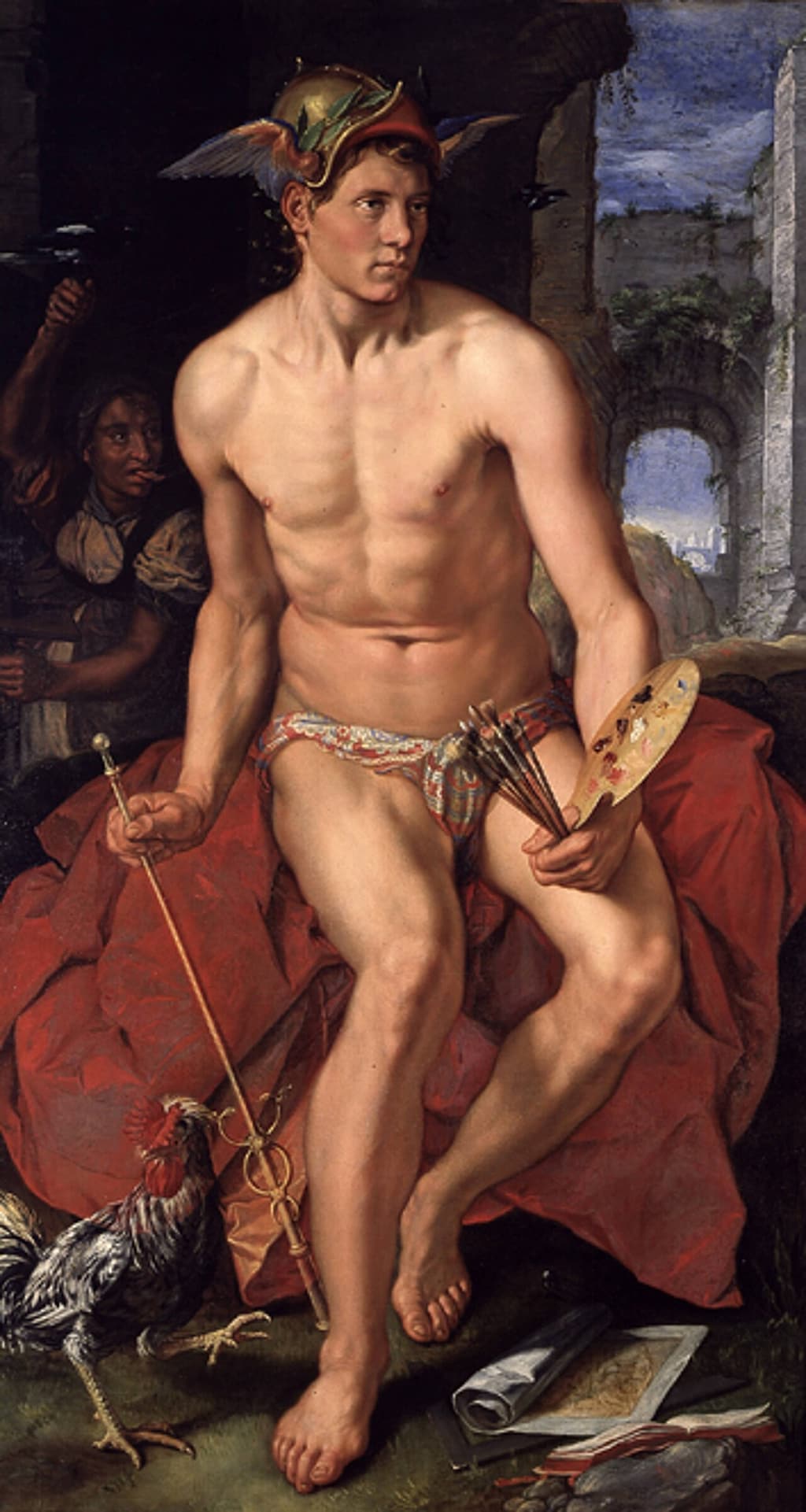
The Homeric Hymn to Hermes is the funniest text to survive from archaic Greece, and its subject is a criminal career that begins before lunch. Born at dawn in a cave on Mount Cyllene to the nymph Maia, the god is out of his cradle by midday. He finds a tortoise at the door, greets it politely, kills it, and strings the shell with sheep gut to make the first lyre. That evening he steals fifty cattle from Apollo's herd, drives them backwards so the hoofprints point the wrong way, wears brushwood sandals to disguise his own tracks, invents fire-sticks, butchers two cows and divides the meat into twelve portions for the twelve gods — including himself, which is his real claim being staked — then slips home through the keyhole "like a breath of autumn air" and lies in his cradle looking innocent.
When Apollo tracks him down, the infant denies everything with a run of perjuries so audacious that Zeus laughs out loud at the trial on Olympus. The settlement is a trade: Hermes hands over the lyre, keeps a herdsman's role, and later invents the shepherd's pipe, which he also sells to Apollo, this time for the golden staff and instruction in a minor form of divination. The god of thieves buys his way into the pantheon with intellectual property.
The herms, which is what he really meant to people
A modern reader thinks "messenger" and pictures winged sandals. An Athenian thought of a stone pillar. Herms stood at doorways, at crossroads, at boundaries between farms, in the Agora and along roads: a rectangular shaft, a bearded head on top, and an erect phallus on the front. They were apotropaic, they marked transitions, and they were so ordinary that Thucydides can describe the city's reaction when almost all of them were mutilated in a single night in 415 BCE, on the eve of the Sicilian expedition.
That episode — the Mutilation of the Herms — is the single best evidence for what the god meant. Athens interpreted it as a sacrilege aimed at the fleet's safe passage and as evidence of oligarchic conspiracy; Alcibiades was implicated, recalled from command, and defected to Sparta rather than face trial. The Sicilian expedition was destroyed. A war may have turned on the vandalism of boundary-god pillars.
The name itself probably derives from herma, a heap of stones, and Greek travellers added a stone to roadside cairns as they passed. That is his oldest function: the god of the place where one territory becomes another, which explains everything else. Messages cross boundaries. Trade crosses boundaries. Theft crosses them illegitimately. And death is the boundary crossing that requires a guide.
Psychopompos: the escort of the dead
At the opening of Odyssey 24, Hermes takes up his golden wand — with which, Homer says, he charms the eyes of men asleep and wakes others — and leads the souls of the dead suitors, squeaking like bats in a cave, down past the streams of Ocean and the White Rock to the fields of asphodel. He is the only Olympian who moves freely between the worlds. He fetches Persephone back from Hades at the end of the Homeric Hymn to Demeter; he escorts Priam through the Greek camp to Achilles' tent in Iliad 24, disguised as a young man, which is the most tender thing any god does in that poem.
His epithet Argeiphontes is usually rendered "slayer of Argos", after the hundred-eyed watchman he killed to free Io — lulling him to sleep with the pipe and a long dull story before striking. The etymology is disputed; some read it as "bright-appearing" instead. Ancient Greek usage assumed the killing.
Trade, luck, and the things you find
Hermes is the god of hermaion — a windfall, a lucky find, something valuable on the road that belongs to nobody. That word tells you how the Greeks felt about him: profit and chance are morally ambiguous and they have a patron. He presides over markets as Agoraios, over athletics and gymnasia as Enagonios, over herds as Nomios, and over sleep and dreams as Oneiropompos. His grandson through Autolycus, the master thief who could make stolen goods unrecognisable, is Odysseus — which is the family explanation for the cleverest and least trustworthy hero in Greek epic. It is Hermes who gives Odysseus the moly plant to protect him from Circe.
With Pan as his son by an Arcadian nymph, and Mount Cyllene in Arcadia as his birthplace, his oldest cult is pastoral and rural — a god carried into the city rather than born there.
The caduceus is not a medical symbol
This matters and it is constantly got wrong. Hermes' staff, the kerykeion or caduceus, is a herald's wand: a rod with two snakes twined around it, usually winged at the top. It signals diplomatic immunity — a herald carrying it could not be harmed. The rod of Asclepius is a different object: a rough staff with a single snake and no wings, belonging to Asclepius, the god of healing.
The confusion is modern and traceable. Printers' devices used the caduceus for centuries as a mark of commerce and of Hermes Trismegistus; the decisive error was the US Army Medical Corps adopting the caduceus as its insignia in 1902, apparently on the initiative of a single officer, after which it spread across American medical branding. Studies of insignia in the twentieth century found that professional bodies and academic institutions tended to use the correct rod of Asclepius while commercial healthcare organisations used the caduceus — which is a fittingly Hermetic outcome, since the two-snake staff really is the symbol of trade. If you want to know what a symbol actually meant before it was borrowed, this is the textbook case.
Mercury, Thoth, and the Thrice-Great
The Roman Mercury is transparently commercial: his name shares a root with merx, merchandise, and mercari, to trade. His temple near the Circus Maximus was dedicated in 495 BCE together with a merchants' guild, and his festival on 15 May involved traders sprinkling their goods and their own heads with water from his spring.
Far more consequential was the Greek identification of Hermes with the Egyptian Thoth, scribe and god of writing and measurement, in Hellenistic Egypt. From that fusion came Hermes Trismegistus, "thrice-greatest", the supposed author of the Hermetic writings — Greek philosophical and magical texts of the second and third centuries CE that Renaissance readers, following a mistaken early dating, believed to be Egyptian wisdom older than Moses. Ficino translated them for Cosimo de' Medici in 1463, interrupting his work on Plato to do it. The entire Western esoteric tradition — alchemy, "hermetic" sealing, much of Renaissance magic — descends from that misdating, exposed by Isaac Casaubon in 1614 and by then far too late to matter.
A portfolio that turned out to be the modern economy
He is the Olympian best served by the modern world, because his portfolio is the modern world's: logistics, messaging, markets, borders, information. His name is on a Paris fashion house founded as a harness-maker, on delivery companies across Europe, on the FTL messaging protocol, on Mercury the planet and the element and the American space programme. Percy Jackson gives him the mailroom and a wry, tired competence. The winged-cap-and-sandals figure on postal insignia across the twentieth century is his; so, by that persistent error, is the snake staff on the side of an ambulance.
Theft and oath-keeping lodged in a single portfolio
Why is a thief also the god of oaths and heralds?
Because both roles concern the reliability of what passes between parties. A herald's word must hold across a boundary where no law compels it; a thief exploits exactly that gap. Greek thought was comfortable with a single power governing both the honest and dishonest movement of goods and information, and Hermes is regularly called on to protect against theft as well as to enable it.
What is a hermaphrodite named for?
Hermaphroditus, his son by Aphrodite, who in Ovid's telling was fused into a single body with the nymph Salmacis when she prayed never to be separated from him at the spring where he bathed. The figure was a favourite subject in Hellenistic sculpture — the Sleeping Hermaphroditus in the Louvre, with its later Bernini mattress, is the best-known example — and there is evidence of cult in Attica.
Was there really a festival where slaves and masters swapped roles?
Yes, on Crete: the Hermaia, at which Athenaeus reports slaves feasted while their masters served them, and slaves were permitted to run the city. Similar inversions attach to other festivals across the Greek and Roman world, the Saturnalia most famously. For a god of boundaries, the temporary suspension of the most rigid social boundary of all is entirely in character.
How old is he?
At least Bronze Age. e-ma-a2, read as Hermahas, appears on Linear B tablets from Pylos receiving offerings, which puts him in Greece well before Homer. That makes him one of the securely attested Mycenaean gods, alongside Zeus, Hera, Poseidon, Athena and Dionysus.