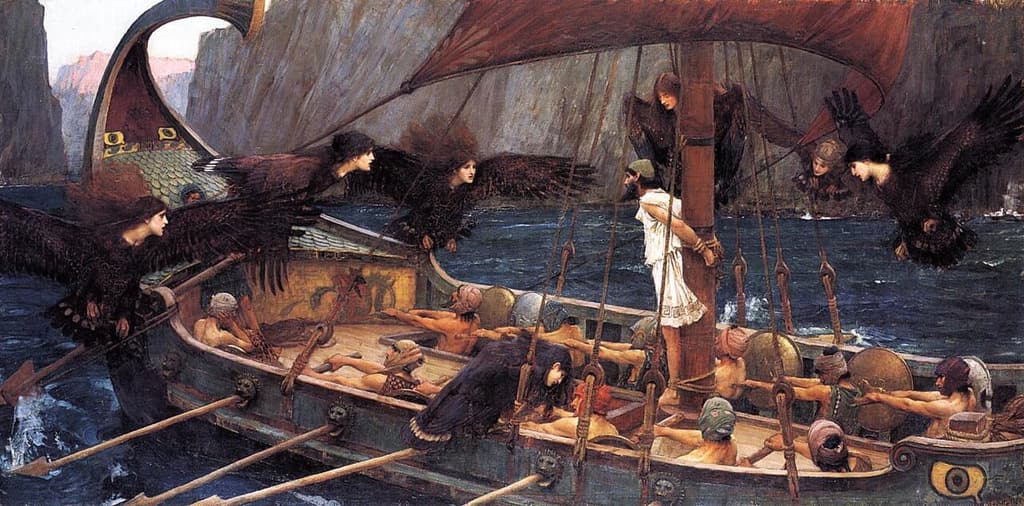
The monsters everyone remembers reach us through the mouth of the man who wants something: Odysseus recounts them after dinner, in a Phaeacian hall, to hosts from whom he is angling for passage home.
Books 9 to 12 — the Cyclops, the bag of winds, the Laestrygonians, Circe, the underworld, the Sirens, Scylla and Charybdis, the cattle of the Sun — are a first-person narration delivered to the Phaeacians at the court of Alcinous. Nothing in them is corroborated. Every monster in the poem's most famous stretch exists only in the mouth of a man the narrator has already introduced as polytropos, "of many turns", and whom Athena praises specifically for being a liar so accomplished that a god enjoys the contest. Elsewhere in the poem he tells at least four other elaborate false life-stories — to Athena in disguise, to Eumaeus, to Penelope, to his own father — each internally consistent, each detailed, each untrue.
The poem itself flags this. Alcinous tells him he is not like the wandering frauds who make up stories, which is a strange thing to say unless the question has occurred to everybody in the hall. Whether Homer intends the tales to be true within the fiction is a matter for the reader, but the poem is unmistakably interested in what it means to trust a story, and it puts the question at the centre rather than the edge.
Cunning as a moral problem
His defining quality is mētis, practical cunning — the same word that names Zeus' first wife, whom he swallowed. It gets him the Trojan horse, the escape under the rams' bellies, the name "Nobody", the recovery of his house. It is also, in Greek terms, ambiguous in a way that raw courage is not.
The Iliad and Odyssey admire it. Later Greek literature turns on him hard. In Sophocles' Philoctetes he is the manipulator urging a young man to lie to a sick castaway; in Ajax he is the one decent voice, which shows the reversal was never total. Euripides' Hecuba has him argue for the sacrifice of a child. Pindar accuses Homer of having overrated him. By the time we reach Rome the transformation is complete: for Virgil, whose people descend from the Trojans, he is dirus Ulixes, cruel Ulysses, the architect of the horse and the destroyer of a city. Dante puts him in the eighth circle among the false counsellors, burning in a shared flame with Diomedes, and invents for him a final voyage past the Pillars of Hercules — the speech about following virtue and knowledge that Tennyson reworked into Ulysses six centuries later, and which is now more quoted than anything Homer wrote about him.
His reputation is the single most complete reversal in classical reception, and the pivot is which side of the Trojan war a culture claims descent from.
The homecoming, which is a different poem
The second half of the Odyssey is a domestic thriller and it is where the poem's real interest lies. He arrives on Ithaca asleep, is put ashore by the Phaeacians without waking, and does not at first recognise his own island. Disguised as a beggar by Athena, he goes to the hut of Eumaeus the swineherd — a loyal slave given some of the warmest treatment in the poem — and works his way in.
The recognitions are the poem's great sequence, and each is different. Argos, the hound he left behind as a puppy, has been dumped untended on a midden outside his own gate; the animal twitches its tail at a master nobody else can see, and expires. His nurse Eurycleia, washing his feet, recognises the boar scar on his thigh and drops his foot in the basin; he grabs her throat to keep her quiet. Telemachus is told outright. Penelope refuses to be told at all.
The bow test — stringing the great bow and shooting through twelve axe-heads — kills the suitors, and the slaughter is not sanitised. Twelve women of the household who had gone with the occupiers are first set to hauling corpses and scouring blood out of the hall, and executed together once the work is finished; Homer likens them to thrushes tangled in a fowler's net. Their killing is the passage that most modern readers stop at, and it has generated a substantial literature of its own, most notably Margaret Atwood's The Penelopiad.
Penelope tests him back
The best scene in the poem is the last recognition. After the killing, Penelope will not accept him. She tells the nurse to move the bed out of the bedchamber — and he explodes, because he built that bed himself around a living olive tree rooted in the ground, and it cannot be moved unless someone has cut it. Only then does she accept him. She has caught him with a lie, which is the only way to identify a man like this.
The bed is also the poem's whole argument in one object: a marriage that is literally rooted, immovable, and secret to two people.
The other end of the story
The Odyssey does not end at the reunion. Tiresias, in the underworld, has told him he must travel inland carrying an oar until he reaches a people who do not know the sea and mistake it for a winnowing fan, plant it there and sacrifice to Poseidon, and only then die gently from the sea in a comfortable old age. The instruction is not carried out within the poem.
The lost epic Telegony completed it, and badly. Telegonus — fathered on Circe during the year on Aeaea, and never met — sails out in search of a father he could not identify if he saw him, puts in at Ithaca taking it for somewhere else, and in the resulting skirmish runs him through with a shaft barbed from a ray's sting. That satisfies Tiresias to the letter, which is the joke: the sea-borne death arrives as a boating accident with a stranger. The surviving cast then intermarry in a tidy and absurd arrangement.
Ithaca, and whether he was real
There is no evidence for a historical Odysseus. There is evidence of cult: a cave at Polis Bay on Ithaca produced thirteen bronze tripods from around the ninth to eighth centuries BCE — objects that match the tripods the Phaeacians give him in the poem — along with a later fragmentary inscription reading as a dedication to Odysseus. Whether the poem generated the cult or the cult fed the poem is exactly the kind of question that cannot be settled, but a hero shrine on the island his epic names is a real archaeological fact.
The geography of the wanderings has been "identified" continuously for 2,700 years — Strabo already complains about it. Eratosthenes' remark, that you will find the route of Odysseus' wanderings when you find the cobbler who sewed the bag of the winds, remains the best comment on the genre.
Ulysses, Joyce, and the most reused plot in fiction
The Roman form Ulixes, giving English Ulysses, is what carried him through Latin literature to the Middle Ages, when Homer was largely unavailable in western Europe. Every major reworking until the nineteenth century runs through the Latin name and the Virgilian hostility.
Then in 1922 James Joyce mapped the poem onto a single day in Dublin — Leopold Bloom as Odysseus, Stephen Dedalus as Telemachus, Molly as a very different Penelope — and permanently changed what the myth was for. Joyce's Odysseus is chosen precisely because he is the complete man: son, father, husband, soldier, wanderer, and, unusually for an epic hero, someone who wants to go home rather than to win.
After Joyce the homecoming became the modern novel's standard structure. Derek Walcott's Omeros moves it to St Lucia; the Coen brothers' O Brother, Where Art Thou? moves it to Depression-era Mississippi; Emily Wilson's 2017 translation, the first into English by a woman, opens with "Complicated" for polytropos and started an argument about the character that has not settled. Nikos Kazantzakis wrote a 33,333-line sequel. The word odyssey itself now means any long transformative journey, which is a fair summary of what happened to him.
The horse, the shroud, and what the Cyclopes are for
Was the Trojan horse his idea?
The Odyssey credits it to him repeatedly — Menelaus and Demodocus both name him as the author — and says Epeius built it with Athena's help. The Iliad does not mention the horse at all; the story belonged to the Little Iliad and the Iliupersis, now lost, and reaches us most fully through Virgil's Aeneid 2, told by the enemy. There is a long-standing speculation that the "horse" was a siege engine or an earthquake, which is a modern rationalisation with no ancient support.
Why does Athena favour him?
She says so directly in Book 13: because he is careful, quick-witted and self-possessed, and because she is the same. It is the only relationship in Homer between a god and a mortal that reads as genuine mutual liking rather than patronage or debt. She is also, in the Iliad, notably absent from him for the ten years of the return — Poseidon's anger constrains her, and the poem is careful about the etiquette of gods not crossing each other.
Is Penelope's shroud trick a real weaving practice?
The trick — weaving a burial shroud for Laertes by day and unpicking it by night, for three years, to delay the suitors — is credible as textile work: an unfinished warp-weighted loom's weft can be unpicked. The episode is told three times in the poem by three different characters, which is unusual emphasis, and it makes her the equal of her husband in deception rather than a passive waiter. Whether the poem admires or distrusts her cunning is left conspicuously open.
What are the Cyclopes supposed to represent?
Homer's Cyclopes are not the skilled thunderbolt-forgers of Hesiod. They are herdsmen without laws, assemblies, agriculture or ships, each ruling his own family in a cave, and the poem lists what they lack in detail. Polyphemus' great crime is refusing hospitality and eating his guests, which inverts the poem's central value. The episode functions as a definition of civilisation by describing its opposite — which is also, conveniently, exactly the kind of story a traveller tells to flatter the sophisticated hosts he is currently trying to impress.