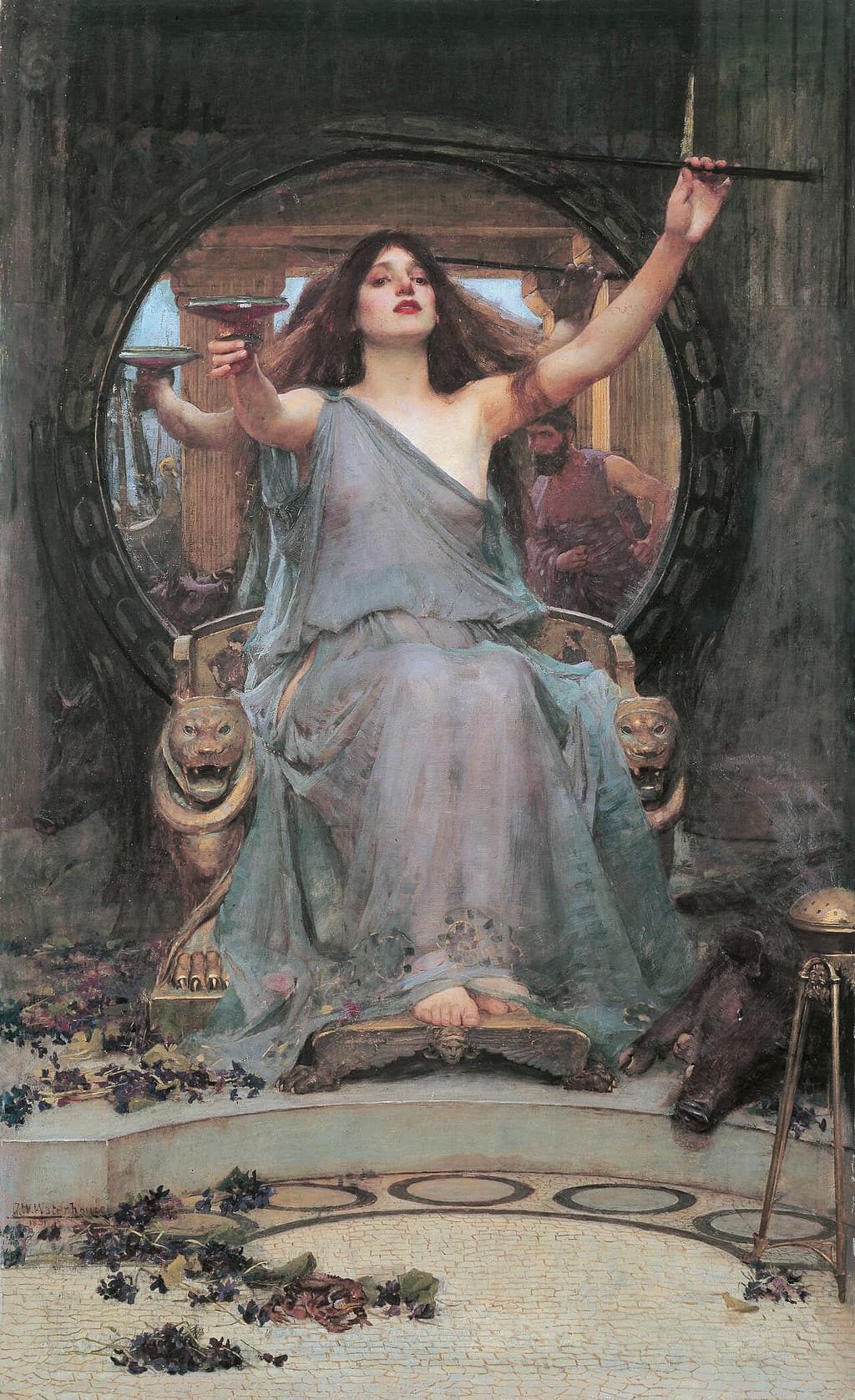
Homer describes her working method with more technical precision than any other magic in either poem. She mixes cheese, barley meal and yellow honey into Pramnian wine, adds pharmaka — drugs — and gives it to the men in a cup; when they have drunk she strikes them with a wand and drives them into the sties. The remedy is equally specific: Hermes gives Odysseus a plant with a black root and a milk-white flower, which the gods call moly and which is dangerous for mortals to dig up.
That is the first magic in Western literature, and it is pharmacology. Botanists have spent centuries guessing at moly — snowdrop, with its galantamine content that counteracts certain anticholinergic poisons, is the most-cited modern candidate, and the pairing of a plant poison producing delirium with a plant antidote is at least chemically coherent. Whether Homer knew anything of the kind is unknowable. What is clear is that his witch works with substances, not with will.
The pigs, and what happens next
The episode in Odyssey 10 is much stranger than its reputation. The men keep their minds: Homer says they had the heads, voices, bristles and bodies of swine, but their minds were as before, and they wept. The transformation is a trap of consciousness, not a demotion.
Then, once Odysseus resists and threatens her with his sword and she swears the oath he demands, the tone changes completely. She restores the crew — anointing each with another drug, and Homer notes they became younger and handsomer than before — and the Greeks stay with her for a full year, feasting. It is Odysseus' own men who eventually remind him to leave. She is not defeated and expelled; she becomes the host, and then the adviser.
And the advice is what actually saves him. She tells him he must go to the underworld first and how to do it; she tells him about the Sirens and about the mast; she tells him that Scylla will certainly take six men and that fighting back will cost him six more; she warns about the cattle of the Sun. Every survival strategy in the second half of the wanderings is hers. The witch is the navigator.
Family: the sorcerers of the sun
Her father is Helios and her mother the Oceanid Perse. Her brother is Aeetes, king of Colchis and keeper of the fleece; her sister is Pasiphaë, wife of Minos and mother of the Minotaur; her niece is Medea, whom Apollonius has her purify for the killing of Apsyrtus in a scene of considerable unease — Circe performs the rite because kin-blood requires it, and then tells her she wants nothing further to do with her.
That family is the mythology's concentration of dangerous knowledge, and it descends from the god who sees everything.
Ovid's Circe, who is worse
The Roman treatment makes her vindictive rather than formidable. In Metamorphoses 14 she turns Picus, an Italian king who refuses her, into a woodpecker; she poisons the pool where Scylla bathes out of jealousy over Glaucus, turning the girl into the barking monster of the strait; she deals with Odysseus' men as before but at greater length. Ovid also gives her a son by Odysseus, Telegonus, who in the lost epic Telegony eventually kills his father with a stingray-tipped spear without recognising him. Hesiod already names sons of Circe and Odysseus and connects them to the Etruscans.
She was located, in Roman geography, at Monte Circeo on the Latian coast — a headland that looks like an island from the sea, which is a fair match for Homer's Aeaea and which the Romans identified with total confidence.
What she was for
The episode has been read as an allegory since antiquity: appetite turning men into beasts, with moly as reason or self-control. That is how the Stoics and the Neoplatonists took it, how Boethius took it, and how it entered the medieval and Renaissance moral tradition — Circe as the standard figure of sensual temptation, in Spenser's Acrasia, in Milton's Comus, whose mother she is said to be.
The counter-reading, also ancient, is Plutarch's dialogue Gryllus, in which one of the transformed men is given the chance to be restored and argues, at length and rather well, that pigs are better off. It is the earliest surviving argument in European literature that animals have the better life.
Miller's Circe, and the modern rehabilitation
Madeline Miller's novel Circe (2018) narrates her whole existence in the first person — the childhood in Helios' halls, the discovery that she can work with herbs, the exile to Aeaea, the visitors, the men who arrive and what some of them do, Telemachus, motherhood — and it changed her standing more thoroughly and more quickly than any modern retelling has changed any classical figure. Book clubs, bestseller lists and a large secondary literature followed.
The novel's most-noticed move is to supply a reason for the pigs that Homer does not give: crews who arrive on an island where a woman lives alone. That is not in the Odyssey. It is a modern interpretation, and a coherent one, and it is now the version many readers have first. Distinguishing it from Homer is exactly the kind of dating that makes the difference between knowing a myth and knowing a novel.
Before that, she had a long career as an opera character, as the subject of Waterhouse's much-reproduced paintings, and as Eudora Welty's and Margaret Atwood's narrator in shorter pieces — Atwood's "Circe/Mud Poems" preceded Miller by four decades in giving her a voice and a grievance.
Goddess or witch, and why the transformation is into pigs
Is she a goddess or a witch?
Homer calls her a goddess — dia thea, and "dread goddess with a human voice", a formula he also uses of Calypso. She is immortal, divine-born and lives alone; the "witch" label is a later categorisation applied because of what she does rather than what she is. Greek had no clean word for witch in the later European sense, and pharmakis, drug-woman, is the closest available term.
Why pigs specifically?
No source explains it, and other victims in her repertoire become lions and wolves, which prowl tamely around her house — Homer says they fawned like dogs, which is one of the more unsettling images in the poem. Pigs were the ordinary Greek sacrificial and food animal, so turning men into pigs makes them into the category of things that get eaten. Plutarch's dialogue takes the choice as an invitation to think about what separates the categories at all.
What is Aeaea, and where did Odysseus go from there?
An island in the far east according to the Odyssey's internal geography — Homer says it is where the dawn has her dwelling and the sun rises — which is hard to reconcile with anything else in the voyage and with the Roman identification on the west coast of Italy. From it he sails to the edge of Ocean for the underworld consultation, then returns to Aeaea to bury Elpenor, who fell off the roof drunk, before continuing. That return leg is one of the poem's odder structural features.
Does she appear before Homer?
There is no earlier text. Her name may be connected to kirkos, a hawk, which would fit a family of shape-related names and has been noticed since antiquity. Comparisons have been drawn with Near Eastern figures — the goddess who detains a hero, the mistress of animals — but the Odyssey is where she starts for us, and everything else in the tradition builds outward from that one book.