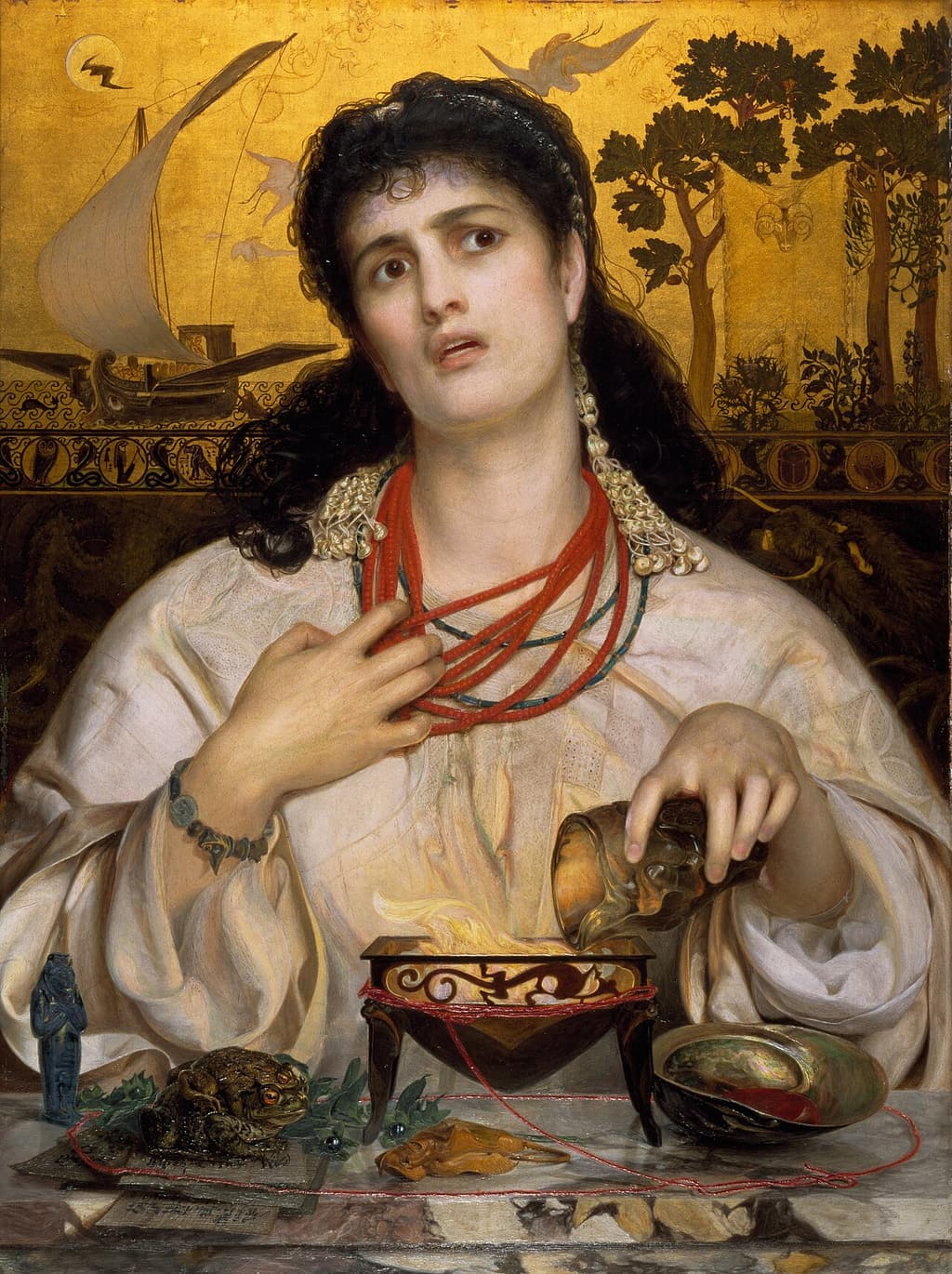
Ancient Corinth had a different story, and it accused Euripides of taking a bribe.
The local Corinthian tradition, reported in the scholia to Euripides and by other late sources, held that Medea's children were killed by the Corinthians — stoned in the sanctuary of Hera Akraia, where they had taken refuge — and that the city was afflicted with a plague of infant deaths afterwards, expiated by an annual rite in which seven boys and seven girls in black, with shorn hair, served the goddess for a year. That rite is independently attested. The accusation is that the Corinthians paid Euripides five talents to put the killing onto the mother instead, and that his version stuck.
Whether the bribe happened is unknowable and probably invented. What the story tells us is that ancient audiences knew the child-killing was contested, and suspected a specific author of introducing it. If Euripides did invent it in 431 BCE, he created in one play the most disturbing figure in Greek tragedy and permanently overwrote a rival tradition.
Before the tragedy: the competent one
Everything in the Argonaut voyage that succeeds is hers. Apollonius' Argonautica devotes its third book to her falling in love, in a long and psychologically precise account of a young woman arguing with herself at night, and then to what she does about it: she gives Jason the drug that makes him fireproof for the bulls, tells him to throw a stone among the earth-born men so they kill each other, drugs the sleepless serpent, and later destroys the bronze giant Talos with incantation from the deck of a passing ship.
She is a priestess of Hecate and a granddaughter of Helios, and her expertise is described in technical rather than supernatural terms — which herb, cut with which implement, at what hour, with what preparation. Her name comes from a root meaning to plan or contrive, the same as in Medea's cousin-word mēdomai; it is the female counterpart of the mētis that makes Odysseus admirable.
The flight home includes the killing of her brother Apsyrtus, in two irreconcilable versions: dismembered and scattered piece by piece to delay the pursuing fleet, in the older and more brutal telling, or ambushed by Jason at a rendezvous she arranges, in Apollonius'. She has burned every bridge before she reaches Greece.
Iolcus, and the boiling
At Iolcus she takes revenge on Pelias for Jason. The method is a demonstration: she cuts up an old ram, boils it with herbs, and a lamb jumps out of the cauldron. Pelias' daughters, convinced, cut up their father — and she leaves out the herb. Ovid gives the fullest account and lingers on the moment the daughters turn their faces away while striking.
This is the episode that makes her a witch in the popular sense, and the cauldron follows her through European art and into every subsequent witch iconography. It also gets her and Jason expelled from Iolcus, which is how they come to be exiles in Corinth, dependent on a king's goodwill — the precise situation Euripides' play begins from.
What Euripides actually wrote
The Medea of 431 BCE opens with a nurse describing a woman lying in the house refusing food. The plot is simple: Jason has married the king's daughter; Creon orders Medea into exile; she asks for one day; she uses it.
The play's real force is in the arguments. Her first speech to the chorus of Corinthian women is one of the most quoted passages in Greek drama — that of all creatures that have life and reason, women are the most wretched, that they must buy a husband with a dowry and take a master for their body, and that she would rather stand three times in the battle line than give birth once. Then, in the same speech, she reminds them she is also a foreigner with no city to return to.
Jason's defence is worse than an insult because it is sincere: she should be grateful for the civilising benefit of Greece, Aphrodite rather than Medea deserves credit for saving him, and the new marriage is a rational provision for the family. Euripides gives him plausible sentences and lets the audience watch them curdle.
The killing is preceded by a monologue in which she changes her mind four times, addressing her children directly, and the play stages the deaths offstage with the boys' voices audible through the door. Then she appears above the roof in a chariot drawn by dragons, sent by her grandfather the Sun, with the bodies, and Jason cannot even touch them for burial. The escape mechanism is the point: the play refuses to punish her, and gives her the machinery of a god.
Athens afterwards, and the historical residue
She goes to Athens, where Aegeus has promised her sanctuary — a scene planted earlier in the play — and marries him, and later attempts to poison Theseus when he arrives unrecognised. Driven out again, she is said to have returned east, and Herodotus reports the tradition that the Medes took their name from her. That is a Greek etymological guess of the standard kind, and it shows how the figure was used to explain the map: the foreign sorceress becomes the ancestress of a foreign empire.
Two thousand years of arguing about her
Seneca's Latin Medea makes her a monster from the first line and gives her the horrifying claim Medea nunc sum — "now I am Medea" — the self at last matching the name. Ovid wrote a lost tragedy that ancient critics rated his best work, and gives her a long letter in the Heroides and a long sequence in Metamorphoses 7.
Modern reception is enormous and has divided sharply. She has been read as a study in the psychology of the abandoned wife; as a tragedy of the immigrant and the refugee, which the text supports directly; as an argument about the status of women in a society where a wife could be discarded without recourse; and, less persuasively, as a straightforward monster. Cherríe Moraga's The Hungry Woman sets her in a future Chicano context; Christa Wolf's novel restores the Corinthian version in which she is framed; Toni Morrison's Beloved, though not a retelling, has been discussed alongside it for the same reason — a mother who kills a child to prevent a fate she considers worse.
Maria Callas played her in Pasolini's 1969 film. The play is one of the two or three most performed Greek tragedies in the world.
Her divinity, her pharmaka, and the children’s cult at Corinth
Is she a goddess or a mortal?
Ambiguous, and deliberately so. She is a granddaughter of Helios, a niece of Circe, and in some traditions she becomes immortal and marries Achilles in the Elysian Fields. Hesiod lists her among goddesses in the Theogony's catalogue. But she is also a woman who can be exiled, and Euripides plays the ambiguity hard: the dragon chariot at the end is the arrival of the divine half of her, produced at the moment the human half has done something unforgivable.
What does she use in her spells?
Named plants and a described procedure, unusually for Greek literature. The "Prometheian" herb of the Argonautica springs from the ichor dripped by the tortured Titan, is cut at night after bathing in seven streams and calling on Hecate seven times, and the earth groans as the root is pulled. Ovid's Latin version adds an extensive catalogue of ingredients and a nine-day journey by dragon chariot collecting them. This is the closest ancient poetry comes to depicting an actual working procedure.
Was there a cult of her children?
Yes, and it is one of the better-evidenced ritual anchors of a myth. Pausanias saw the monument at Corinth to the children — he calls them Mermerus and Pheres — and describes the annual rite performed by fourteen Corinthian children in black. Whatever the myth's original form, a real Corinthian city was really performing an expiation for dead children, and the two versions of who killed them are alternative explanations of the same rite.
Where is Colchis?
The eastern shore of the Black Sea, in what is now western Georgia — a real region with a real Bronze and Iron Age metalworking culture, and a plausible destination for early Greek voyages after gold and metals. Greek colonies were established there from the sixth century BCE. Modern Georgia claims the Argonaut connection enthusiastically, and the association of the region with gold is supported by the ancient reports of fleeces used to trap alluvial grains in mountain streams.