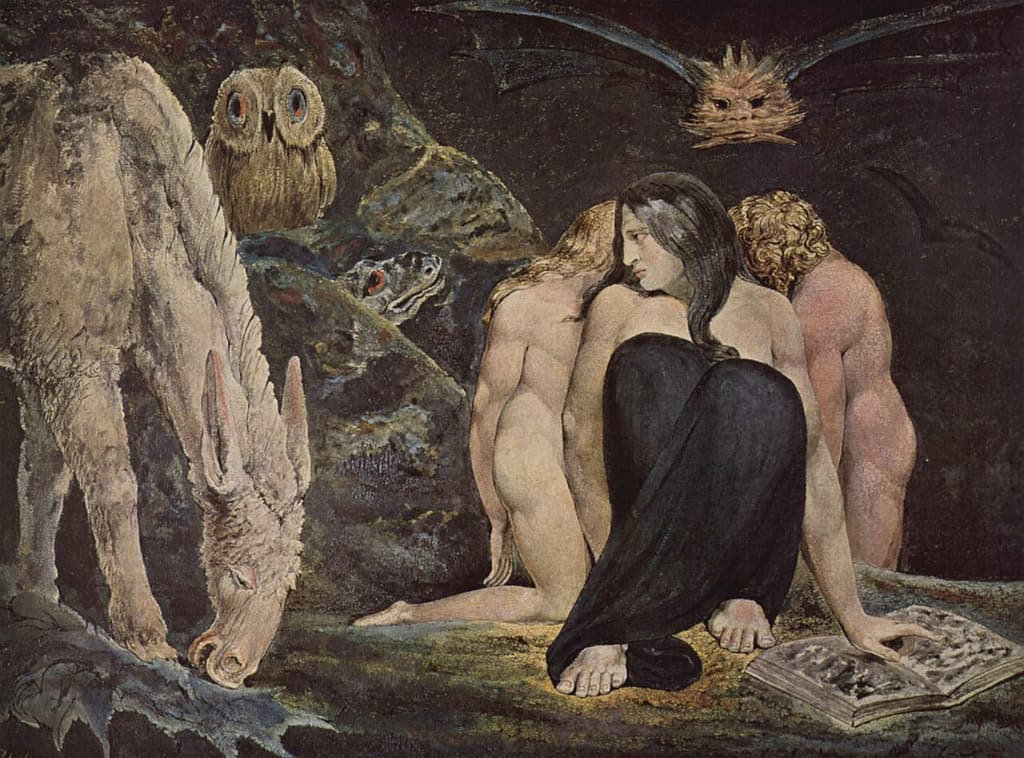
Hesiod interrupts the Theogony — a poem that mostly lists — to deliver a long, warm, oddly personal hymn to a goddess who has no part in its plot. Hecate, daughter of the Titans Perses and Asteria, is honoured by Zeus above all others; she keeps her ancient privileges after the Titan war; she has a share of earth, sea and sky; she stands beside kings in judgement and beside soldiers in battle, gives victory to athletes and horsemen, increases the catch of fishermen and the herds of cattle, and nurses the young. Nobody has ever satisfactorily explained why this passage is there. Proposals range from Hesiod having a personal or family devotion to her, to a Boeotian local cult, to an interpolation. Whatever the cause, it is the single most generous portrait of any deity in early Greek poetry, and it belongs to the goddess whom later centuries would make the patron of witches.
Watching the distance between those two Hecates is the point of reading her at all.
Where she came from
Her cult centre is not in mainland Greece. The great sanctuary is at Lagina in Caria, in southwestern Asia Minor, where an enormous Hellenistic temple stood with a frieze showing the birth of Zeus and the gathering of the gods, and where a procession carried a sacred key along a road connecting the sanctuary to the city of Stratonikeia. Eunuch priests served there and a festival of the key, the Kleidos Agoge, is attested by inscription. Carian personal names built on Hekat- are common. The likeliest account is that she is an Anatolian goddess taken into Greek religion early enough to be treated by Hesiod as fully Greek, which also explains why her genealogy attaches to the Titan generation rather than to Olympus.
Her name has been connected to hekas, "far off", and read as a feminine of an epithet of Apollo, Hekatos, "the far-shooter" — attractive, and not secure.
The torch-bearer of the Demeter hymn
Her earliest narrative role is small and decisive. In the Homeric Hymn to Demeter she is in her cave and hears Persephone's cry but does not see the abduction; she comes to Demeter on the tenth morning carrying a light, and the two goddesses go together to Helios, who did see. At the end of the hymn she embraces the returned Persephone and becomes her attendant and forerunner.
That is where the torches come from, and where her underworld connection begins — not as a queen of the dead but as the one who goes down with the light and comes back. Everything later attributed to her follows from combining that with her crossroads function.
Trioditis: the crossroads, the suppers and the dogs
Greek practice knew her chiefly as a goddess of doorways and of the point where three roads meet. Hekataia — small triple images — stood outside Athenian houses, and she was Propylaia, "before the gate", with a shrine at the entrance to the Acropolis by Alkamenes, which Pausanias records as the first sculptor's three-bodied Hecate.
At the new moon, households put out Hekate's suppers at the crossroads: fish, eggs, cakes, and the sweepings from the house purification. Aristophanes jokes that the poor ate them. The practice is a disposal rite as much as an offering — the pollution goes out to the boundary, where the goddess of boundaries takes it. Her animal is the dog, and puppies were sacrificed to her, an unusual and non-edible offering shared with a small set of chthonic and purificatory deities. Barking dogs are her sign of approach.
She is also Kleidouchos, key-holder, and the key is one of her most stable attributes across a thousand years and two continents — from the Carian procession to the magical papyri.
Medea, the Argonautica, and the turn towards magic
The literary shift is visible and datable. Sophocles and Euripides begin to associate her with drugs and night-work; Medea in Euripides swears by Hecate as the goddess she reveres most, keeping her at her own hearth. Apollonius' Argonautica takes it further: Jason is instructed to sacrifice to her alone at midnight in a pit, bathed, in dark robes, honey without wine, and to walk away without looking back when the hounds bay. Theocritus' second Idyll has a woman working a love-binding by moonlight and calling on her.
By the imperial period the transformation is complete. The Greek Magical Papyri — actual working spellbooks from Roman Egypt — invoke her constantly, fused with Selene, Artemis, Ereshkigal and others, in long strings of divine names, and the Chaldean Oracles of the second century CE make her a cosmic soul mediating between the intelligible and material worlds, an interpretation the Neoplatonists took very seriously. Curse tablets from graves and wells name her. She has moved from Hesiod's universal benefactor to the specialist power you address at night when you want something done that the city would not approve of.
Nothing was subtracted along the way. The same goddess who receives a curse tablet is still standing outside the door as Propylaia, protecting the house.
Why three bodies?
The triple form appears from the late fifth century BCE, credited to Alkamenes' Acropolis statue, and the standard explanation is functional: at a three-way crossroads, an image facing all three roads at once needs three bodies. Later theology built on it — the widely repeated triad of Luna in heaven, Diana on earth and Hecate below is a Roman and post-classical systematisation, given its most influential form by Renaissance mythographers rather than by any Greek text. Her three animal heads in some late descriptions (dog, horse, serpent, lion, and bull in varying combinations) come from the magical material, not from classical cult.
Shakespeare, the Romantics, and modern witchcraft
Two lines of transmission carried her to the present. The first is Roman poetry: Ovid's Medea and Seneca's, Lucan's ghastly Thessalian witch Erictho in the Pharsalia, Horace's Canidia. Through them Hecate reached medieval and early modern Europe as the archetype of the witch-goddess. Macbeth puts her onstage to scold the weird sisters — the scene is usually thought to be a later addition by Middleton, and Shakespeare's own use elsewhere ("pale Hecate's offerings") is more atmospheric.
The second is modern. No Greek deity has been adopted as thoroughly by contemporary pagan and witchcraft movements. Wicca's development in the mid-twentieth century, Robert Graves' The White Goddess and the triple-goddess framework it popularised, and a large devotional literature since have made her a central figure in living practice — usually as maiden-mother-crone, a scheme with no ancient basis, and usually with the emphasis on autonomy, the underworld and the moon. Her Roman-era identification with Selene made the lunar association possible; Hesiod's Hecate has nothing to do with the moon.
She also runs through modern fiction with unusual persistence, from the Percy Jackson books to television series where she is the patron of a coven, and through games where she is a straightforwardly magical deity. That version is genuinely descended from an ancient one — just from the imperial magical papyri rather than from anything an archaic Greek would recognise.
Her rank, her overlap with Artemis, and the curse tablets
Was she actually an Olympian?
No, and the question misstates how Greek religion worked. She is of Titan descent in Hesiod, is not among the canonical twelve, and has no seat on Olympus — but the twelve were a limited iconographic and civic convention, not a hierarchy of importance. Hecate had shrines at doorways in a city where several of the twelve did not, which is a better measure of significance than the list.
What is her connection to Artemis?
They converge rather than begin as one. Both are associated with wild places, torches, dogs and the protection of the young; both were eventually identified with the moon. Attic cult keeps them distinct — Artemis has the great sanctuaries at Brauron and Mounichia, Hecate has the doorway shrines and the crossroads suppers. From the Hellenistic period onward the boundaries blur, and by the magical papyri they are frequently one composite goddess along with Selene.
Are the curse tablets real archaeology?
They are, in quantity: several thousand defixiones survive, mostly thin lead sheets rolled or pierced with nails and deposited in graves, wells and sanctuaries, from the fifth century BCE into late antiquity. They concern lawsuits, business rivals, athletic competitions and love. Hecate is one of several powers invoked, alongside Hermes Chthonios, Persephone and Ge. They are the best evidence we have for what ordinary Greeks actually did about their enemies.
Where does the key symbolism come from?
From the Carian sanctuary, where the annual procession of the key between Lagina and Stratonikeia is documented by inscription, and from her role as gatekeeper — the deity at the threshold naturally holds what opens it. The magical material extends the idea to the gates of the underworld and eventually to the boundaries of the cosmos, but the origin appears to be a real ritual object carried down a real sacred road in Asia Minor.