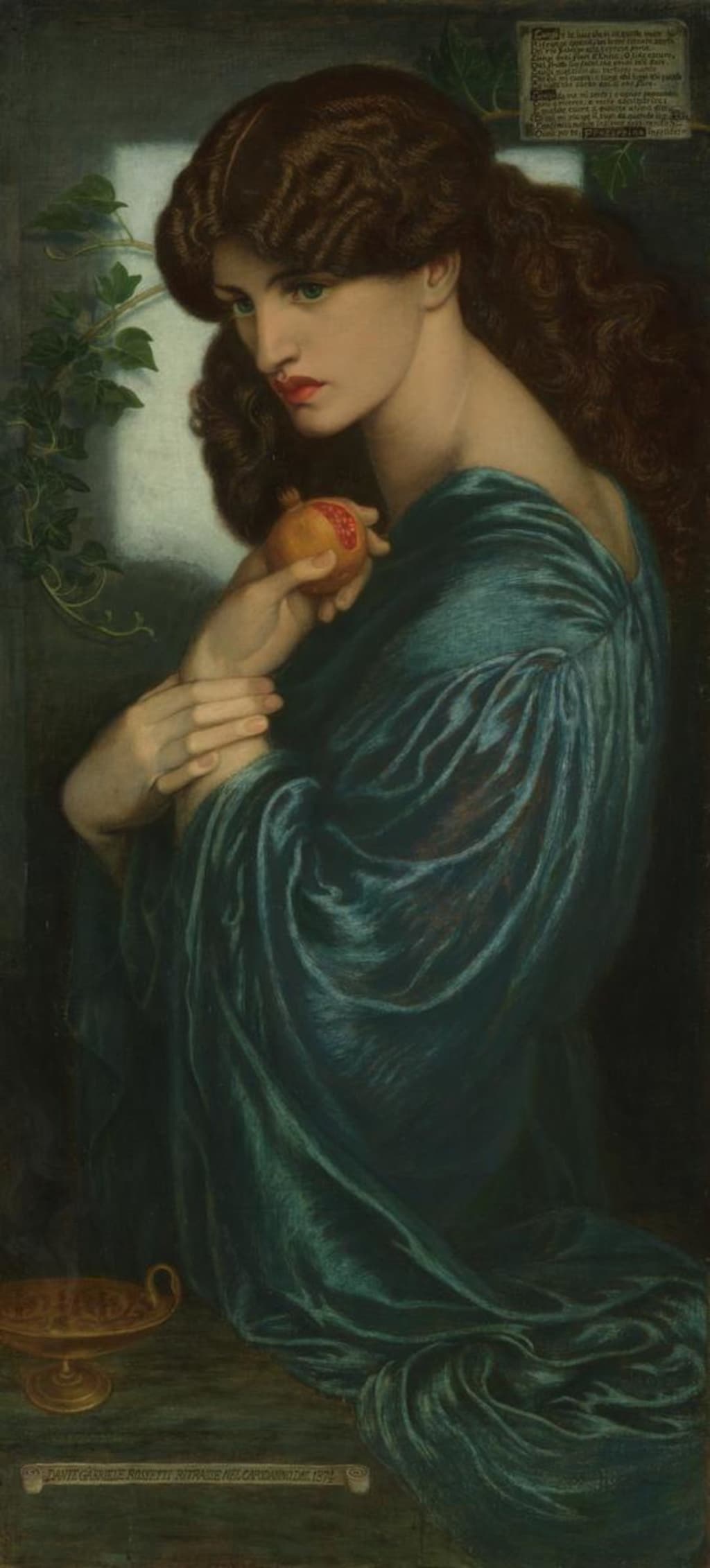
She has two names and they are not synonyms. Kore simply means "the girl" — an unmarried daughter, a maiden, and in Greek usage often the pupil of the eye. Persephone is a name of unknown meaning that Greeks themselves seem to have found uncomfortable; the Odyssey pairs it repeatedly with epaine, "dread", and Plato in the Cratylus records people being frightened of the name. The forms it takes across dialects — Persephatta, Phersephassa, Pherrephatta — vary far more than a Greek word normally does, which is usually a sign that a name has been borrowed from something pre-Greek and reshaped by folk etymology. In Athenian usage the same goddess is the girl in her mother's meadow and the queen who sends the Gorgon's head after intruders. Being both is the whole of her.
The abduction, and who agreed to it
The Homeric Hymn to Demeter is the earliest full account and it is precise about responsibility. Zeus gives her to his brother without consulting her mother. Earth grows a narcissus of a hundred blossoms as a snare; when she reaches for it the ground splits and Hades drives up in his golden chariot. She screams; only Hecate in her cave and Helios in the sky hear it.
The Sicilian setting everyone knows — the plain of Enna, the pool of Cyane — is not in the hymn. It comes from later Greek Sicilian tradition and reaches modern readers through Ovid's twin retellings in Metamorphoses 5 and Fasti 4. Cicero, prosecuting Verres, treats Enna as the site as an established fact. The hymn is vaguer: a plain of Nysa. Different places claimed the chasm, as different places claimed everything.
The return is negotiated only after Demeter's strike starves the sacrifices out of existence. Hermes fetches her; Hades, courteous throughout the hymn, promises her honours and lets her go — having first given her something to eat.
How many seeds, and how the year divides
This is a real disagreement, not a rounding error, and the number determines the shape of the year.
- The Homeric Hymn says Hades gave her a honey-sweet pomegranate seed to eat, in the singular, secretly, so that she would not remain above with Demeter for all time. The hymn then has her spend a third of the year below and two thirds above.
- Ovid's Metamorphoses has her pick and eat seven seeds from a pomegranate in the underworld garden, observed by Ascalaphus, who is turned into a screech-owl for reporting it. Ovid splits the year in half.
- Apollodorus reports a pomegranate seed given by Hades to prevent a long stay with her mother, and a division into thirds.
- Later mythographers and much modern retelling settle on three or six, matching a tidy season count.
The half-year division that most people carry in their heads is Roman. The third that the primary Greek text gives is harder to map onto seasons, and the honest reading of the hymn is that her absence is not the winter at all — in a Mediterranean climate the dead season is the burning summer, when the grain is already in the ground jar. The seasonal allegory is a later and largely northern European tidying.
Locri, and the queen who is not a victim
At Locri Epizephyrii in southern Italy, thousands of terracotta plaques — the pinakes, produced roughly 490–450 BCE — were dedicated in her sanctuary, and they show something the literary sources barely prepare you for. She appears enthroned beside Hades, receiving offerings; women bring cloth, mirrors, cockerels; there are scenes of wedding preparation, of a chest being opened, of a girl gathering fruit. Whatever the abduction meant in Athenian poetry, Locrian women approached her as a goddess presiding over marriage, adulthood and the transition into a woman's life, and they did so in enormous numbers.
That is a corrective worth holding. The story of a girl seized and taken to another man's house, mourned by her mother, and returning only for part of the year, is not merely a nature allegory: it is a fairly literal description of exogamous Greek marriage, in which a girl left her mother's household at around fourteen for a husband she had not chosen. The rite at Locri treats the myth as instruction rather than as tragedy.
The dread queen of the underworld
In Homer she is never a captive. The Odyssey's underworld is hers to administer: she sends up the shades for Odysseus to interview and calls them away again, and Odysseus retreats in fear that she will send the Gorgon's head against him. She is the one who grants Tiresias his mind intact after death. In the Iliad, Althaea beats the ground and calls on Hades and epaine Persephone to kill her own son.
She is also the one figure of the underworld who can be moved. Orpheus wins his hearing from her — in Ovid's telling she and her husband weep, and it is she who is described as unable to refuse. In the Homeric Hymn she rules; in the katabasis stories she pardons. Heracles takes Cerberus with her permission in Apollodorus, and she blocks the release of Pirithous, who came to abduct her.
Her few personal myths are jealous ones: she and Aphrodite quarrel over Adonis until Zeus divides his year between them, a story with the same structure as her own; and she turns the nymph Minthe into the mint plant and Leuce into the white poplar, both of them Hades' interests. These are late and thin, and it is notable how few stories she has as an agent — she is a goddess of enormous cultic weight and small narrative footprint.
The Mysteries, and the Orphic afterlife
At Eleusis she is one half of "the Two Goddesses", and the reunion of mother and daughter is generally taken to be at or near the centre of the rite. What initiates were promised is stated in the hymn itself: a better portion after death. That promise is her real business.
Orphic and Bacchic mystery cult goes further. The gold leaves buried with initiates in Thurii, Hipponion, Pelinna and Crete — small inscribed sheets giving the soul its instructions — repeatedly address her. One tells the dead to say to the queen of the underworld that Bacchus himself released them; another has the soul declare that it has paid the penalty for unrighteous deeds and claim to be of the same race as the gods. In the Orphic system she is also the mother of Dionysus as Zagreus, which places her at the origin of humanity itself.
Proserpina and the long European afterlife
The Roman Proserpina absorbed her wholly, her name probably reshaped by association with proserpere, "to creep forth", as of a shoot. Claudian's unfinished De raptu Proserpinae around 400 CE gave the Middle Ages its version. Bernini's Rape of Proserpina, carved when he was in his early twenties, is the most famous single image — the marble fingers pressing into marble thigh — and it fixed the violence of the moment in European art.
Milton reached for her in Paradise Lost to describe Eden, and the comparison of Eve to "Proserpin gathering flowers" is one of the poem's most quoted turns. Tennyson, Swinburne, H.D., Rilke, Louise Glück's Averno and Rita Dove's Mother Love have each rewritten her.
The modern romance, and what it replaces
Since roughly the 2010s, "Hades and Persephone" has become a publishing category of its own: a genre of romance in which the abduction is reframed as escape from a controlling mother, and the underworld as a place where a woman finally has power. It is a legitimate reading of a real strand — the Locrian queen, the Homeric administrator, the goddess who is not depicted as suffering once she is enthroned — and it is not what the Homeric Hymn to Demeter says. The hymn uses the vocabulary of seizure, has her scream, and has her tell her mother on return that Hades gave her the seed by force, though the hymn's own earlier narration says he did it secretly.
Both the romance and the trauma reading are selecting. The honest position is that the Greek material contains a violent abduction, a courteous captor, a genuinely powerful queen and a cult in which women celebrated all of it, and that no single modern frame accommodates the set.
The pomegranate, Agrai, and a goddess she is not
Was the pomegranate significant before this story?
It carries strong marriage and fertility associations in Greek practice — brides ate pomegranate seeds, and Hera's cult statue at Argos held one, which Pausanias explicitly declines to explain because the story is a secret. Its many seeds in a sealed red case make it a natural fertility emblem, and its association with the dead is attested elsewhere in the eastern Mediterranean. Eating in the underworld is the binding act; the fruit chosen is the one already loaded with marriage meaning.
Did she and Demeter have separate cults?
Frequently. In Sicily and southern Italy she often outranks her mother, and at Locri she is worshipped effectively alone. Elsewhere they are the inseparable "Two Goddesses" or "the Mother and the Maid", invoked as a pair in oaths — the Athenian women's oath "by the Two" refers to them. The Thesmophoria belonged principally to Demeter, the mystery cult of Eleusis to both.
What are the Lesser Mysteries at Agrai for?
They were a spring preliminary, held at Agrai on the Ilissos, and were understood as a purification qualifying a candidate for the Greater Mysteries in autumn. Later sources connect them specifically with Persephone, where the autumn rite is more associated with Demeter — a seasonal division that mirrors the myth's own division of her year, though the ancient evidence for the association is thin.
Is Melinoe the same as her?
No. Melinoe is a figure known almost entirely from a single Orphic hymn, described as a saffron-cloaked bringer of nightmares born to Persephone at the mouth of the Kokytos. She appears in modern games and fiction far out of proportion to her ancient footprint, which consists of that hymn and a Pergamon curse tablet. Treating her as a well-attested daughter of Persephone overstates the evidence considerably.