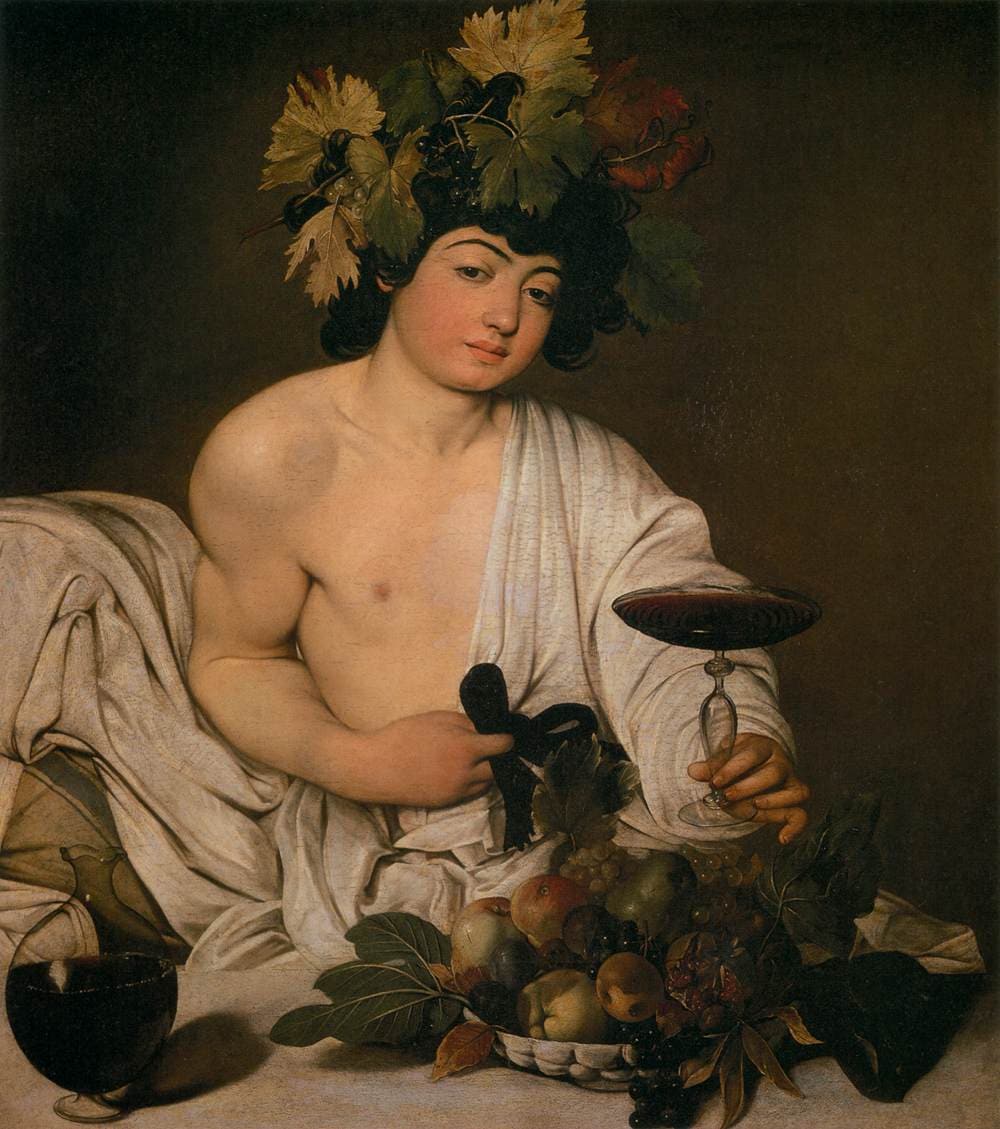
Euripides wrote the Bacchae at the end of his life, in Macedonia, and it is the most frightening thing in Greek theatre. A young god arrives at Thebes in the form of a smiling foreign holy man. The king, Pentheus, refuses to acknowledge him, calls him a fraud, and tries to imprison him. The god destroys him — not with a thunderbolt, but by persuading him, gently, in a scene of terrible calm, to dress as a woman and go up the mountain to spy on the rites. There Pentheus is torn apart by the maenads, and his own mother Agave carries his head down to the city in triumph, believing it to be a lion's, and does not understand what she is holding until her father walks her through it piece by piece. The god appears at the end and shows no remorse whatever.
That play is the correct starting point for Dionysus, because everything softer about him — the vine, the wine cup, the party — is contained in it and is not contradicted by it. He is the god of release, and release includes the release of everything a person is holding down.
He was not a foreigner, whatever the myths say
The stories insist he came from outside: from Thrace, from Phrygia, from India, arriving at Greek cities and demanding recognition. Herodotus thought he was recently imported from Egypt. The pattern is so consistent that nineteenth-century scholars treated him as a late arrival who muscled into a settled pantheon.
The Linear B tablets ended that. di-wo-nu-so-jo appears on tablets from Pylos and Khania, in contexts including wine, which places him in Greece in the thirteenth century BCE — as old as any Olympian. The "foreign god" is a native god whose myths are about resistance to him. That reframing is one of the genuinely settled results of twentieth-century scholarship, and it changes the meaning of every arrival story: they are not about immigration but about a community's refusal to admit something that is already inside it.
Twice-born, and the disputed second birth
Semele, daughter of Cadmus of Thebes, is pregnant by Zeus when Hera, disguised as her old nurse, plants the suggestion that she should ask her lover to appear as he does to his wife. Zeus has sworn to grant anything and cannot refuse; the lightning burns her. He takes the unborn child and sews it into his own thigh, from which it is born at term. Hence Dithyrambos, "twice-born", and hence the god's peculiar standing: mortal mother, divine father, incinerated origin. He later descends to the underworld to bring Semele up and make her a goddess, one of the very few successful retrievals in Greek myth.
The Orphic tradition tells a different and far stranger story that the Theban material knows nothing about. Zeus fathers Zagreus on Persephone; the Titans distract the child with toys, a mirror among them, tear him apart and eat him; Athena saves the heart; Zeus destroys the Titans with the thunderbolt and from their soot humanity is formed, carrying both Titanic guilt and a Dionysiac spark. The god is then reborn from Semele. This is the theological core of Orphism and of a real ancient doctrine about the soul, and it is not a variant of the Theban birth so much as a rival religion using the same name. Modern scholarship disputes how early the anthropogony from Titan soot can be traced; the dismemberment itself is attested well before the fully elaborated version in Nonnus.
What the maenads actually did
The women who followed him — maenads, "the mad ones", or bacchants — appear in art with fawnskins, ivy crowns and the thyrsus, a fennel stalk topped with a pine cone. The rites in the sources involve mountain dancing at night in winter (oreibasia), the tearing apart of a live animal (sparagmos) and eating it raw (omophagia). Inscriptional evidence from cities including Miletus shows organised, regulated women's thiasoi with official priestesses, and Plutarch tells the story of the Thyiads of Delphi being caught in a snowstorm at Amphissa and protected by the women of that town — a report about a real practice, not a myth.
How far the literary extremes reflect actual behaviour is one of the live arguments in the study of Greek religion. What is not in doubt is that the cult gave women a licensed, city-sanctioned period outside the household, on a mountain, at night, and that this was regarded as normal.
The theatre is his building
Tragedy and comedy were performed at his festivals and nowhere else. The City Dionysia at Athens, in late March, was a state occasion: the god's ancient wooden image was carried in from Eleutherai, tribute was displayed in the theatre, and three tragedians competed with three tragedies and a satyr play each. The Lenaia in midwinter favoured comedy. The Anthesteria, older than either, ran three days in February — the opening of the new wine jars, a drinking contest in silence from separate cups, the ceremonial marriage of the god to the wife of the archon basileus in a building called the Boukoleion, and a final day for the dead, when the doors were smeared with pitch and the ghosts were told at nightfall to leave.
Every surviving Greek tragedy was written for his festival. Whatever tragedy is about, it happened in his precinct, and Nietzsche's The Birth of Tragedy — which set the Dionysian against the Apollonian and made the opposition famous — was arguing about a real institutional fact even where its history was shaky. Delphi itself gave the three winter months to Dionysus while Apollo was among the Hyperboreans, and his tomb was said to be in the temple there.
The other stories
- The pirates. In Homeric Hymn 7, Tyrrhenian sailors seize a beautiful youth on the shore, and the ropes will not hold him. Wine begins to flow through the ship, a vine climbs the mast, ivy wreathes the sail, a bear appears amidships and the god becomes a lion. The crew leap overboard and become dolphins; only the helmsman, who had recognised him, is spared. Exekias painted the scene on a drinking cup around 530 BCE and it is one of the masterpieces of Greek vase painting.
- Ariadne. Abandoned by Theseus on Naxos, she is found and married by Dionysus; her bridal crown becomes the constellation Corona Borealis. He is the only Olympian in a stable, celebrated marriage to a mortal, which sits oddly with everything else about him.
- Midas, who rescues the god's tutor Silenus and asks for the golden touch, then begs to have it taken back. Ovid tells it in Metamorphoses 11 and everyone since has borrowed it.
- Lycurgus of Thrace, who drove the god's nurses with an ox-goad and was blinded and destroyed — a resistance story mentioned as far back as Iliad 6, which shows the pattern is old.
Bacchus and the Roman crackdown
The Roman Bacchus carried the Greek god's rites into Italy, and in 186 BCE the Senate suppressed them in one of the most striking pieces of Roman religious policing on record. Livy gives a lurid account of secret nocturnal initiations, conspiracy and murder; the Senate's actual decree, the Senatus consultum de Bacchanalibus, survives inscribed on a bronze tablet found in Calabria in 1640. It does not ban the cult outright but places it under state licence, limits gatherings to five people, and forbids men to hold priesthoods in it. Thousands were reportedly executed. Whatever the truth of Livy's allegations, the episode shows a state recognising an uncontrolled association as a political threat.
Later Roman Bacchus becomes gentler and richer: the Villa of the Mysteries at Pompeii with its enormous initiation frieze, sarcophagi showing the triumphant return from India, and the mosaics that carried his imagery into late antiquity.
The defanged god, and the Bacchae that keeps refusing to be
He is everywhere and consistently defanged: the god of partying, of festivals named after him, of wine branding, of the amiable hedonist in fiction. Where the harder god survives it is through the Bacchae, which has become one of the most staged Greek plays of the last fifty years, repeatedly used to think about cults, charisma, gender and state authority — Wole Soyinka's The Bacchae of Euripides and the productions that followed the Manson and Jonestown years are the clearest examples. The theatrical inheritance is his largest and least acknowledged monument: the institution of drama itself belongs to the god who dissolves the boundary between who you are and who you are pretending to be.
Ivy, watered wine, and two incompatible faces
What does the ivy have to do with wine?
Ivy is evergreen, flourishes in winter when the vine is bare, and grows wild on mountains where the maenads went. Ancient sources also credited it with a cooling property that counteracted drunkenness, which is why drinkers wore ivy wreaths. The pairing of vine and ivy across his imagery is a seasonal statement: the god is present in both halves of the year.
Was Greek wine really drunk neat?
Not by anyone respectable. Wine was mixed with water in a krater, typically at ratios around one part wine to three of water, and drinking it unmixed was a marker of barbarism or of dangerous excess — the Cyclops in the Odyssey drinks it unmixed and is destroyed by it. The symposium's rules about mixing are a social technology for containing exactly what the god represents.
Is there any connection to later mystery religions?
Bacchic mystery cult was real and widespread, and gold leaves buried with initiates in southern Italy, Crete and Thessaly carry route directions for the soul below — the water to ask for by name, the password to give at the gate. They are among the most direct evidence for personal eschatology in Greek religion. Attempts to draw a straight line from Dionysiac cult to later religions with dying-and-rising figures have been made since the nineteenth century and are treated cautiously now, because the resemblances are general and the transmission is not documented.
Why is he sometimes bearded and sometimes a beautiful youth?
The change happens in the visual record around the end of the fifth century BCE. Archaic vases give him a full beard, long robes and dignity; classical and Hellenistic art gives him a soft, long-haired, often androgynous young body, sometimes leaning on a satyr. The Bacchae, written right at the hinge, makes his effeminate appearance a plot point — Pentheus mocks it and dies for underestimating it.