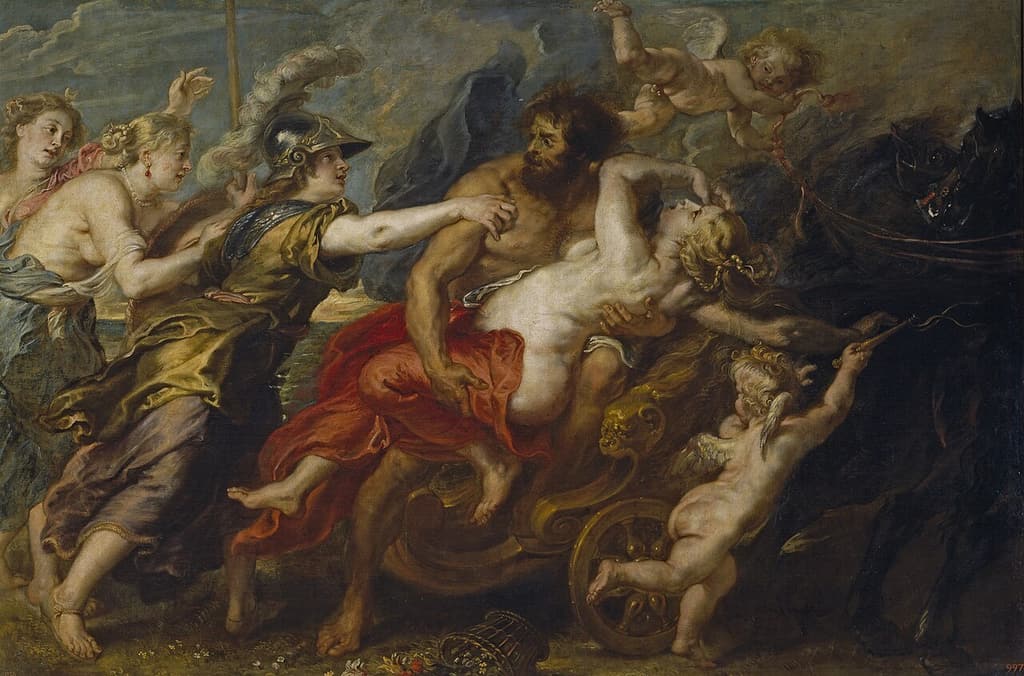
Greeks avoided saying his name. They called him Plouton, the rich one; Klymenos, the famous one; simply "the god below". When they swore by him they struck the ground rather than raising a hand to the sky. There were almost no temples to him, almost no festivals, and almost no myths — the abduction, and then a handful of appearances in which somebody comes to his kingdom and he lets them argue. That silence is not an absence of material. It is the material.
Not a devil
The single most necessary correction: Hades is not evil, is not a tempter, does not punish the wicked, and does not rule a place of torment. Greek religion has no Satan, and the god of the dead was not understood as an adversary of the other gods. He is Zeus' brother, allotted a share of the cosmos in a three-way division after the war with the Titans, and he administers it.
Punishment exists in his realm — Tantalus, Sisyphus, Ixion, the Danaids — but those are specific sentences on specific offenders, imposed for offences against the gods generally, and they are not what happens to ordinary dead people. The ordinary dead go to the asphodel meadow and continue in a diminished, shadowy condition. In the Odyssey, Achilles' shade tells Odysseus he would rather be a hired labourer for a landless man than king over all the dead. That is the standard Greek view of death, and it is not a punishment; it is simply the condition.
Christian tradition later used "Hades" to translate a Hebrew word for the grave, and medieval and Renaissance art then merged the classical god with the devil. Disney's Hercules, most video games, and a large fraction of modern fiction inherit that merger. It has no basis in Greek sources.
The abduction, and what the argument is about
The one substantial myth is the seizure of Persephone, told fullest in the Homeric Hymn to Demeter and later by Ovid. He rises through a fissure while she is picking flowers, takes her down, and her mother's search and refusal to let anything grow eventually force a settlement: she spends part of the year below and part above.
Two things about it are genuinely disputed, and both were disputed in antiquity.
Was it a marriage or a rape? The Hymn says Zeus gave her — that the arrangement was made between the brothers without consulting either mother or daughter — which by Greek marriage convention makes it a legitimate betrothal, since brides were given by fathers and not consulted. It also describes her screaming. Both are in the same poem. Greek sources contain both the legal framing and the violence, and any retelling that keeps only one is editorialising.
The pomegranate seeds. How many, and whether she ate them by trickery, differ between sources: the Hymn has one seed given secretly, later versions have four or seven, and the number determines the months. The story is doing calendrical work, and the versions do not agree on the arithmetic.
The full retelling of the story, from Demeter's side rather than the abduction scene, is on the myth page for it; this page is about the god.
The visitors
A small set of myths turn on someone coming down and dealing with him directly, and in every one of them he behaves reasonably.
- Orpheus plays, and Hades and Persephone are moved, and grant the return of Eurydice on a condition Orpheus breaks. He is not tricked into it and he does not renege.
- Heracles comes for Cerberus, and Hades permits it provided he takes the dog without weapons. Heracles wrestles it out.
- Sisyphus cheats death twice, including by instructing his wife not to bury him and then persuading Persephone to let him return to arrange it. He is punished for the fraud rather than for dying.
- Theseus and Pirithous come to abduct Persephone, which is the one attempt on his household. They are trapped in stone seats; Heracles later gets Theseus out and leaves Pirithous.
The pattern is a god who keeps his word, enforces his rules and does not leave his kingdom. His helmet of invisibility — used by Perseus, not by him — is a nice emblem for a deity whose defining feature is that he is not seen.
Plouton: the wealth is agricultural
The euphemism has substance behind it. What comes out of the ground is wealth: grain, metals, minerals. A god who owns everything below the surface owns the harvest's source as well as the dead, which is why he is depicted holding a cornucopia far more often than anything grim, and why his consort is the daughter of the grain goddess.
This is also why his few genuine cult sites look the way they do. Chthonic offerings went into a pit at night, burned entirely rather than shared at a feast — the opposite of Olympian sacrifice. Pausanias reports a sanctuary at Elis, opened once a year and entered only by the priest, which is about as close to a temple as he gets. At the Nekromanteion on the Acheron in Epirus, consultants of the dead went through a preparatory regime before descending into an underground chamber. And there were several ploutonia — cave mouths emitting carbon dioxide, notably at Hierapolis, where birds and animals brought to the opening died and priests apparently did not, which the ancients read as evidence and modern geologists read as a stratified gas layer.
Reading the geography
The kingdom's furniture is worth having straight, since sources use it loosely: five rivers, of which Styx is the one gods swear by and Acheron and Lethe the ones souls cross and drink; Charon the ferryman, who requires payment, which is why coins turn up in graves — though the practice is far less universal in the archaeology than the story implies; Cerberus at the gate, facing inward; and the judges Minos, Rhadamanthys and Aeacus, who sort rather than sentence.
The three-part division — Tartarus for the punished, the asphodel meadow for the ordinary, Elysium for the favoured few — hardens over time and is much clearer in later authors than in Homer, where the whole thing is bleak and undifferentiated. Elysium expands under the influence of mystery cults, which offered initiates a better outcome, and set against the Norse hall of the slain it turns out to work on completely different principles.
Why the silence
The most interesting question about Hades is why a god with such a large domain has such a small mythology. The likeliest answer is the one the naming taboo already suggests: attention was hazardous. You do not build a temple to the god of death in your city, you do not name him at dinner, and you certainly do not tell entertaining stories about him. Greek religion managed the dead through household rites, tomb offerings and specific festivals like the Anthesteria — where the dead were understood to walk, doors were smeared with pitch and the day ended by telling the spirits to go — rather than through a cult of their king.
Two questions this page settles
Is Hades the name of the god or the place?
Originally the god, and the place is "the house of Hades" — the possessive gets shortened until the name transfers. Greek writers use both, and by the classical period the usage is genuinely ambiguous. Latin picked up Pluto for the god and used inferi or Orcus for the place, which is a tidier distinction than the Greek ever had.
Did he have any children?
Almost none, and that is unusual enough to be worth noticing in a pantheon where every major god has a long list. Late and minor sources attach a few figures to him, but the mainstream tradition gives him a marriage and no offspring. A god of the dead who does not reproduce is thematically apt, and it also removes him from the genealogical politics that occupy the rest of the family.
Was he ever worshipped for anything positive?
Yes, under the Plouton name, in agricultural and wealth contexts, and at Eleusis he appears in a distinctly benign register alongside Persephone. Late antique sources also show a Plouton who receives ordinary prayers. The frightening version and the wealth-giving version are the same god addressed under different names, which is precisely the point of using a different name.