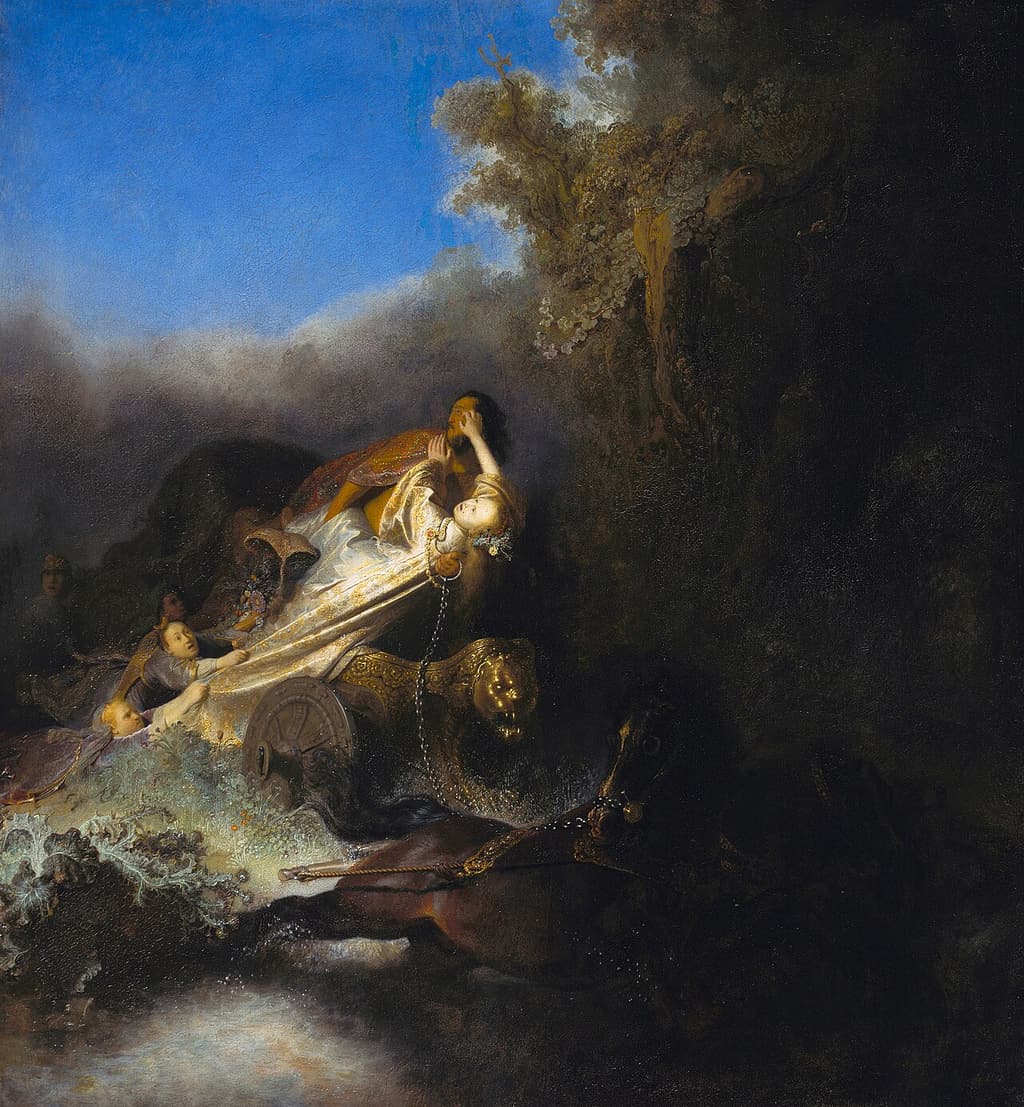
Most retellings open with the flowers and the chariot. This one opens nine days later, with a middle-aged woman walking a road in Attica carrying two burnt-down torches, because that is where the oldest surviving version spends most of its length. The Homeric Hymn to Demeter — anonymous, probably seventh century BCE, preserved by luck in a single damaged manuscript found in Moscow in 1777 — is not really about an abduction. It is about a mother's refusal to cooperate with the world, and what it costs everyone else.
What the mother heard
She heard a cry and nothing else. No witness came forward. Hecate, sitting in her cave, heard the girl call out but saw nothing; Helios, who sees everything by professional obligation, saw it and said nothing until asked. For nine days Demeter crossed the earth with a torch in each hand, eating nothing, drinking nothing, washing in nothing. On the tenth Hecate came to her with a light of her own and the two of them went to the sun.
Helios was blunt about it and, in his own view, kind. Hades had taken her. Zeus had given her. It was a good match — a third of the universe, a king for a husband — and Demeter should be reasonable. The hymn's poet gives Demeter no reply to this at all. She simply leaves the company of the gods, disguises herself as an old woman past childbearing, and walks away from the job.
The nurse at the well
She stopped at Eleusis and sat by the Maiden Well under an olive, and four daughters of King Celeus came out for water and found her there. She told them her name was Doso and that pirates had taken her from Crete and she had run. They took her home. In the doorway she grew tall and her head touched the roof beam and light came off her, and their mother Metaneira went cold with fear and offered her the good chair, which the goddess refused. She sat on a stool with a fleece over it and said nothing, and would not smile, until a serving woman called Iambe made a series of jokes coarse enough to break the silence. She refused wine and asked instead for barley and water with pennyroyal stirred in — the kykeon, which is also, and this is not a coincidence, what initiates would drink at Eleusis for the next twelve hundred years.
Metaneira gave her the baby, Demophoon, to nurse. The child grew like a god because he was being fed on nothing at all; the goddess breathed on him, anointed him with ambrosia, and at night buried him in the fire like a log. She was burning the mortality out of him. Metaneira, watching from the doorway one night, screamed.
That scream is the hinge of the whole poem. Demeter pulled the child out of the coals and put him on the floor and said the thing that everyone who reads the hymn remembers: mortals are fools, and they cannot tell good luck from bad when it arrives. She would have made him deathless. Now he would die like anyone. She revealed herself, ordered a temple built on the hill above the well, and went into it, and stayed there.
The year nothing grew
What follows is the earliest famine in Greek literature, and it is a strike, not a curse. Demeter simply stopped. Seed went into the ground and stayed there. Oxen dragged ploughs across fields that produced nothing. The hymn is explicit that the gods noticed only when the smoke of sacrifice stopped rising — humanity would have died out and the Olympians would have lost their income.
Zeus sent Iris. Demeter refused her. He sent every other god in turn with gifts and honours, and she refused all of them, and said she would not set foot on Olympus or let anything grow until she saw her daughter. So Zeus, who had arranged the marriage in the first place, sent Hermes down to ask for it to be unarranged.
Hades was courteous, which is the detail retellings usually cut. He told his wife to go, told her to think well of him, reminded her that she was queen of a third of everything and that those who wronged her would pay forever. And then, as she was getting into the chariot, he gave her something to eat. One pomegranate seed, in the hymn — given quietly, so that she would not stay above forever.
She came up. She ran to her mother. And the first question Persephone's mother asked her, before anything else, was whether she had eaten.
Where the versions come apart
The hymn and the Roman retellings do not tell the same story, and the differences are not decorative.
- The seeds. One in the Hymn to Demeter, and it is given to her rather than taken. Seven in Ovid's Metamorphoses 5, plucked and eaten in a garden while she wandered, with the underworld gardener's son Ascalaphus watching — for reporting it he is turned into a screech owl, a scene the Greek hymn has no room for. Apollodorus keeps it to one.
- The share of the year. The hymn gives Persephone a third below and two thirds above. Ovid halves it. The familiar six-months-six-months arrangement is Roman, not Greek, and it is the version that got into every schoolbook.
- Where it happened. The hymn says the Nysian plain and does not locate it on any map. Ovid puts it at Enna in Sicily, by the lake, with the nymph Cyane dissolving into her own pool trying to stop the chariot. Sicilian civic pride is doing real work there.
- Whether Zeus planned it. The hymn states flatly that the girl was given away by her father's design. Ovid supplies a different mechanism entirely: Venus, worried that a third of the world is escaping her jurisdiction, has Cupid shoot the lord of the dead. That converts a political marriage into an accident of passion, and it changes who is to blame.
- The Eleusis material. The nurse, the fire, the jokes, the stool — all of it is in the Greek hymn and essentially absent from Ovid, who is not writing a founding charter for a mystery cult and has no reason to care.
Why Eleusis paid for this poem
The hymn ends by naming the men Demeter taught her rites to, and by promising that whoever has seen them is blessed and whoever has not will never have the same portion in death. That is a sales pitch. The Eleusinian Mysteries ran annually for something like a millennium, admitted anyone who spoke Greek and had not committed murder — women, foreigners, the enslaved — and required silence about what happened inside. The silence held. We know the procession route from Athens, the fasting, the drink, the torches, and nothing reliable about the central revelation.
What the story gave initiates was not an explanation of winter. Greece's dead season is the dry summer, not the cold; the agricultural fit is loose and was probably never the point. What it gave them was a goddess who had lost a child to death and got most of her back, and a promise attached to that.
Afterwards, and elsewhere
The Roman version is the one that travelled. Ovid's Proserpina supplies Milton his image of the field of Enna, and through him nearly every English poem on the subject. Bernini's marble of the abduction in the Villa Borghese, carved when he was twenty-three, is Ovid's scene, not the hymn's. Modern retellings have swung hard toward Persephone's own account — Margaret Atwood, Rita Dove's Mother Love, and an entire webcomic-and-novel industry that reads Hades as a romantic lead. That reading has ancient warrant in the courtesy of the hymn's parting speech, and no warrant at all in the word the poem uses for what he did.
The name outlasted the cult. Kore, "the girl", is the title Athenians actually used for her in ritual, and it survives as a modern given name that most parents choosing it do not connect to a queen of the dead.
Questions this story keeps raising
Is Persephone the same figure as Kore? They are the same goddess under two names used for different situations. Kore, "girl", is what she is called in cult alongside her mother; Persephone is the name used for the queen below, and the Greeks themselves were unsure what it meant. Attic inscriptions frequently write "the two goddesses" rather than either name.
Did anyone in antiquity treat the story as literally seasonal? Some did, and said so — the allegorical reading is already present in later antiquity, with the grain buried and rising. But the mysteries do not appear to have taught it as an agricultural allegory, and Cicero, who was initiated, describes the benefit he took from Eleusis in terms of dying well rather than farming.
Is there any archaeological trace of the Eleusis sanctuary? A great deal. The Telesterion, the hall where initiates gathered, was rebuilt repeatedly from the Bronze Age onward and its foundations survive; so does the Ploutonion, a cave-mouth shrine that the site treated as the entrance the goddess came up through. The sanctuary was destroyed by Alaric's Goths in 396 CE and never reopened.
What happened to Demophoon? In the hymn, nothing further of consequence — he grows up mortal and the poem drops him. Later authors sometimes swap in Triptolemus as the child in the fire, which lets him become the hero who carries grain across the world in a winged chariot. The substitution is not in the hymn, where Triptolemus is simply one of the local nobles who receives the rites.
Related reading: the Greek tradition as a whole, who is descended from whom, and the descent of Inanna, the older Mesopotamian story of a goddess who goes below and must leave a substitute behind.