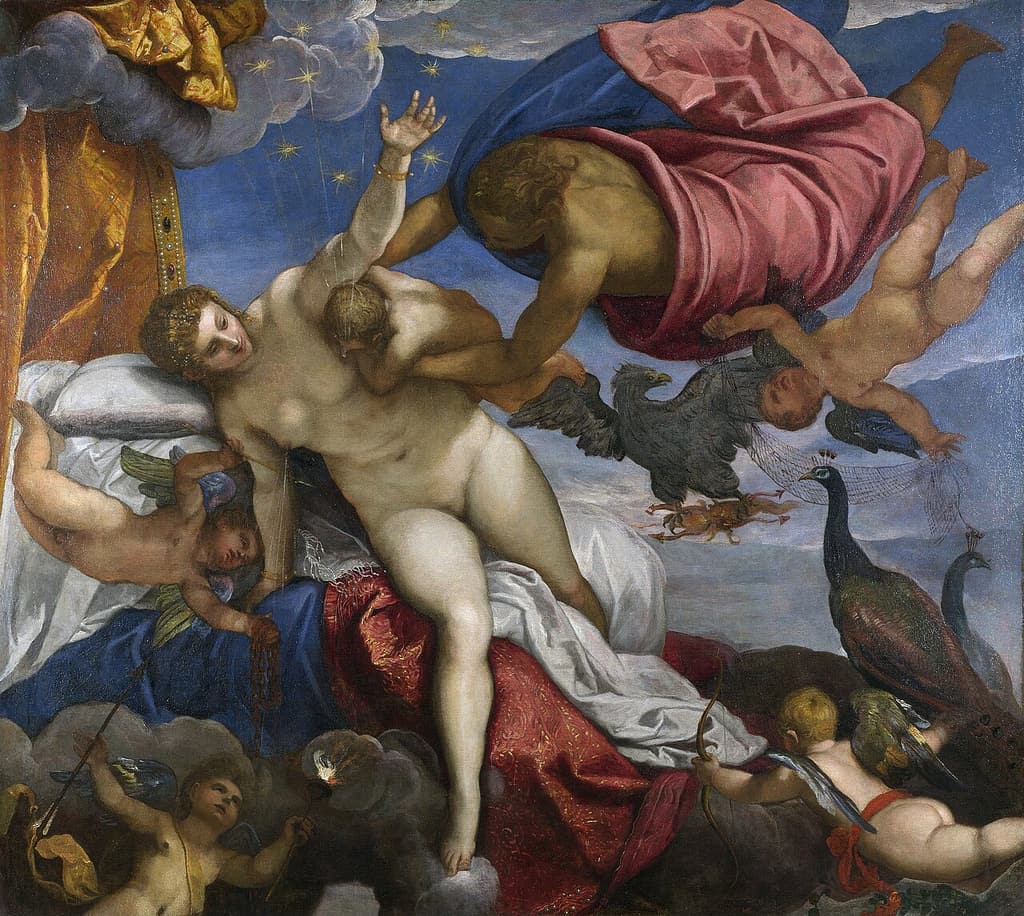
If you met Hera only in poetry you would think she was a minor character with a large grudge: the wife who spends the Iliad scheming against her husband and the Argonautica meddling on behalf of a favourite. If you met her only in the archaeological record you would conclude she was among the two or three most important deities in the Greek world. Her sanctuary on Samos and her sanctuary at Argos are older, richer and better attested than almost anything belonging to Zeus, and the great temples at Paestum in southern Italy were built for her, not for him. The distance between those two Heras is the most interesting fact about her, and it is not a puzzle that resolves — it is what happens when an established regional goddess is written into a pantheon as somebody's wife.
Argos, Samos, Paestum: the goddess of the great temples
Greek temple architecture arguably begins with her. The Heraion of Samos went through successive rebuildings from the eighth century BCE onward, one of them the first known Greek temple with a surrounding colonnade, and the votive deposits there are extraordinary — imported Egyptian and Near Eastern bronzes, wooden objects preserved in the wet ground, ivories, thousands of dedications. The Argive Heraion, on a terrace between Argos and Mycenae, was the political centre of the Argolid; Pausanias describes its seated cult statue of gold and ivory by Polykleitos, with a pomegranate in one hand and a sceptre topped by a cuckoo in the other, and says the priestess's years were used as a dating system for the whole region.
Her Samian rite included the Tonaia, in which the cult image was carried down to the shore, washed, and bound with withies of the lygos tree — the plant she was said to have been born under. Nobody has satisfactorily explained the binding. At Argos she was said to renew her virginity annually by bathing in the spring Kanathos, a rite Pausanias reports as a secret told to him. Both of these are the marks of a goddess with her own independent, pre-Homeric ritual life, and neither has any narrative connection to a marriage quarrel.
She is worshipped in three aspects at Stymphalos, according to Pausanias: Pais (girl), Teleia (fulfilled, that is, married) and Chera (widowed or separated). That triad is the real content of her patronage. She is not the goddess of weddings so much as the goddess of the whole arc of a woman's status — including its collapse.
What her name might mean, and why nobody is sure
Hera has resisted etymology harder than most divine names. Proposals include a connection to hora, "season" or "ripeness", making her something like the goddess of the right time for marriage; a link to heros, "hero"; a derivation from a root for "protector"; and the possibility that it is not Greek at all. She appears on Linear B tablets from Pylos as e-ra, paired with Zeus, so the pairing is Bronze Age. What she was before that pairing is exactly what the etymological argument is trying to reach, and it has not got there.
The Iliad's Hera, and why she hates Troy
Homer's characterisation is unflattering but not shallow. In Book 14 she borrows Aphrodite's embroidered strap, bathes and dresses, and seduces Zeus on Mount Ida solely in order to put him to sleep while the Greeks push the Trojans back — a set-piece of extraordinary craft in which the god of the world is defeated by his own wife's tactics. In Book 4 she says outright that Zeus may destroy any three cities she loves, Argos, Sparta and Mycenae, provided Troy falls. It is one of the coldest speeches in the poem.
Her hatred is usually traced to the judgement of Paris, in which the Trojan prince awarded the golden apple to Aphrodite over her and Athena. Homer alludes to that only once and briefly, near the end of the Iliad, which has made scholars suspect it was a well-known story he chose largely to leave alone. But notice which three cities she names as her own: Argos, Sparta, Mycenae. Her enmity with Troy has the shape of an Argive political tradition, not a beauty contest.
The persecutions, which are dynastic
The pattern of Hera against Zeus' other children and lovers is real and relentless, and it is worth reading as a genealogical argument rather than as temperament. She sends two serpents into the infant Heracles's cradle; she drives him mad so that he kills his own children, which is the crime his labours expiate; she delays Alcmene's labour by having Eileithyia sit with crossed legs and clasped hands until a servant tricks her. She forbids the whole earth to give Leto a place to bear Apollo and Artemis, which is why they are born on floating Delos. She turns Io into a heifer and sets the hundred-eyed Argos Panoptes to watch her, and when Hermes kills him she puts his eyes into the peacock's tail. She talks Semele into demanding that Zeus appear in his true form, which incinerates her.
Every one of those targets is a rival lineage: Theban, Delian, Argive, Boeotian. The wife's jealousy is the mythic form of a real contest between local traditions, each claiming the sky-god as an ancestor. Hera, who holds legitimate marriage, is the mechanism by which those claims get contested.
The disputed birth of Hephaestus
The list of her children looks simple — Ares, Hephaestus, Hebe, Eileithyia — and it is not. Hesiod's Theogony states that Hera bore Hephaestus without any father at all, in anger and in rivalry with Zeus, because he had produced Athena from his own head. Homer's Iliad, by contrast, has Hephaestus address Zeus as father and refer to a quarrel between his parents. These cannot be reconciled and there is no point pretending otherwise: the parthenogenetic version makes her a goddess capable of generation on her own terms, and the Homeric version makes her a wife. Later sources also credit her with bearing the monster Typhon alone, or with procuring him from Gaia, in the Homeric Hymn to Apollo — again as a retaliation for Athena's birth. The theme of a goddess who answers a motherless daughter with a fatherless son runs across several texts and belongs to her, whichever text you prefer.
She is also, in one Argive strand, the mother-in-law who eventually relents: Heracles marries Hebe on Olympus, which makes his persecutor his wife's mother, and reconciles the two lineages in a single stroke.
Cow-eyed, and the animals that stayed with her
Homer's fixed epithet for her is boopis, "cow-eyed" or "ox-eyed" — a formula so old that its literal sense had probably faded, but which links her to the cattle sacrificed to her in enormous numbers at the Argive Hekatombaia. The pomegranate in her Argive statue's hand belongs to marriage and to fertility, and to the underworld through Persephone; the cuckoo on the sceptre belongs to an Argive story that Zeus first approached her in the form of a bedraggled cuckoo which she took pity on and warmed at her breast. The peacock arrives later, with Argos Panoptes, and became her dominant attribute only in Roman and post-classical art — which is why Renaissance Juno has peacocks and archaic Hera does not.
Juno is a state, not a wife
The Roman Juno absorbed Hera's mythology wholesale, but her own functions came from elsewhere: Juno Moneta on the Capitol, whose sacred geese warned the city and whose temple housed the mint that gave English the word money; Juno Lucina, invoked in childbirth; Juno Sospita at Lanuvium in a goat-skin with a spear. As one of the Capitoline Triad with Jupiter and Minerva she is a goddess of Roman public order. Reading her back into Greek Hera flattens both.
The modern default, and what it inherits
Modern retellings — the Percy Jackson sequence, God-of-War-style games, most young-adult mythology fiction, the Wonder Woman films' occasional Olympians — have converged almost unanimously on Hera as antagonist: petty, vindictive, obstructive. That is Homer's Hera and Ovid's Juno, adopted without the cult that balanced them. The result is a goddess whom several thousand years of Greek women prayed to at the most consequential moments of their lives, remembered chiefly as a jealous spouse. Where modern writers have gone the other way, as in retellings that give the wronged wives of myth their own voice, the source material is still literary rather than religious. The Samian withy-binding remains almost entirely unused.
The Argive Heraion, and what she was when Zeus was not there
Was she ever worshipped apart from Zeus?
Routinely, and at her greatest sanctuaries she is the principal deity with Zeus barely present. Samos, Argos, Perachora and Paestum are all Hera sites first. There were also hieros gamos rites enacting the sacred marriage, at Argos and on Samos and Crete, so the pairing was ritually celebrated as well — but a Samian pilgrim was not visiting a consort's shrine.
Why is her Argive priestess used as a date?
Because Argos measured years by the tenure of the priestess of Hera the way Athens used its archons and Sparta its ephors. Thucydides dates the outbreak of the Peloponnesian War partly by the forty-eighth year of the priestess Chrysis' term. It is a direct measure of institutional weight: you do not run a civic calendar off a minor cult.
Did she have any children who mattered in cult?
Eileithyia, goddess of childbirth, is the significant one — she has her own cave sanctuary at Amnisos in Crete going back to the Bronze Age and is invoked independently of her mother. Hebe, cupbearer and goddess of youth, had a sanctuary at Phlius where Pausanias says fugitives could claim asylum and prisoners' released chains were hung in the grove.
What is the lygos tree about?
The chaste-tree, Vitex agnus-castus. Samian tradition held that Hera was born under one, and its branches bound her image during the Tonaia. The same plant was strewn on beds by women during the Thesmophoria of Demeter and was believed in antiquity to suppress sexual desire, which is a strange thing to associate with a marriage goddess and one of the better arguments that her Samian rite preserves something older than the Olympian marriage story.